Bearing Standards Reference: ISO 492:2023 | ABMA Standard 20 | ASTM A295 | ISO 281:2007 | DIN 620
Bearing standards are the foundation of quality and interchangeability in industrial procurement. When you source a bearing, the spec sheet lists a string of abbreviations—ISO P5, ABEC 3, ASTM A295, ANSI/ABMA 20. These aren’t marketing labels. They’re references to internationally recognized standards that define exactly how a bearing is built, how precisely it is made, and what materials it contains. Understanding these standards is essential whether you’re an engineer selecting bearings for a new design or a procurement manager qualifying a supplier.
This complete bearing standards guide breaks down the four major standards frameworks for bearings—ISO, ANSI/ABMA, ASTM, and DIN—and explains what each one actually controls. Whether you’re comparing ABEC grades, specifying chrome steel material requirements, or sourcing globally, this reference will help you make informed, confident decisions.
Why Bearing Standards Matter
Bearing standards exist to solve a fundamental problem in industrial procurement: bearing interchangeability. A 6205-2RS deep groove ball bearing purchased from a manufacturer in Germany must fit the same shaft and housing as an identical bearing from a supplier in Japan or the United States. Without uniform dimensional standards, every replacement would require re-engineering the surrounding components.
Standards for bearings cover three broad areas:
- Dimensional standards—bore diameter, outer diameter, width, and tolerances on each
- Precision/tolerance standards—how closely the manufactured bearing matches the nominal dimensions
- Material and performance standards—what the steel is made of, how it’s tested, and how long it should last
Each of the main bearing standards bodies addresses these areas differently. Understanding which standard governs which aspect helps you write better bearing purchase specifications and avoid costly sourcing errors. Following established bearing quality standards ensures consistent supplier qualification. See also our guide on Bearing Internal Clearance (C2, CN, C3, C4) for specifications that work alongside precision grades.
ISO Bearing Standards: The Global Baseline
The International Organization for Standardization (ISO) publishes the most widely adopted bearing standards worldwide. ISO bearing standards are the global benchmark for dimensional compatibility and precision tolerance classification. For any bearing purchased outside North America—and for most international trade—ISO is the reference framework.
Key ISO Standards for Rolling Bearings
The core ISO bearing standards for rolling bearings include:
ISO 15—Dimensions Series. Defines the basic boundary dimensions (bore, outer diameter, width) for radial rolling bearings. This is the foundation for interchangeability: an ISO 15-compliant 6205 bearing from any manufacturer will have a 25 mm bore, 52 mm OD, and 15 mm width.
ISO 281—Bearing Life Calculation. Defines the method for calculating basic rating life (L10)—the number of revolutions or hours that 90% of a batch of identical bearings will complete before the first sign of fatigue under a given load. ISO 281 introduced the modified life rating (Lnm) that accounts for lubrication, contamination, and material improvements. This is the standard your engineers use in bearing selection software.
ISO 492:2023—Radial Bearing Tolerances. Specifies the dimensional and geometric tolerances for radial bearings—a key bearing tolerance standard grouped into precision classes: Normal (P0), P6, P5, P4, and P2. Higher class numbers indicate tighter tolerances. The 2023 sixth edition added stiffness series data for tapered roller bearings and updated annex content—if your design references ISO 492:2014, it is worth checking whether the revision affects your tolerance specifications.
ISO 1132—Terminology. Establishes the vocabulary used across all other bearing standards. When a datasheet says “inner ring” or “raceway” it is using ISO 1132 definitions.
ISO 15312—Thermal Speed Rating. Provides the method for determining the thermal reference speed of rolling bearings—the speed at which heat generated by friction equals heat dissipated under standardized conditions. Relevant when specifying bearings for high-speed spindles or motor applications.
ANSI/ABMA Standards: The North American Framework
In the United States, ANSI bearing standards are coordinated between the American National Standards Institute (ANSI) and the American Bearing Manufacturers Association (ABMA). ANSI does not write bearing standards directly; instead, it approves standards developed by ABMA technical committees and adopts them as U.S. national standards.
The ABEC Precision Scale
The most widely cited ABEC bearing standard for precision is ABMA Standard 20, which defines the ABEC (Annular Bearing Engineers’ Committee) tolerance classes for ball bearings and RBEC classes for roller bearings. The table below now includes concrete bore tolerance values for a standard 25 mm bearing so you can see the real-world difference between grades:
| ABEC Grade | ISO Equivalent | Bore Tolerance (25mm) | Typical Application |
|---|---|---|---|
| ABEC 1 | P0 (Normal) | ±12 μm | General industrial machinery, conveyors, motors |
| ABEC 3 | P6 | ±8 μm | Electric motors, pumps, agricultural equipment |
| ABEC 5 | P5 | ±5 μm | Machine tool spindles, precision instruments |
| ABEC 7 | P4 | ±2.5 μm | High-speed spindles, robotics, aerospace |
| ABEC 9 | P2 | ±1.5 μm | Gyroscopes, ultra-precision instruments |
What ABEC Does NOT Control
ABEC bearing standards specify dimensional and geometric accuracy—they define the bearing precision grades that engineers reference on datasheets of the bearing rings. They do not cover:
- Internal clearance (specified separately, e.g., C3 or CN)
- Surface finish of the raceway
- Ball grade and roundness
- Noise and vibration levels
- Lubrication quantity and type
- Cage material and design
For applications where these factors matter—high-temperature motors, food-grade environments, ultra-low-noise applications—specify these requirements explicitly in addition to the ABEC bearing class. Understanding the full bearing specification beyond ABEC grades is essential for proper bearing selection. Our Deep Groove Ball Bearing specification guide covers these additional parameters in detail.
ASTM Standards: Materials and Testing
While ISO bearing standards and ANSI/ABMA focus on dimensions and tolerances, ASTM International (formerly the American Society for Testing and Materials) governs material composition and testing methods. ASTM standards tell manufacturers exactly what the steel is made of and how to verify it.
Critical ASTM Standards for Bearings
ASTM A295—Chrome Bearing Steel. The most important material standard for bearing rings and rolling elements. ASTM A295 defines the composition requirements for high-carbon chromium steel (equivalent to SAE 52100 / GCr15), including carbon content, chromium content, sulfur limits, and cleanliness requirements. When a product description says “chrome steel bearing,” ASTM A295 is the underlying specification.
ASTM A485—High Hardenability Bearing Steel. Used for large bearings and through-hardened applications where ASTM A295 does not provide sufficient hardenability for full-section heat treatment.
ASTM F2130—Fatigue Testing of Rolling Element Bearings. Standard test method for evaluating the fatigue life of rolling element bearings under controlled conditions. Used by manufacturers to validate rating life predictions.
ASTM F2488—Terminology for Rolling Element Bearings. Standardizes the definitions used in ASTM bearing test standards.
DIN Standards: The German Framework
DIN bearing standards are widely used in European manufacturing. The Deutsches Institut für Normung (DIN)—the German Institute for Standardization—maintains these roller bearing standards that underpin the European supply chain. The primary precision standard is DIN 620, which uses the same P-class nomenclature as ISO 492 (P0, P6, P5, P4, P2, P4P, P2P).
For most practical purposes, DIN and ISO bearing tolerances align closely, and bearings marked to DIN 620 precision classes are considered equivalent to the corresponding ISO 492 class. If you are sourcing from German or European manufacturers, you will see DIN 620 references rather than ABEC grades on datasheets. Both frameworks are equivalent bearing tolerance standards for precision classification. Browse our cylindrical roller bearings for examples of DIN 620-compliant products.
The JIS B1514 standard (Japanese Industrial Standards Association) follows the same P-class structure and is the equivalent framework for bearings manufactured in Japan by SKF, NSK, NTN, JTEKT, and Nachi.
Standards Comparison: ABEC vs. ISO vs. DIN vs. JIS
This bearing standards comparison table shows the equivalence between the major precision standards for rolling bearings. This equivalence is critical when sourcing across regions—an ABEC 3 bearing from a North American supplier and a P6-class bearing from a European or Asian manufacturer should meet the same dimensional tolerance requirements.
| Precision Level | ABEC (USA) | ISO 492 | DIN 620 | JIS B1514 | Typical Use Case |
|---|---|---|---|---|---|
| Standard | ABEC 1 | P0 / Normal | P0 | Class 0 | General industrial machinery, conveyors, motors |
| Medium precision | ABEC 3 | P6 | P6 | Class 6 | Electric motors, pumps, agricultural equipment |
| High precision | ABEC 5 | P5 | P5 | Class 5 | Machine tool spindles, precision instruments |
| Very high precision | ABEC 7 | P4 | P4 | Class 4 | CNC spindles, robotics, aerospace |
| Ultra precision | ABEC 9 | P2 | P2 | Class 2 | Aerospace, gyroscopes, ultra-precision |
How to Use Bearing Standards in Procurement
Understanding bearing standards is only useful if it translates into better buying decisions. Here is a practical four-step framework for using standards in your procurement specifications.
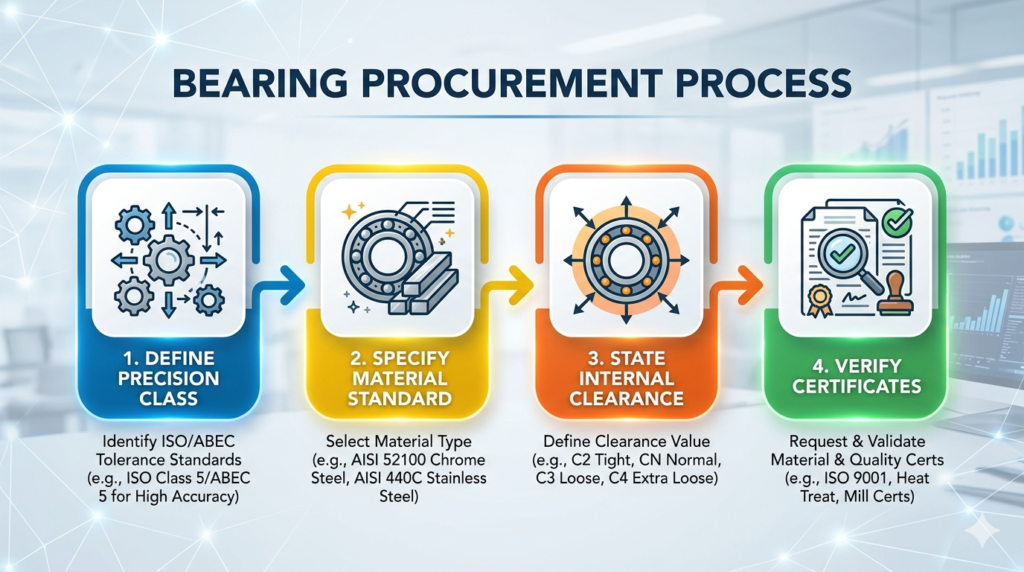
Step 1: Define the Precision Class You Actually Need
Use this bearing selection guide to match precision class to application:
- General machinery (conveyors, fans, pumps): ABEC 1 or ABEC 3 / ISO P0 or P6
- Industrial electric motors: ABEC 3 / ISO P6
- Precision machine tools and CNC spindles: ABEC 5 or ABEC 7 / ISO P5 or P4
- Aerospace, medical, scientific instruments: ABEC 7 or ABEC 9 / ISO P4 or P2
Step 2: Specify the Material Standard
For chrome steel bearings, require ASTM A295 bearing material standard or ISO 683-17 compliance. Specifying the correct bearing material standard ensures durability and fatigue life. If corrosion resistance is needed, specify stainless steel (AISI 440C / ISO 683-17 Class 6) or ceramic-coated variants. Always request a material certificate (mill cert) to confirm steel composition meets the standard.
Step 3: State Internal Clearance Separately
Precision class and internal clearance are independent bearing specifications. A C3 clearance (greater than standard) is often combined with standard ABEC 1 or ABEC 3 bearings for applications with interference fits or thermal expansion during operation. See our Bearing Internal Clearance Guide for the full breakdown of C2, CN, C3, and C4 classes.
Step 4: Verify—Don’t Assume
Bearing standards compliance should be supported by test certificates or material certificates from the manufacturer. Verifying bearing quality standards protects your supply chain. For critical applications, request:
- Material Certificate (chemical composition to ASTM A295 or ISO 683-17)
- Dimensional Inspection Report (bore, OD, width, runout to ABEC/ISO class)
- Hardness Test Certificate (HRC or HV, zone by zone)
- Noise/vibration test report for electric motor or precision spindle applications
Summary: Choosing the Right Bearing Standards for Your Application
Selecting the correct bearing standards is a critical step in bearing specification and procurement. Whether you reference ISO 492 for global sourcing, ANSI/ABMA 20 for North American ABEC bearing grades, ASTM A295 for chrome steel material requirements, or DIN 620 for European manufacturing, each bearing quality standard serves a specific purpose in ensuring bearing interchangeability and reliable performance.
For most bearing selection decisions, matching the precision class to the application requirement and verifying material compliance through certificates will prevent costly specification errors. Consult our bearing tolerance chart and bearing selection guide for detailed dimensional data, or browse our product catalog for bearings manufactured to these international bearing standards.
FAQ: Standards for Bearings
What is the most important bearing standard for international trade?
ISO standards are the foundation for international bearing trade and the most universally accepted bearing quality standards worldwide. ISO 15 governs boundary dimensions and ISO 492 governs tolerance classes. Bearings manufactured to ISO standards can be directly substituted between suppliers from different countries, which reduces supply chain risk and simplifies technical communication across borders.
What is the difference between ABEC 1 and ABEC 3 bearings?
Both are standard commercial-grade bearing tolerance classes suitable for general industrial applications. ABEC 3 specifies tighter tolerances on bore diameter, outer diameter, and ring width than ABEC 1. The practical difference in most industrial applications is small; ABEC 3 is often selected for electric motors where slightly better runout characteristics are beneficial without the cost premium of ABEC 5 or higher.
Are ISO P5 and ABEC 5 the same thing?
For the dimensional tolerances they govern—bore diameter, outer diameter, and ring width—ISO P5 and ABEC 5 are equivalent under these harmonized bearing standards. However, the standards are not identical documents. For applications in regulated industries where the specific standard must be cited (aerospace, medical, defense), verify which standard your customer or certifying body requires.
Does a higher ABEC rating mean a longer bearing life?
Not necessarily. ABEC bearing standards control dimensional tolerances, not material quality, surface finish, ball grade, or lubrication. Two bearings with the same ABEC rating from different manufacturers can have significantly different service lives depending on steel cleanliness, heat treatment, and manufacturing process control. Bearing life is calculated using ISO 281 and depends on load, speed, and lubrication—not precision class.
What does SAE 52100 mean on a bearing datasheet?
SAE 52100 is the American designation for high-carbon chromium bearing steel and a key bearing material standard, the most common material for bearing rings and rolling elements. The equivalent international designations are GCr15 (China/GB standard) and 100Cr6 (European/DIN). The material composition requirements are defined in ASTM A295 (USA) and ISO 683-17 internationally.
Can I mix bearings from different bearing standards systems on the same shaft?
Yes, in most cases. Because ABEC, ISO P-class, DIN, and JIS bearing precision grades are harmonized at the same precision levels (e.g., ABEC 5 ≈ ISO P5 ≈ DIN P5 ≈ JIS Class 5), bearings from different standards frameworks at equivalent grades will share the same shaft and housing dimensions. Always confirm against the tolerance tables in each applicable standard before mixing for precision or regulated applications.
Ready to find bearings that meet these standards?
Browse our selection of Deep Groove Ball Bearings and Cylindrical Roller Bearings, all manufactured to ISO and ABEC specifications. Every product ships with material certificates and dimensional inspection reports.