Proper bearing mounting techniques are essential for maximizing the service life and performance of any rotating machinery. Incorrect installation is one of the most common causes of premature bearing failure, accounting for an estimated 16% of all bearing-related breakdowns. Whether you are installing a 6202 ZZ deep groove ball bearing or a larger industrial roller bearing, understanding the correct bearing mounting techniques for your specific application can mean the difference between years of reliable operation and costly downtime. This guide covers the fundamental bearing mounting techniques used across industrial maintenance, from press fitting and shrink fitting to mechanical tool procedures and alignment best practices. Per SKF bearing mounting guidelines, proper installation procedure is the single most controllable factor in determining bearing service life.
What Are Bearing Mounting Techniques?
Bearing mounting techniques refer to the methods and procedures used to install a bearing onto a shaft and into its housing correctly. The choice of technique depends on several factors: the bearing type and size, the fit classification (clearance fit, interference fit, or transition fit), the housing material, and the operating conditions the bearing will face. For deep groove ball bearings like the 6202 ZZ, which has a 15 mm bore diameter and 35 mm outside diameter, proper mounting is critical to maintain the internal clearance and prevent raceway damage.
The three primary bearing mounting approaches are press fitting (cold mounting), shrink fitting (heat mounting), and mechanical tool mounting. Each method has specific applications, advantages, and precautions. Selecting the wrong technique can introduce misalignment, brinelling, or excessive preload — all of which shorten bearing life.
For a complete overview of fit types and their implications, see our Deep Groove Ball Bearings category page, which covers standard dimension series and recommended fits.
Press Fit Bearing Mounting
Press fitting is the most common bearing mounting technique for smaller bearings, including the 6202 ZZ. In this method, force is applied to press the bearing onto the shaft or into the housing. The key principle of this bearing mounting technique is that the mounting force must never pass through the rolling elements. Force applied through the balls creates brinelling (permanent indentations on the raceways) that generates vibration and noise during operation.
Shaft Mount (Inner Ring Interference Fit)
When mounting a bearing onto a shaft with an interference fit, the mounting force must be applied to the inner ring face only. Use a cylindrical sleeve or a bearing mounting tool that contacts the inner ring uniformly. For 6202 ZZ bearings with standard P0 tolerance, the recommended shaft fit is typically j6 or k6, providing a light interference that prevents the inner ring from creeping on the shaft during rotation.
Housing Mount (Outer Ring Interference Fit)
If the interference fit is on the outer ring — for example, when installing into a housing bore — the force must be applied to the outer ring face. A tubular drift matching the outer ring diameter distributes the load evenly around the full circumference. Never strike the bearing directly with a hammer; always use a mounting sleeve or arbor press.
Correct and incorrect force application during press fit bearing mounting. Force should always be applied directly to the ring being mounted, never through the rolling elements.
Arbor Press vs. Hammer Mounting
An arbor press is strongly preferred over hammer-and-drift methods. Hand-operated or hydraulic arbor presses provide controlled, steady force that reduces the risk of cocking the bearing at an angle. These bearing mounting techniques produce more consistent results than manual methods. If a hammer and drift must be used (field repairs with limited tooling), use a brass or copper drift — never steel — and tap alternately at 180-degree positions around the ring to keep the bearing square to the shaft.
Shrink Fit and Heat Mounting
For larger bearings or tighter interference fits, press fitting may require excessive force. In these cases, shrink fitting (heating the bearing or cooling the shaft) is the preferred bearing mounting technique. Differential thermal expansion allows the bearing to slide into position without force, then locks it in place as temperatures equalize. This bearing mounting technique is widely used for larger deep groove and roller bearings where press-fit forces would be impractical.
Induction Heating
Induction heaters are the fastest and most controlled method for heating bearings during mounting. They use an alternating magnetic field to heat only the inner ring, leaving the outer ring and rolling elements at a lower temperature. This minimizes the risk of damaging the grease or seals. Most induction heaters have built-in temperature controls to ensure the bearing does not exceed 110°C (230°F) — the maximum safe temperature for standard grease-lubricated shielded bearings like the 6202 ZZ.
Oil Bath Heating
An oil bath is a traditional method for heating bearings. The bearing is suspended in clean mineral oil heated to 80-100°C. Key precautions include using a dedicated heating tank (never a container used for cooking), supporting the bearing off the tank bottom to avoid localized overheating, and never using an open flame. After heating, the bearing is removed with clean gloves and mounted quickly onto the shaft before it cools.
Shaft Cooling Method
An alternative approach for shaft-mounting is to cool the shaft using dry ice (solid CO₂, -78°C) or liquid nitrogen (-196°C). The shaft contracts, allowing the bearing to slide on with minimal force. This method requires proper safety equipment — cryogenic gloves, face shield, and ventilation — as direct contact with cryogenic materials can cause severe frostbite.

Bearing fit classification diagram. The choice between clearance, transition, and interference fit depends on the bearing type, load conditions, and which ring rotates.
Mechanical Mounting Tools and Procedures
Beyond basic press fit and heat methods, several specialized tools facilitate proper bearing mounting techniques across different operating environments. Selecting the right tool for the job is a critical part of professional bearing mounting techniques.
Bearing Mounting Sleeves (Drifts)
Mounting sleeves are tubular tools with a machined face that contacts the bearing ring precisely. They distribute the mounting force evenly around the ring circumference, preventing localized stress. A basic mounting sleeve set covering common bearing sizes (including 15 mm bore for 6202 ZZ) is an essential investment for any maintenance workshop.
Hydraulic Nut and Oil Injection
For larger cylindrical bore bearings, hydraulic nuts provide controlled axial force for mounting and dismounting. Oil injection systems force high-pressure oil between the shaft and inner ring to create an oil film that reduces friction during mounting. While less common for small deep groove bearings like the 6202 ZZ, these are standard techniques for larger spherical and cylindrical roller bearings.
Bearing Pullers for Dismounting
Correct bearing mounting techniques are mirrored by proper dismounting methods. Mechanical pullers (two-jaw or three-jaw) grip the inner ring and apply even withdrawal force. For bearings that will be reused, use a puller that engages the inner ring only; pulling on the outer ring transmits force through the balls and damages the raceways.
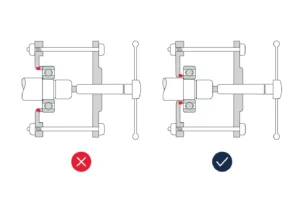
Proper alignment and bolt tightening sequence during bearing mounting. A cross-tightening pattern ensures even clamping force and prevents housing distortion.
Shaft and Housing Preparation
Before any bearing mounting technique can be applied, the shaft and housing surfaces must be properly prepared. Contamination, surface defects, and incorrect dimensions are among the most common causes of mounting failure.
Surface Inspection and Cleaning
The shaft journal and housing bore must be cleaned of all burrs, nicks, rust, and machining debris. Use a fine stone or emery cloth to remove raised burrs, then clean with a lint-free cloth and solvent. Even small particles trapped between the bearing ring and its mounting surface can cause the ring to distort, leading to premature fatigue failure. Proper surface preparation is a prerequisite for all bearing mounting techniques.
Dimensional Verification
Measure the shaft diameter and housing bore with a micrometer or bore gauge at multiple points (minimum three positions around the circumference). Compare against the recommended fit tolerances: for a 6202 ZZ bearing with a 15 mm bore, the ISO fit recommendations under normal load conditions are typically:
| Component | Recommended Fit | Diameter Tolerance (ISO) |
|---|---|---|
| Shaft (rotating inner ring) | j6 or k6 | 15.000 to 15.012 mm |
| Housing (stationary outer ring) | H7 | 35.000 to 35.025 mm |
Lubrication Before Mounting
Apply a thin film of clean oil to the shaft journal and housing bore before mounting. This reduces the force required during press fitting and helps prevent galling between the bearing ring and shaft surface. Use the same type of oil as the bearing’s operating lubricant where possible, or a lightweight machine oil compatible with the bearing grease. This simple step applies across all bearing mounting techniques and is often overlooked.
Common Bearing Mounting Mistakes to Avoid
Even experienced technicians can make errors during bearing mounting. Awareness of these common pitfalls helps ensure your bearing mounting techniques deliver reliable, long-lasting results. For comprehensive reference, the NSK bearing mounting guide provides detailed procedures for each bearing type and fit class.
- Applying force through the wrong ring — Always apply mounting force to the ring with the interference fit. Pressing through the rolling elements causes irreversible brinelling damage.
- Using excessive force — If a bearing does not slide on with reasonable pressure, stop and check dimensions. Forcing a bearing onto an oversized shaft creates hoop stress that reduces internal clearance and causes overheating.
- Overheating during heat mounting — Never exceed 110°C for grease-packed shielded bearings. Higher temperatures degrade the grease and can damage the shield seals. For open bearings, the maximum is typically 120°C.
- Misalignment at insertion — Cocking the bearing during mounting creates an angled installation that generates uneven load distribution and vibration. Always start the bearing square to the shaft and check alignment after the first few millimeters of travel.
- Contaminated mounting environment — Dust, metal filings, and moisture introduced during mounting will circulate through the bearing during operation, accelerating wear. Always work in a clean area and keep the bearing in its packaging until immediately before mounting.
For a deeper understanding of how incorrect installation affects bearing health, refer to our 6202ZZ Deep Groove Ball Bearing product page, which includes detailed specifications and application guidance.
Best Practices for 6202 ZZ Bearing Mounting
The 6202 ZZ bearing is a single-row deep groove ball bearing with metal shields on both sides. Its 15 × 35 × 11 mm dimensions make it a common size in electric motors, power tools, pumps, and light industrial machinery. Applying correct bearing mounting techniques to this specific bearing type requires attention to a few particular considerations.
Handling the ZZ Shields
The metal shields on the 6202 ZZ are non-contact seals that retain grease and exclude coarse contaminants. During mounting, avoid pressing directly on the shield surface — the thin metal can deform and contact the rolling elements, creating drag and noise. Always apply mounting force to the inner or outer ring face, never to the shield.
Recommended Mounting Method
For most 6202 ZZ applications, cold press mounting using an arbor press and a properly sized mounting sleeve is the preferred technique. The small size of the 6202 ZZ means induction heating is rarely necessary unless the shaft fit is unusually tight. If using heat mounting, limit the temperature to 100°C maximum to protect the factory grease charge.
Post-Mounting Check
After mounting, rotate the bearing by hand to check for smooth, quiet rotation. Any roughness, binding, or noise indicates a mounting problem — remove the bearing and re-inspect the shaft and housing dimensions. Check the axial and radial runout with a dial indicator where precision is critical.
For a full listing of compatible bearing types and sizes, explore our Deep Groove Ball Bearings collection, which includes 6200-series bearings from 10 mm to 30 mm bore diameters.
Frequently Asked Questions
What is the most common bearing mounting technique used in industrial maintenance?
Press fitting (cold mounting) using an arbor press and a correctly sized mounting sleeve is the most widely used bearing mounting technique for bearings up to approximately 100 mm outside diameter. It is simple, cost-effective, and does not require specialized heating equipment.
Can I use a hammer to install a bearing on a shaft?
Using a hammer directly on a bearing is never recommended. If no arbor press is available, use a brass or copper drift against the inner ring face and tap alternately at 180-degree intervals. Never strike the outer ring, shields, or seals. For best results, use a proper bearing mounting tool set.
How hot can I heat a 6202 ZZ bearing during shrink fitting?
The maximum safe temperature for a 6202 ZZ bearing with factory grease and metal shields is 110°C (230°F). Above this temperature, the grease degrades and the shield retaining compound may weaken. For open bearings without seals, the limit is approximately 120°C. Induction heating is the preferred method as it heats only the inner ring.
What happens if I mount a bearing with excessive interference fit?
Excessive interference fit reduces the bearing’s radial internal clearance (clearance reduction), which can cause the bearing to run hot, generate noise, and fail prematurely. For a 6202 ZZ bearing with normal CN clearance, a shaft fit tighter than k6 may eliminate the internal clearance entirely under operating conditions.
How do I know if a bearing was mounted incorrectly?
Signs of incorrect bearing mounting include: noise or vibration during operation, overheating at the bearing location, uneven wear patterns on raceways, brinelling (visible indentations on the raceway at ball spacing), and premature fatigue failure. Regular vibration analysis and temperature monitoring can detect mounting-related issues before catastrophic failure occurs.
Conclusion
Mastering proper bearing mounting techniques is one of the most impactful skills in industrial maintenance. Whether you choose press fitting, heat mounting, or a specialized mechanical tool approach, the fundamental principles of good bearing mounting techniques remain the same: apply force only to the ring being mounted, keep everything clean and properly aligned, and verify dimensions before installation. By following the bearing mounting techniques outlined in this guide, you can significantly extend the service life of 6202 ZZ bearings and other deep groove ball bearings in your equipment.
Need high-quality deep groove ball bearings for your application? Browse our Deep Groove Ball Bearings collection or contact our team for technical assistance with bearing selection and mounting recommendations.