Choosing the right bearing clearance is one of the most overlooked decisions in rotating machinery — and one of the most damaging to get wrong. A bearing with too little internal play can overheat, vibrate, and seize within days; one with too much runs noisy, loses stiffness, and wears unevenly. This bearing clearance guide explains what internal clearance is, how the ISO 5753-1 clearance groups — C2, C3, C4, and Normal (CN) — differ, and how to choose the correct bearing clearance class for your application, whether you are a design engineer, a maintenance technician, or a buyer sourcing replacement bearings.
What Is Bearing Clearance and Why It Matters
Bearing clearance is the total internal play between the rolling elements and the raceways, measured with no external load applied. In a deep groove ball bearing it is the sum of the diametral gaps at both contact points: the distance the outer ring can move radially relative to the inner ring before the balls touch the raceways. Cylindrical and spherical roller bearings use the same concept, with larger nominal values because line-contact rollers are more sensitive to clearance loss.
Radial clearance controls the size of the loaded zone — the arc over which the rolling elements actually carry the load:
- Smaller clearance — more balls share the load, giving higher stiffness, quieter running, and longer fatigue life.
- Zero or negative clearance (preload) — the rolling elements jam; the bearing overheats, vibrates, and can seize.
- Excessive clearance — only a few balls carry the load, so the bearing skids, generates noise, and fails early.
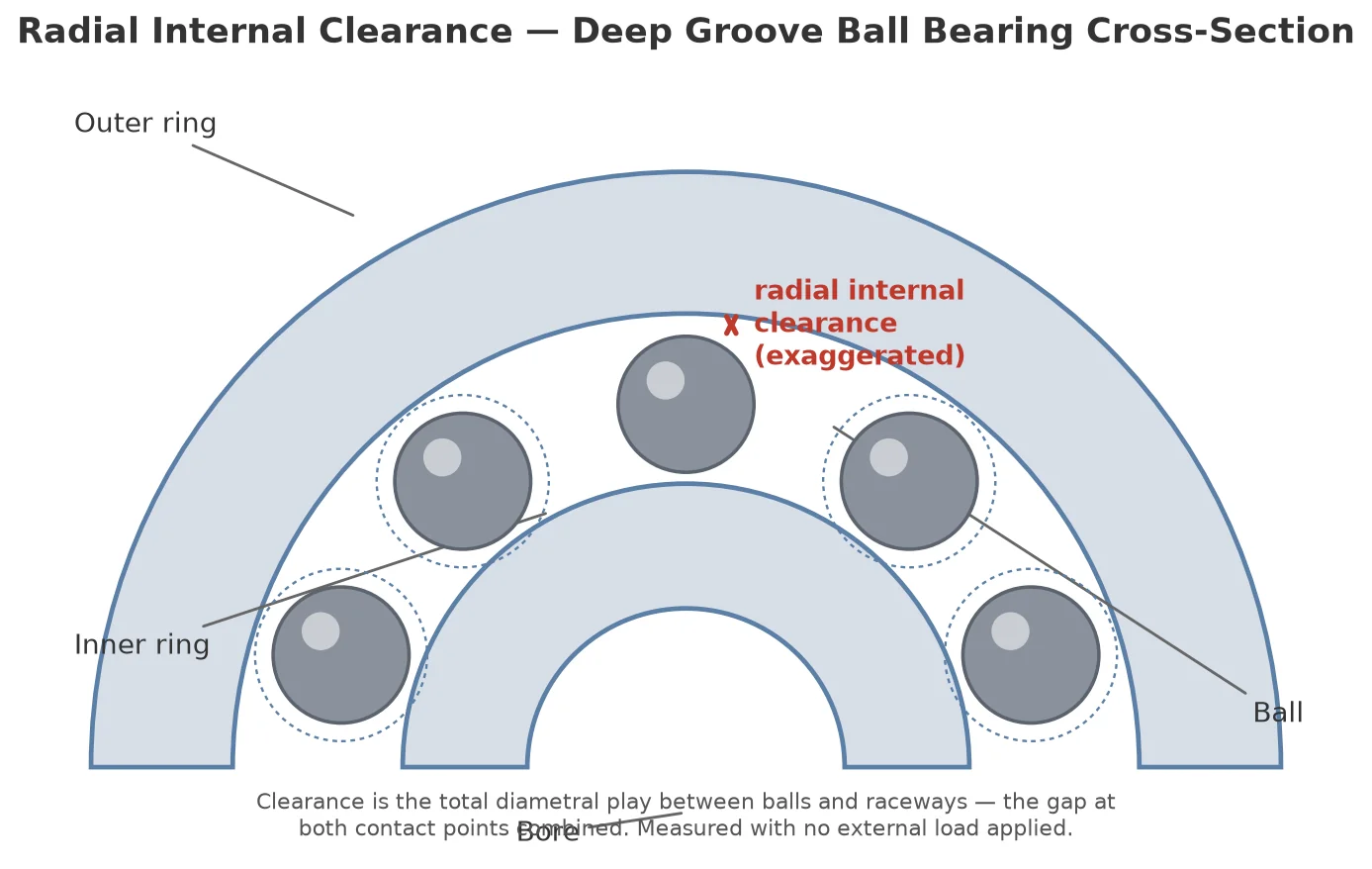
The figure above shows the gap that clearance describes. The critical point: the clearance class printed on the box is the bearing clearance measured at the factory. What actually governs performance is the operating clearance that remains after the shaft fit and operating temperature have consumed part of it:
Operating clearance = initial clearance − interference fit loss − temperature differential loss
Getting the initial group right means accounting for those two losses before they happen — which is exactly why C3 exists.
Bearing Clearance Groups: C2, C3, C4, and Normal (CN)
ISO 5753-1 defines five radial bearing clearance groups, in ascending order of internal play:
C2 < CN (Normal, also called C0) < C3 < C4 < C5
- C2 — smaller than Normal. Used where a deliberately small clearance or near-preload is wanted (precision spindles, high-speed low-load positions).
- CN / C0 (Normal) — the default group. Suits the majority of applications: steel shaft and housing, room-temperature operation, light to moderate loads.
- C3 — greater than Normal. The standard choice when an interference fit and/or a temperature differential will consume clearance in service (motors, pumps, gearboxes).
- C4 — greater than C3. For heavy interference plus high temperature, or shock-loaded positions (large motors, vibrating screens).
- C5 — greater than C4. Extreme heat or heavy interference, typical of kilns, paper machines, and rolling mills.
Suffix notation varies slightly by manufacturer but means the same thing: 6205 C3, 6205/C3, and 6205.C3 all specify the C3 group. A shielded variant is written 6205-2RS C3. The group ladder and values follow ISO 5753-1 and are documented in the same form in manufacturer references such as SKF’s bearing internal clearance overview and NSK’s rolling bearing catalog.
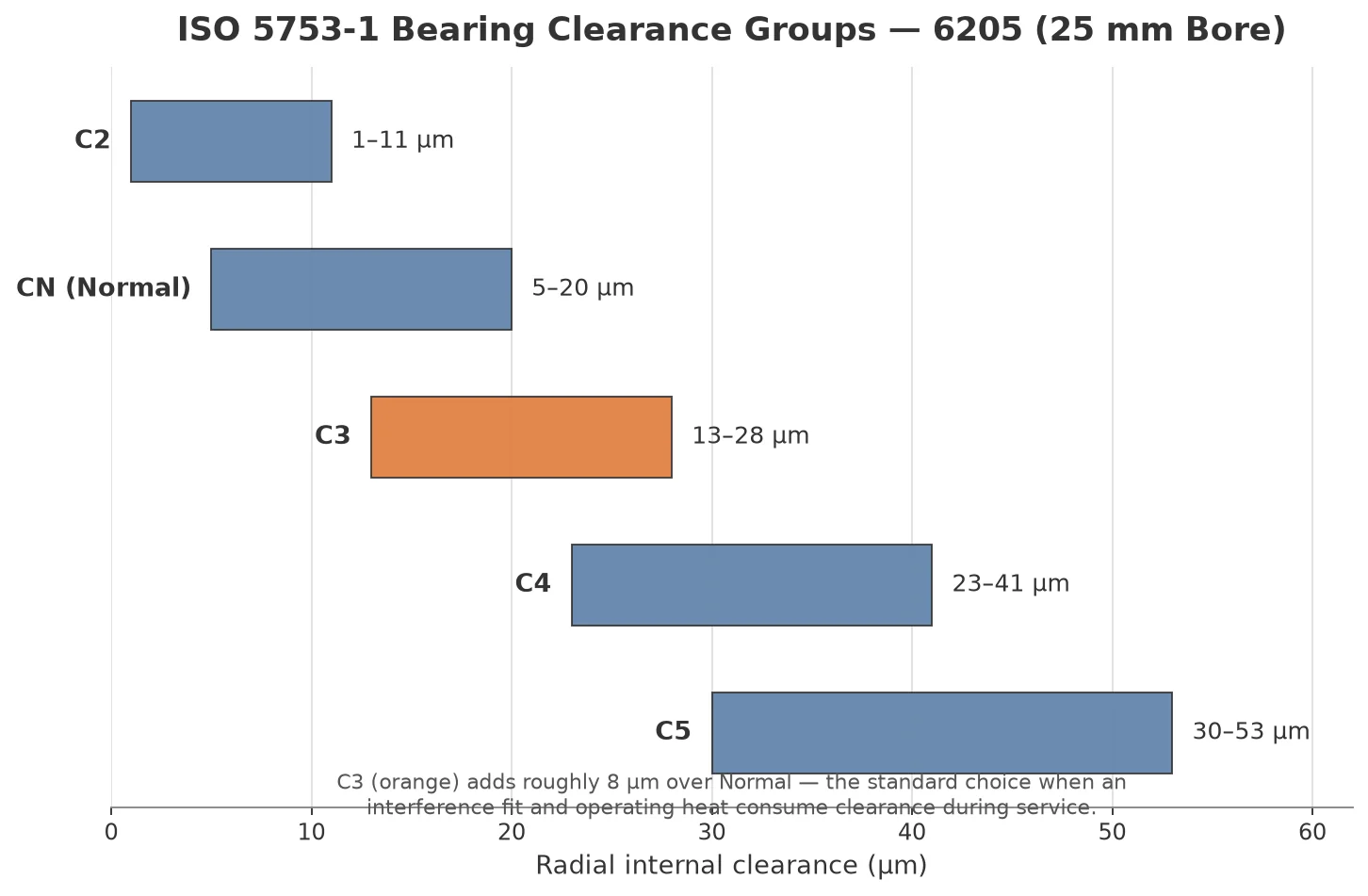
Two points are worth stating plainly, because they are the source of most bearing clearance confusion. First, the clearance group has nothing to do with precision class: ISO 492 tolerance grades (P0, P6, P5, P4) govern dimensional accuracy and runout, while ISO 5753-1 governs internal play. A C3 bearing is not “higher precision” and carries no higher load rating — it simply has more internal space. Second, clearance is set at the factory before seals or shields are fitted; on sealed bearings, manufacturers often apply a slightly reduced table, so confirm the value in the catalog rather than assuming.
The table below gives the ISO 5753-1 radial bearing clearance values for deep groove ball bearings in micrometres (μm; 1 μm = 0.001 mm):
| Bore d (mm) | C2 (μm) | CN (μm) | C3 (μm) | C4 (μm) | C5 (μm) |
|---|---|---|---|---|---|
| >10 – 18 | 0–9 | 3–18 | 11–25 | 18–33 | 25–45 |
| >18 – 24 | 0–10 | 5–20 | 13–28 | 20–36 | 28–48 |
| >24 – 30 | 1–11 | 5–20 | 13–28 | 23–41 | 30–53 |
| >30 – 40 | 1–11 | 6–20 | 15–33 | 23–41 | 30–53 |
| >40 – 50 | 1–11 | 6–23 | 18–36 | 28–46 | 35–59 |
| >50 – 65 | 1–15 | 8–28 | 20–41 | 30–51 | 41–64 |
| >65 – 80 | 1–15 | 10–30 | 23–46 | 38–61 | 48–76 |
| >80 – 100 | 1–18 | 12–36 | 25–53 | 41–66 | 53–84 |
| >100 – 120 | 2–20 | 13–41 | 30–61 | 48–79 | 61–94 |
As an example, a 6205 (25 mm bore) ships with 5–20 μm in Normal and 13–28 μm in C3 — about 8 μm more internal space. Talos supplies every ISO 5753-1 group; standard stock is CN (C0), and C3 is the most frequently requested variant for motor and pump applications.
What Consumes Bearing Clearance in Service
Two losses dominate bearing clearance selection. Understanding them turns “which group?” from a guess into a calculation.
1. Interference fit loss
When the inner ring is pressed onto the shaft with an interference fit (the standard k6/m6 recommendation for rotating loads), the ring stretches outward and consumes radial clearance — roughly 60–80% of the interference value on a solid shaft. A 6205 on a k6 shaft carries about 13 μm of average interference, so 8–11 μm of clearance disappears at assembly. The same logic applies to outer rings pressed into housings. Fit selection is covered in detail in our bearing shaft fit tolerance guide — clearance and fit must always be specified together, never independently.
2. Temperature differential loss
In service, the inner ring usually runs hotter than the outer ring — motor rotor heat conducts down the shaft, pump housings transfer process heat. The hotter inner ring expands and eats clearance:
ΔC ≈ 0.0117 × ΔT (°C) × d_m (mm), where d_m is the bearing mean diameter (d + D) / 2
For a 6205 (mean diameter 38.5 mm) running with a 15 °C inner-to-outer ring differential, that is roughly 7 μm of clearance loss — on top of the 8–11 μm from the fit. Note that the temperature term scales linearly with size: a large motor bearing loses two or three times as much clearance to heat as a small one, which is why large machines are almost always C3 or C4 regardless of anything else. Manufacturers document the same loss physics in their engineering manuals — see SKF’s guidance on selecting internal clearance.
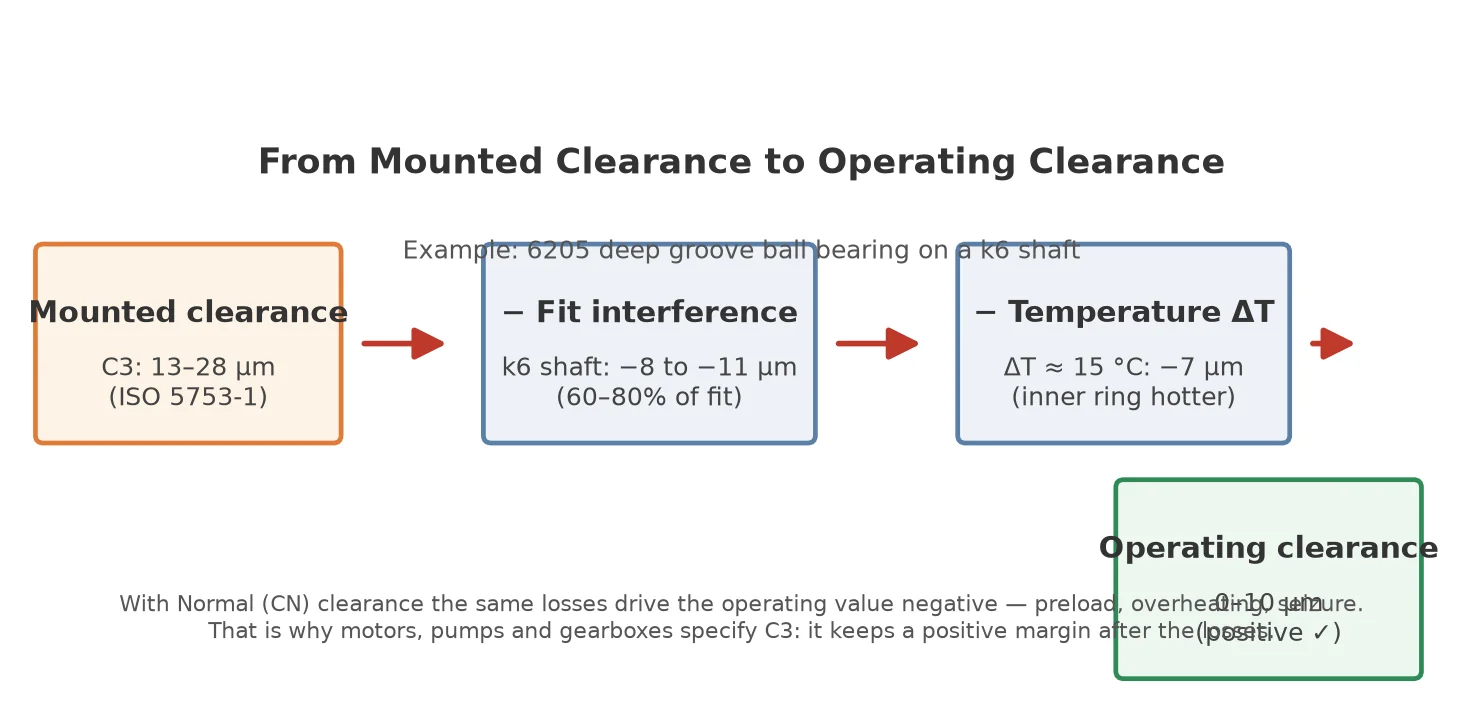
The worked example above shows why Normal clearance fails on a typical motor shaft: the two losses consume 15–18 μm of the 5–20 μm available, and the worst-case combination drives the operating value negative. That negative condition — insufficient clearance — is what causes overheating, vibration, and eventual seizure, and it is routinely misdiagnosed as a lubrication problem. C3 keeps the same bearing positive in operation.
How to Choose C2, C3, or C4 — Step by Step
Selection is a three-part calculation wrapped in one rule: choose the smallest group that keeps a positive operating clearance under the worst realistic combination of fit and temperature. The general bearing selection guide covers the wider choice of type, size, and precision; clearance is one input to that process.
- Start from Normal (CN). It is the correct answer for the majority of applications — steel shaft, steel housing, room-temperature service, light to moderate loads.
- Check the fit. If the inner ring takes an interference fit (k6, m6, or tighter), assume 60–80% of the average interference disappears from the clearance. A heavy fit (m6+) on its own justifies C3.
- Check the temperature differential. Estimate the inner-ring-to-outer-ring ΔT. Above roughly 10–15 °C, or when the machine runs continuously and hot, move up a group.
- Stack the two losses against the group range. If Normal’s minimum value minus both losses is zero or negative, step up to C3 — or to C4 when the fit is heavy and the temperature is high.
- Confirm with the supplier. Bearing clearance values follow ISO 5753-1 across brands, but sealed-bearing tables and special groups can differ by manufacturer — ask for the exact range before ordering. Talos provides the full group table with every quotation and can advise on the right class for your duty.
Bearing Clearance Selection by Application
| Application | Recommended Group | Reason |
|---|---|---|
| General machinery (room temperature, light–moderate load) | CN (Normal) | Default; no significant loss sources |
| Electric motors (k6 shaft, running heat) | C3 | Interference fit + rotor heat; C3 is motor standard |
| Large / high-speed motors | C3 / C4 | Temperature loss scales with bearing size |
| Gearboxes and reducers | C3 / C4 | Interference fits plus high oil temperature |
| Centrifugal pumps | C3 / C4 | Fit loss + process heat conducted into the shaft |
| Vibrating screens / shakers | C4 | Shock loads, heat, heavy interference (m6/p6) |
| Kilns, dryers, paper machines, mills | C4 / C5 | Extreme heat and large bearing size |
| Precision spindles, high-speed low-load | C2 / CN (often with preload) | Near-zero stable clearance for stiffness |
| Angular contact or tapered roller bearings | — (no C groups) | Set by preload / axial end play at assembly |
When in doubt for a motor, pump, or gearbox shaft, C3 is a safe default — it is the most common non-Normal group in industry and costs nothing in interchangeability, since the outer dimensions are unchanged. The 6200-series bearings in our deep groove ball bearing range, such as the Talos 6201 ZZ, are dimensionally identical in every group, so upgrading a design to C3 never requires housing or shaft changes.
Common Bearing Clearance Mistakes to Avoid
Mistake 1: Treating C3 as a quality upgrade
C3 is not “better” or “higher precision.” It is simply more internal space, specified for a reason. Using C3 where Normal suffices reduces stiffness, raises vibration and noise, and can shorten life — you pay the same and get less. Precision class (P0/P6/P5, ISO 492) is a completely separate specification.
Mistake 2: Assuming more clearance is always safer
The opposite is closer to the truth. Larger bearing clearance shrinks the loaded zone, so fewer balls carry the load, the cage skids at speed, and noise and wear increase. The selection goal is the smallest group that stays positive in service, not the biggest.
Mistake 3: Ordering C3 to fix a noise problem
Noise and vibration usually call for a smaller clearance or a preloaded pair, a better precision grade, or improved lubrication — C3 typically makes noise worse, not better.
Mistake 4: Ignoring fit and temperature when specifying Normal
Specifying CN on a k6 motor shaft without checking the losses produces insufficient clearance in operation: overheating, vibration, and seizure that gets blamed on grease or load. The clearance class must be chosen together with the shaft fit — our shaft fit tolerance guide covers that pairing in depth.
Mistake 5: Asking for C3 on bearings that have no C groups
Angular contact ball bearings use preload classes; tapered roller bearings are set by axial end play at assembly. Neither uses the C2–C5 radial groups — specifying “C3” on these simply confuses the order.
Working with a manufacturer that publishes its bearing clearance tables — as Talos does for every ISO 5753-1 group — removes most of this risk: the values are on the quotation, the group is stamped or stated on the packing, and the engineer can verify the calculation instead of trusting a hunch.
Frequently Asked Questions
What is the difference between C2, C3, and C4 bearing clearance?
They are three of the five ISO 5753-1 radial clearance groups, in ascending order of internal play: C2 is smaller than Normal, C3 is larger than Normal, and C4 is larger still. For a 25 mm bore deep groove ball bearing, C2 is 1–11 μm, Normal is 5–20 μm, C3 is 13–28 μm, and C4 is 23–41 μm. You step up a group when interference fits and operating heat consume clearance.
Is C3 bearing clearance better than normal clearance?
Not in general — it is different, for a specific purpose. C3 is the right choice when an interference fit and/or a temperature differential will consume clearance in service, which is why motors, pumps, and gearboxes use it. For a clean, cool, lightly loaded application, Normal (CN) is both correct and better for stiffness and noise. Choose the smallest group that stays positive in operation.
What clearance class do electric motor bearings use?
Most electric motor bearings use C3. The shaft is typically fitted k6 (an interference fit that consumes 8–11 μm of clearance on a 25 mm bore), and the inner ring runs hotter than the outer ring under load. Together those losses exceed the Normal group’s margin, so C3 is the industry standard for motor duty; very large or hot motors step up to C4.
Does an interference fit reduce bearing clearance?
Yes. Pressing the inner ring onto the shaft stretches it outward, consuming roughly 60–80% of the interference from the radial clearance. A k6 fit on a 6205 consumes about 8–11 μm. This is why clearance class and shaft fit must be selected together — see our bearing shaft fit tolerance guide for the full logic.
Is a Talos bearing with C3 clearance the same as an SKF or NSK C3 bearing?
Yes. Clearance values are defined by ISO 5753-1, so a Talos 6205 C3 and an SKF or NSK 6205 C3 carry the same 13–28 μm range — the groups are effectively equivalent across brands. Talos deep groove ball bearings ship with C0 (Normal) as standard and are available in C2, C3, C4, and C5 on request, with the exact measured range stated on the inspection report.
What does CN mean on a bearing?
CN stands for “Normal” clearance — the default radial internal clearance group per ISO 5753-1, sometimes written C0. It suits the majority of applications with standard fits and room-temperature operation. When a fit or heat will consume clearance, the next group up (C3) is specified instead.
Conclusion
Choosing the right bearing clearance comes down to one calculation: start from Normal, subtract the interference fit loss (60–80% of the fit) and the temperature differential loss (≈0.0117 × ΔT × mean diameter), and select the smallest group that keeps a positive operating clearance. For most motor, pump, and gearbox shafts that answer is C3; for heavy fits plus heat it is C4; for clean, cool general duty it remains CN. Correct bearing clearance selection is cheap insurance — it costs nothing in dimensions, and it prevents the overheating, vibration, and seizure failures that are almost always misdiagnosed as something else. For mounting practice that protects the clearance you specified, our bearing mounting techniques guide is the natural next read.
Need deep groove ball bearings in the clearance group your application requires? Browse our deep groove ball bearings — including the 6202ZZ and 6201 ZZ — or contact our engineering team for a clearance recommendation matched to your fit, load, and temperature conditions.