Every 6202ZZ bearing you can buy looks identical on the outside — 15 × 35 × 11 mm, two steel shields, eight balls. What separates a bearing that runs for years from one that spalls out within months is nearly invisible: the material inside and the heat treatment that shaped it. 52100 bearing steel (called GCr15 outside the US) is the high-carbon chromium steel behind roughly 90% of industrial bearings, and the way it is hardened determines the 60–66 HRC hardness that rolling contact demands. This guide explains what 52100 bearing steel is, how its heat treatment builds durability, and what to verify before you buy a 6202ZZ.
What Is 52100 Bearing Steel?
52100 bearing steel is a high-carbon chromium steel engineered for one job: surviving rolling contact fatigue. Its chemistry — about 1.0% carbon and 1.5% chromium — is the same recipe that has defined bearing steel for over a century. Carbon produces the hard martensite that gives 60+ HRC hardness after quenching; chromium adds hardenability, forms fine wear-resistant carbides, and slightly improves corrosion resistance.
The same material is sold under four names depending on the standard you read:
| Standard | Grade | Region |
|---|---|---|
| ASTM A295 | AISI / SAE 52100 | United States |
| GB/T 18254 | GCr15 | China |
| ISO 683-17 | 100Cr6 | Europe |
| JIS G 4805 | SUJ2 | Japan |
Within a 6202ZZ, every load-carrying part is this steel: inner ring, outer ring, and all eight balls. The stamped steel cage and the ZZ shields themselves are low-carbon steel — they carry no load, so they do not need the hardness.
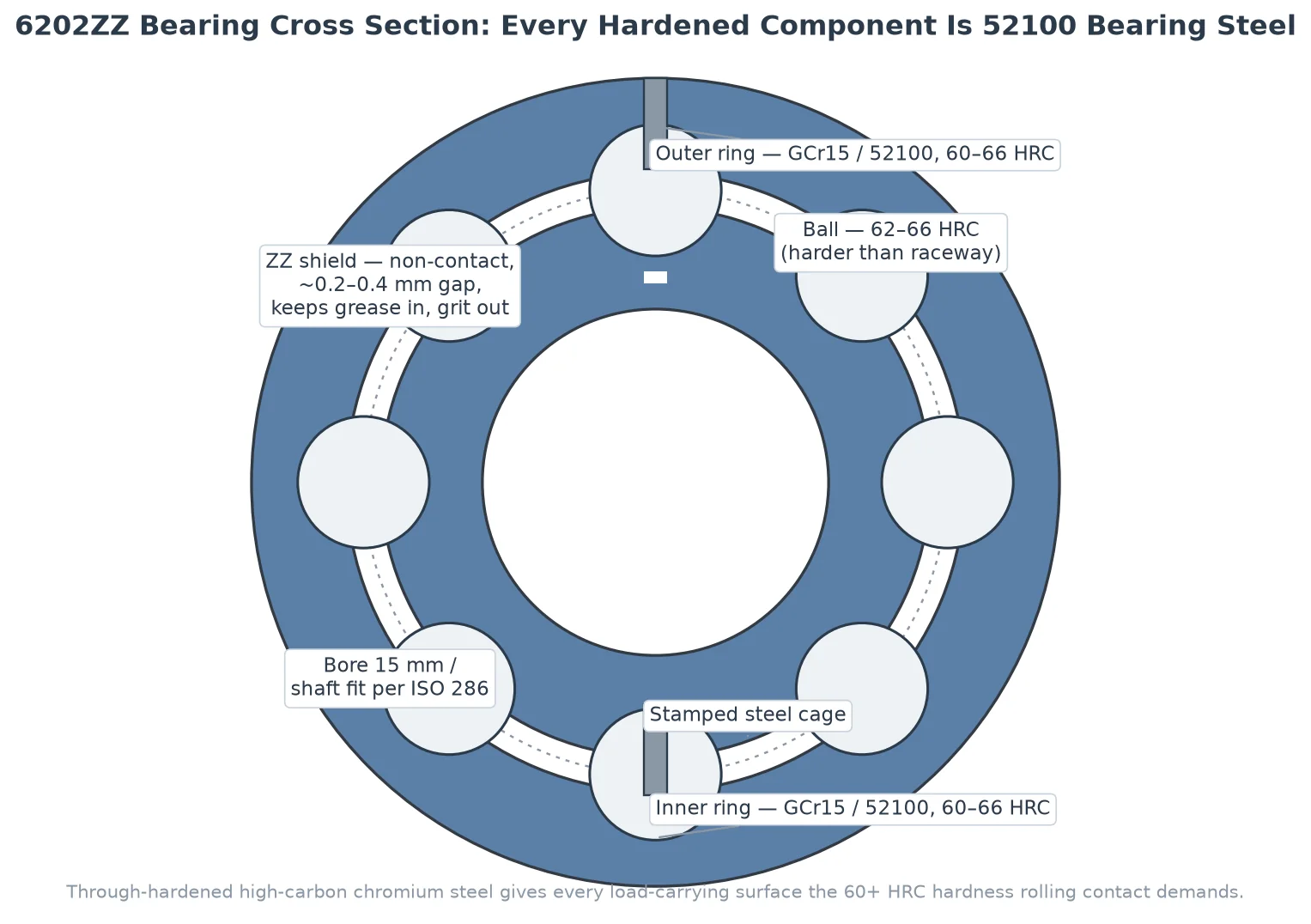
The chemistry table below is worth keeping as a reference. Note that the phosphorus and sulfur limits are held to 0.025% or below — and, more importantly for durability, the steel is vacuum-degassed so total oxygen stays at or under 8 ppm (premium grades reach 6 ppm). Oxygen forms oxide inclusions, and oxide inclusions are where rolling contact fatigue cracks begin.
| Element | GCr15 | 52100 | Role in durability |
|---|---|---|---|
| Carbon | 0.95–1.05% | 0.98–1.10% | Martensite hardness — the 60+ HRC foundation |
| Chromium | 1.40–1.65% | 1.30–1.60% | Hardenability, fine carbides, slight corrosion resistance |
| Manganese | 0.25–0.45% | 0.25–0.45% | Deoxidation, hardenability |
| Silicon | 0.15–0.35% | 0.15–0.35% | Deoxidation, temper resistance |
| Phosphorus / Sulfur | ≤ 0.025% / ≤ 0.025% | ≤ 0.025% / ≤ 0.025% | Kept low — segregation and inclusions shorten life |
Cleanliness is the single biggest quality differentiator between bearings that look alike. Two rings hardened to the same hardness will not have the same life if one steel was vacuum-degassed and the other was not — fatigue cracks start at sub-surface inclusions. For the full material comparison against stainless steel and ceramic, see our ceramic vs steel bearing guide.
How 52100 Bearing Steel Is Heat Treated
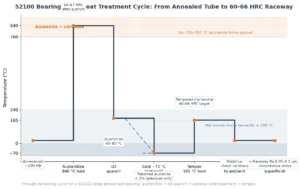
Heat treatment transforms 52100 bearing steel from a machinable ~200 HB tube into a 60–66 HRC raceway. For a 6202ZZ, whose ring wall is only about 3–4 mm thick, the entire section through-hardens — there is no soft core to hide defects in.
Hardening: Austenitizing and Quenching
Machined rings are austenitized at 840 ± 10 °C, held long enough for carbon to dissolve into the austenite, then quenched in oil at 60–80 °C. The fast cooling converts the structure to martensite at 64–67 HRC as-quenched, with 10–20% retained austenite left over. This is the step where temperature control matters most: too low and the steel never reaches full hardness; too high and the grain coarsens, brittleness rises, and retained austenite explodes.
Tempering: Turning Hardness into Durability
As-quenched martensite is hard but brittle. Tempering at 160–170 °C for 2–3 hours relieves quenching stress and settles the hardness into the 60–66 HRC window while keeping enough toughness to survive shock loads. The final microstructure — fine tempered martensite plus small, uniformly distributed carbides and 5–10% retained austenite — is graded 1–4 per JB/T 1255. High-precision bearings (P5/P4) add an optional cold treatment at −60 to −80 °C to push retained austenite below 3% for dimensional stability; a standard 6202ZZ does not need it.
Grinding and Superfinishing
The durability story does not end at the temper furnace. Raceway grinding removes any decarburized layer, and proper grinding leaves a compressive residual stress of roughly −200 to −600 MPa on the surface — compressive stress suppresses crack initiation and growth. Superfinishing then brings the raceway to Ra 0.05–0.2 µm so the lubricant film can separate the rolling elements. Grinding without adequate cooling burns the surface (re-tempering it soft, or worse, re-hardening it brittle) — a hidden defect no hardness tester will catch unless the test is done right.
| Heat treatment stage | Temperature | Result |
|---|---|---|
| Spheroidize anneal | ~780 °C | 179–207 HB, machinable structure |
| Austenitize | 840 ± 10 °C | Austenite + undissolved carbides |
| Oil quench | 60–80 °C oil | Martensite, 64–67 HRC |
| Cold treatment (optional) | −60 to −80 °C | Retained austenite < 3% |
| Temper | 160–170 °C, 2–3 h | Tempered martensite, 60–66 HRC |
| Grind + superfinish | Ambient | Raceway Ra 0.05–0.2 µm, compressive stress |
Why 52100 Bearing Steel Makes a 6202ZZ Bearing Durable
Durability is a chain, and each link multiplies the ones before it — this is why the same model number can deliver wildly different service lives from different factories.
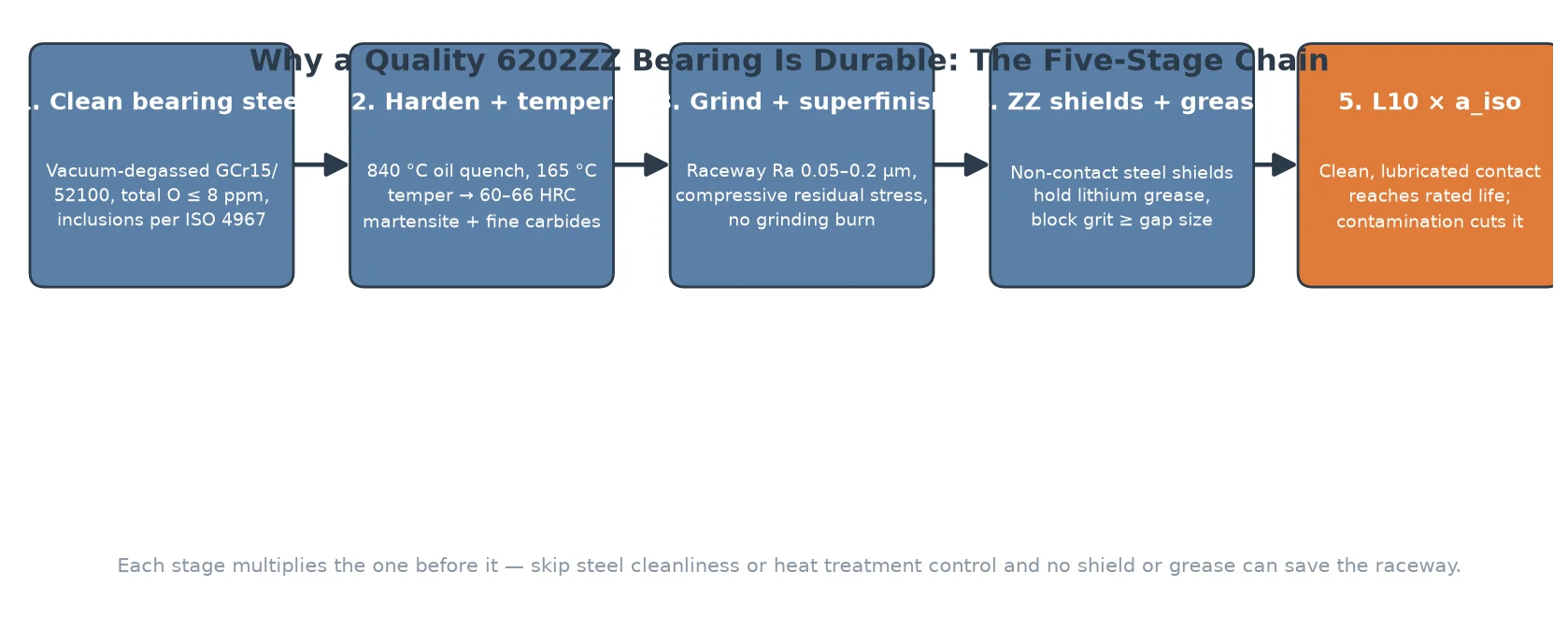
Hardness carries the contact stress
At rated loads, ball bearings operate at Hertzian contact stresses of thousands of MPa — above the yield point of any unhardened steel. ISO 76 defines the static load rating C0 as the load at which permanent deformation begins at roughly 4,200 MPa contact stress. A 6202ZZ rated at C0 = 3.75 kN stays elastic only because its raceways and balls sit at 60+ HRC. That hardness comes entirely from the heat treatment described above.
Cleanliness decides whether rated life is real
ISO 281:2007 basic life L10 = (C/P)³ × 10⁶ revolutions assumes clean, well-lubricated bearings of high-quality steel. For a 6202ZZ with C = 7.65 kN at 1,500 r/min:
| Equivalent load P | P/C | L10 (revolutions) | L10h at 1,500 r/min |
|---|---|---|---|
| 765 N | 0.1 C | 1.0 × 10⁹ | ≈ 11,100 hours |
| 1,913 N | 0.25 C | 6.4 × 10⁷ | ≈ 710 hours |
| 3,825 N | 0.5 C | 8.0 × 10⁶ | ≈ 89 hours |
Load triples, life drops by a factor of 100 — that is the arithmetic of L10. The modified life L10m = a1 × a_iso × L10 (per ISO 281:2007) then scales the result by lubrication quality and contamination. This is where the ZZ shields earn their keep: the non-contact steel shields hold grease inside and block grit, which keeps the contamination factor high. Clean, well-lubricated contacts can see a_iso values up to 50×; contaminated ones drop to 0.1–0.2×. See our bearing contamination control article for the a_iso magnitude table.
Finish and residual stress protect the surface
A 0.05–0.2 µm superfinished raceway forms a full elastohydrodynamic film, keeping the metal surfaces apart. Roughness changes the lambda ratio and decides whether the bearing runs in boundary, mixed, or full-film lubrication — covered in depth in our surface roughness Ra Rz article. Material selection is one of the first steps in SKF’s bearing selection process for exactly this reason.
What to check in a quality 6202ZZ
| Check | Quality bearing (e.g. Talos 6202ZZ) | Cheap substitute |
|---|---|---|
| Steel | Vacuum-degassed GCr15 / 52100 bearing steel, O ≤ 8 ppm | Plain carbon steel, shallow case-hardened |
| Ring hardness | 60–66 HRC | Often below 58 HRC |
| Ball hardness | 62–66 HRC (harder than raceways) | Same as ring or lower |
| Microstructure | Fine tempered martensite, JB/T 1255 grade 1–4 | Coarse or uneven |
| Raceway finish | Ra 0.05–0.2 µm | Visible grinding marks |
A Talos 6202ZZ deep groove ball bearing is manufactured from vacuum-degassed GCr15 (the 52100 bearing steel equivalent), through-hardened to 60–66 HRC with balls at 62–66 HRC, superfinished raceways, stamped steel cage, and double ZZ shields — every link of the durability chain in place.
Common Misconceptions About Bearing Steel and Heat Treatment
“Hardness is the only thing that matters”
Hardness gets the attention, but steel cleanliness, compressive residual stress, and raceway finish matter just as much. A hard bearing made from dirty steel fails from sub-surface inclusions long before wear shows up.
“ZZ shields make the bearing waterproof”
ZZ is a non-contact shield, not a seal. It keeps grease in and coarse grit out, but water and fine dust can still work their way in. For washdown or dusty duty you need 2RS contact seals — see our bearing seal testing and IP rating guide.
“A higher tempering temperature makes a tougher bearing”
Tempering above the 150–180 °C window softens the martensite below 58 HRC, and the raceways start to indent under load. The tempering window exists for a reason: high hardness and enough toughness, in balance.
“Every 6202ZZ uses the same steel”
Dimensionally identical bearings can be made from plain carbon steel with a shallow hardened skin instead of through-hardened 52100 bearing steel. Demand a material certificate (GB/T 18254 or ASTM A295) with the purchase if durability matters — the chemistry and the oxygen content are right there in black and white.
Frequently Asked Questions
Is 52100 bearing steel the same as GCr15, 100Cr6, and SUJ2?
Yes. They are the same high-carbon chromium steel sold under different national standards: AISI 52100 (US), GCr15 (China), 100Cr6 (ISO 683-17), and SUJ2 (Japan). Chemistry ranges differ by a few hundredths of a percent, but hardness, heat treatment, and performance are equivalent.
What hardness should a 6202ZZ bearing have?
Rings should be 60–66 HRC (typically 61–65 HRC in production) and balls 62–66 HRC. Balls are deliberately kept about 1–2 HRC harder than the raceways for wear balance. Anything below ~58 HRC on the raceway will indent under rated load.
Why does a quality 6202ZZ last so much longer than a cheap one if the dimensions match?
Because durability is set by what you cannot see: steel cleanliness (oxygen content and inclusions), heat treatment control (temperature windows, tempering, grinding-burn prevention), and raceway finish. These invisible differences routinely produce 2–5× life differences at the same price point range.
Do ZZ shields alone make a 6202ZZ bearing durable?
No. Shields protect the grease and keep contamination out, which raises the ISO 281 contamination factor — but they cannot compensate for soft raceways or dirty steel. The 52100 bearing steel and its heat treatment are the foundation; the shields protect that foundation.
What is the difference between a shield and a seal on a 6202ZZ?
A ZZ shield is a stamped steel cover with a small non-contact gap (about 0.2–0.4 mm) to the inner ring — it adds no friction and keeps grease in. A 2RS seal is a rubber lip that contacts the inner ring, blocking water and fine dust at the cost of some friction and a lower speed limit.
Conclusion
A durable 6202ZZ is not a mystery — it is the sum of controlled decisions made before the bearing reaches your shelf: vacuum-degassed 52100 bearing steel, a heat treatment cycle that lands every ring at 60–66 HRC, grinding that leaves compressive stress instead of burn, and shields that protect the grease film. Check the material certificate, check the hardness spec, and you can predict durability before the first revolution.
Browse the Talos 6202ZZ deep groove ball bearing — vacuum-degassed GCr15, 60–66 HRC raceways, double shields — or explore the full deep groove ball bearing range for your application. Need help verifying a specification against your duty cycle? Contact our engineers with your load and speed data.