Choosing the wrong bearing can lead to premature failure, unexpected downtime, and higher maintenance costs. This bearing selection guide explains how engineers and purchasing teams can choose the right bearing by evaluating load, speed, precision, operating environment, lubrication, and service life requirements.
Pick the wrong bearing and you find out the hard way — a seized shaft at 2 a.m., or a customer complaint six months after installation. Bearing selection affects reliability, service life, energy use, and total cost all at once, so it pays to get it right the first time. With dozens of bearing types, hundreds of sizes, and a handful of precision grades and materials to choose from, there is no shortcut around a systematic process.
This guide breaks that process into six steps. It works whether you are specifying bearings for a new machine design or troubleshooting a failure on the shop floor.
Step 1: Analyze Bearing Load Requirements
Start with the loads. Everything downstream — bearing type, size, even lubrication — follows from this. Loads break down into three basic types:
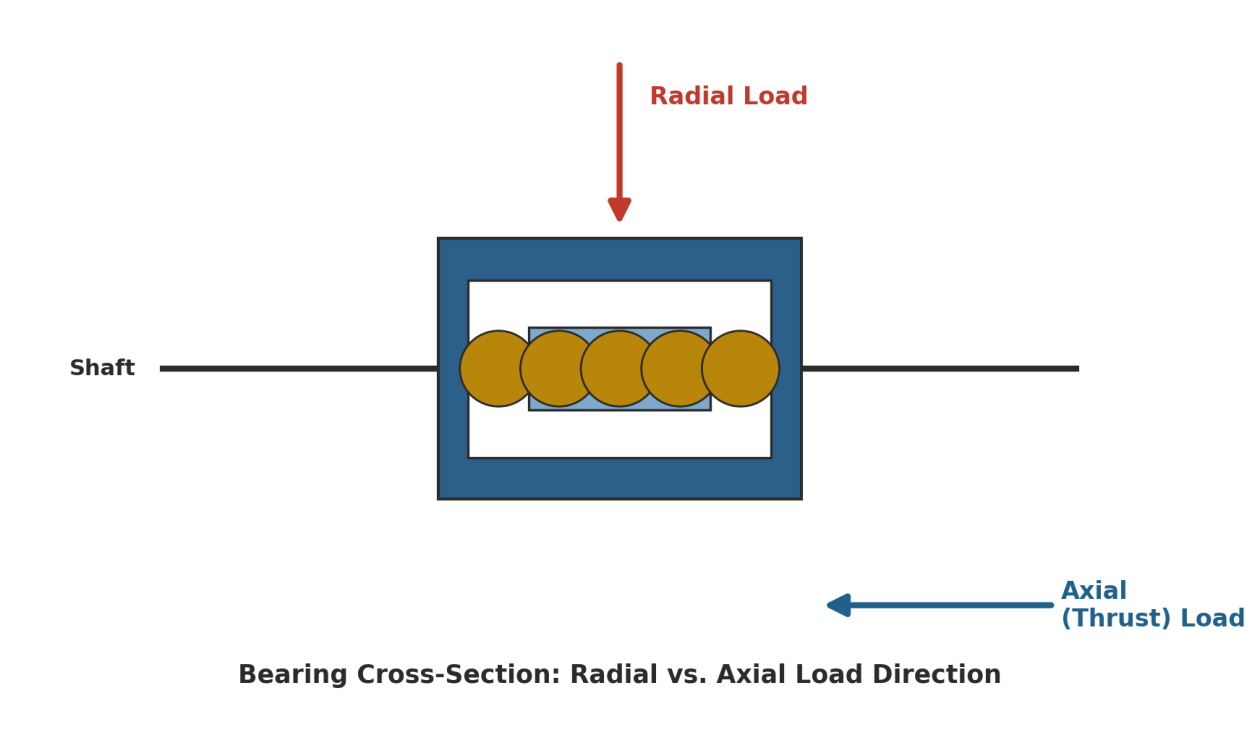
Radial Load
Force perpendicular to the shaft axis, and the most common loading direction in practice. Deep groove ball bearings and cylindrical roller bearings handle radial loads well and are usually worth checking first.
Axial (Thrust) Load
Force parallel to the shaft axis. Thrust ball bearings suit moderate-speed axial loads, tapered roller bearings handle combined loads well, and angular contact ball bearings are the standard choice for high-speed precision axial work.
Combined Load
Gearboxes and electric motors are the classic case: radial and axial forces hit the bearing at the same time. Deep groove ball, angular contact ball, tapered roller, and spherical roller bearings all handle this kind of mixed loading, just to varying degrees.
Consider both magnitude and direction when you work through loads, and add a safety factor of roughly 1.2–1.5× the calculated load if shock or vibration is likely. Every bearing carries a dynamic load rating (C) and a static load rating (C0) — keep your application’s equivalent load safely under both, with margin.
Step 2: Evaluate Bearing Speed Requirements
Speed usually narrows things down fast. Bearing types differ enormously in how fast they can turn:
| Speed Range | Suitable Bearing Types | Limiting Factor |
|---|---|---|
| Ultra-high (> 50,000 RPM) | Angular contact ball bearings, deep groove ball bearings (precision grade) | Heat generation, cage design, lubrication method |
| High (10,000–50,000 RPM) | Deep groove ball bearings, angular contact bearings | Grease type, seal friction, cage material |
| Medium (3,000–10,000 RPM) | Most ball bearings, cylindrical roller bearings | Lubrication interval, operating temperature |
| Low (< 3,000 RPM) | All bearing types including roller bearings | Load rating typically becomes the constraint |
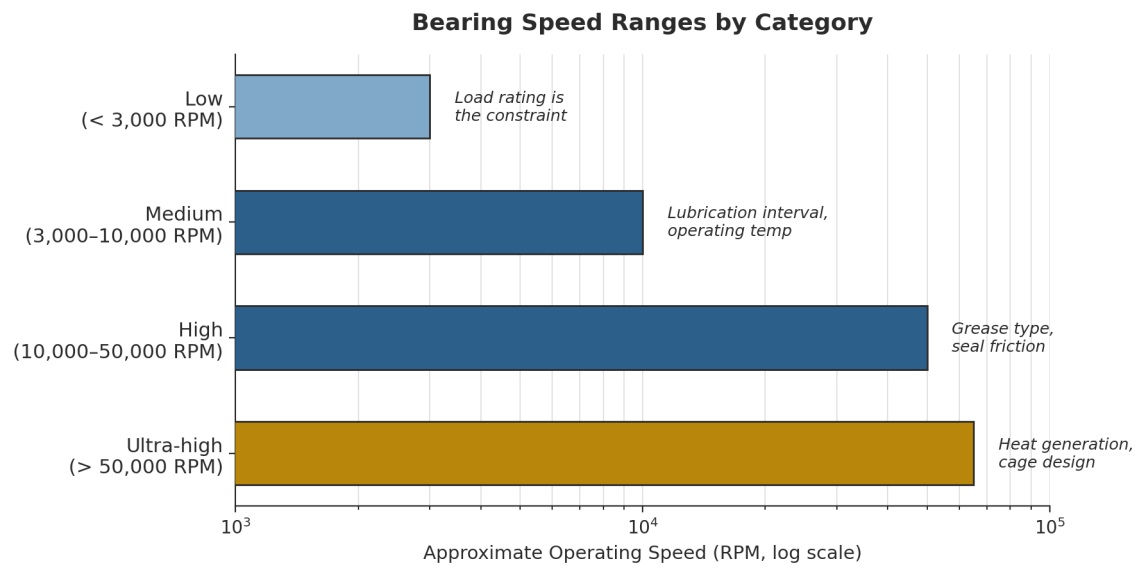
Limiting speed is the ceiling — the fastest the bearing can turn before heat becomes a problem. Grease lubrication typically brings that ceiling down to somewhere around 60–80% of the oil-lubricated limit, though the exact ratio varies by manufacturer and bearing series. Check both grease and oil limiting-speed values in the manufacturer’s catalog against your required RPM.
Step 3: Select Bearing Precision and Runout Tolerances
ABEC (Annular Bearing Engineering Committee) grades cover ball bearings; RBEC covers roller bearings. Both classify dimensional tolerance and runout, in ascending order of precision:
- ABEC 1 — Standard precision. Suitable for most general industrial applications: conveyors, agricultural equipment, fans, pumps.
- ABEC 3 — Improved precision. Common for electric motors, gearboxes, and moderate-speed applications.
- ABEC 5 — High precision. Used in machine tool spindles, printing equipment, and precision instruments.
- ABEC 7 / ABEC 9 — Ultra-precision. For aerospace, high-speed machining, and metrology equipment.
One caveat worth knowing: ABEC and RBEC grades measure dimensional tolerance and geometric precision, not vibration, noise, or overall build quality. A higher number means tighter tolerances — it doesn’t automatically mean a “better” bearing for your application. Treat precision grade as one input alongside load and speed, not a stand-alone quality score.
ABEC 1 or ABEC 3 covers most B2B buying decisions. Reach for a higher grade only when the application genuinely needs sub-micron runout control — ABEC 7 can cost 5–10× as much as ABEC 1 for the same bore size.
Step 4: Evaluate Bearing Operating Environment
Environment decides how the bearing gets sealed and what it’s made of, more than almost anything else. Key factors:
- Temperature — Bearing steel in standard construction generally handles about -30°C to +120°C; heat-stabilized steel extends that toward +150°C. The rubber seals on a standard 2RS bearing are usually the real limiting factor, well before the steel is — typically somewhere in the 100–120°C range depending on the seal compound. Running hot means choosing heat-stabilized steel, high-temperature grease, and metal shields (ZZ) or specially rated seals instead of standard rubber.
- Moisture / Washdown — Food processing, marine, and outdoor applications need stainless steel bearings or corrosion-resistant coatings with contact seals.
- Contamination (Dust, Dirt, Abrasives) — In mining, construction, and agriculture, sealed or shielded bearings protect internal components. If contamination is extreme, consider mounted pillow block units with heavy-duty seals.
- Chemical Exposure — Acids, solvents, and cleaning agents may require special seal materials (Viton, PTFE) or ceramic rolling elements.
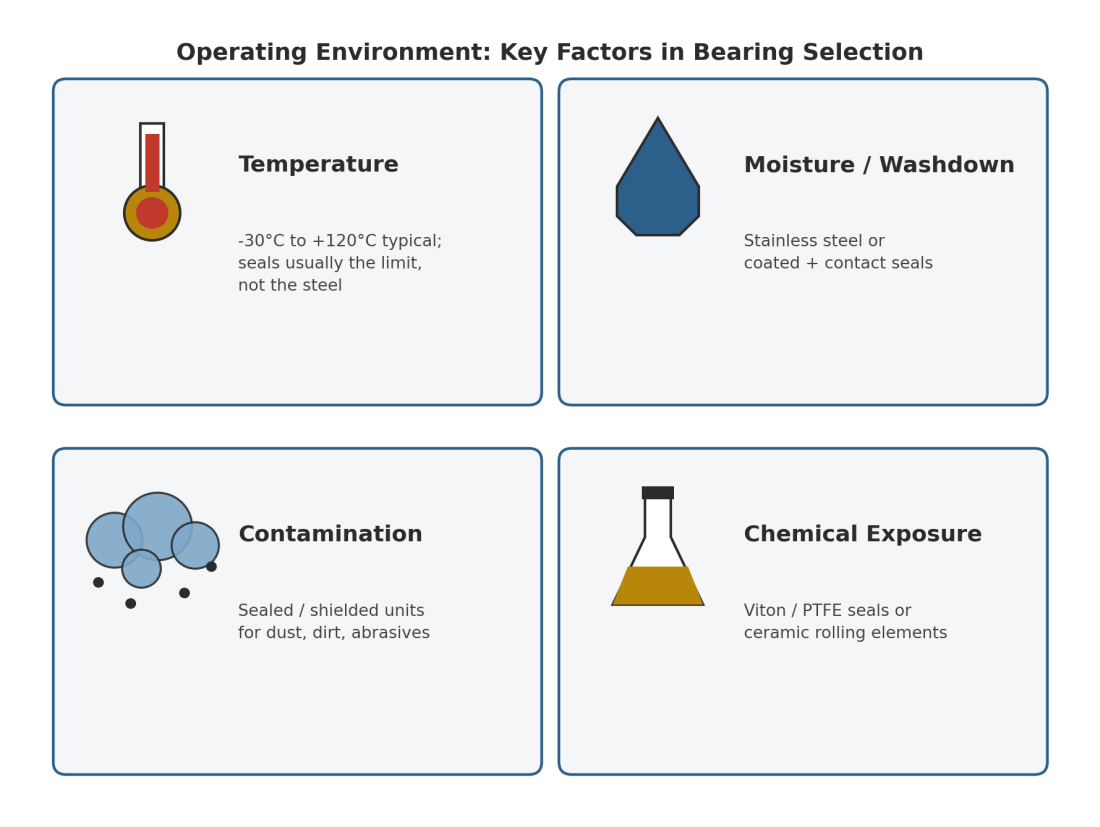
Get the environment right before you specify anything else. A basic deep groove ball bearing with standard rubber seals — from our deep groove ball bearing catalog — works fine indoors in a clean, dry space, and fails within weeks somewhere wet and dusty.
Step 5: Choose Bearing Lubrication and Sealing Methods
Lubrication does more than cut friction — it dissipates heat, fights corrosion, and flushes out contaminants. Three broad options:
- Grease Lubrication is the default for general industrial applications. It simplifies maintenance, seals reasonably well against contaminants, and suits medium-speed work. Sealed bearings (2RS / ZZ) come pre-greased and stay maintenance-free for life.
- Oil Lubrication takes over where grease would degrade — high speed, high temperature. It can be delivered by oil bath, oil mist, or a circulating system, depending on the application.
- Solid / Dry Lubricants (PTFE, graphite, MoS2) come into play when conventional lubricants can’t be used: vacuum environments, extreme temperatures, or food processing where oil contamination isn’t acceptable.
Step 6: Calculate Bearing Life (L10) and Service Requirements
ISO 281 defines L10 life: the number of revolutions, or hours, that 90% of a batch of identical bearings will reach or exceed under a given load. The formula:
L10 = (C / P)p × 106 revolutions
C is the dynamic load rating, P is the equivalent dynamic load, and p is 3 for ball bearings or 10/3 for roller bearings.
20,000–50,000 hours of calculated L10 life covers most industrial equipment. Critical gear — pumps, fans, compressors running continuously — often calls for 80,000–100,000+ hours. SKF and other manufacturers publish bearing life calculators that speed this up once you’ve got a short list of candidates.
ISO 281’s modified rating life calculation goes further — accounting for lubrication condition, contamination, and reliability targets — and is worth a look once you’re past first-pass selection.
Quick Bearing Selection Guide Reference Table
| Application Need | Recommended Bearing Type | Key Advantage |
|---|---|---|
| High speed, light load | Deep groove ball bearing | Low friction, high speed capability |
| Heavy radial load, moderate speed | Cylindrical roller bearing | Highest radial load capacity |
| Combined radial + thrust load | Angular contact ball bearing / Tapered roller bearing | Handles both load directions |
| Shaft misalignment expected | Spherical roller bearing / Self-aligning ball bearing | Self-aligning capability |
| High thrust load only | Thrust ball bearing / Thrust roller bearing | Optimized for axial loads |
| Limited space, high load density | Needle roller bearing | Smallest cross-section for given load |
| Linear motion required | Linear ball bearing / Linear bushing | Smooth linear movement |
| Corrosive or high-temperature | Ceramic / Stainless steel bearing | Material-specific chemical resistance |
| Easy mounting replacement | Pillow block bearing (mounted unit) | Pre-assembled housing + bearing |
Common Bearing Selection Mistakes
A few patterns come up again and again:
- Over-specifying precision — An ABEC 7 bearing in a slow conveyor adds cost with no benefit.
- Ignoring housing fit and shaft tolerances — The best bearing performs poorly if the fits are wrong. Always check the recommended shaft and housing tolerances in the manufacturer’s catalog.
- Underestimating speed requirements — A roller bearing selected for high load capacity may overheat at modest RPM if its limiting speed is exceeded.
- Neglecting thermal expansion — Shafts heat up during operation and expand. C0 or C3 internal clearance grades accommodate that; CN (normal) clearance may not.
- Choosing sealed bearings in high-temperature applications — Standard rubber seals give out well before the bearing steel does, often around 100–120°C (see Step 4). Use shielded (ZZ) or specially rated seals in hot environments instead.
Frequently Asked Questions
What is the Most Common Bearing Type for General Applications?
The deep groove ball bearing is the default choice worldwide: simple design, handles both radial and moderate axial loads, and available in nearly every size and precision grade you’d need.
How Do I Choose the Right Bearing Size?
Size comes down to three things: shaft diameter (bore), housing bore diameter, and required load capacity. Start with the shaft, then confirm the bearing’s dynamic load rating (C) clears your calculated load with margin to spare. The manufacturer’s catalog size chart lists standard dimensions for each bore size.
What is the difference between C3 and normal bearing clearance?
Normal (CN) clearance suits most applications with standard shaft and housing fits at room temperature. C3 (increased) clearance adds internal space to accommodate thermal expansion — when the shaft heats up more than the housing, or when interference fits reduce internal clearance. When in doubt about temperature conditions, C3 is a safe default.
Can I replace an open bearing with a sealed one?
Yes, as long as the physical dimensions match. Sealed bearings (2RS) offer maintenance-free operation and better contamination protection — an easy upgrade in many cases. They do carry a lower speed rating than open bearings because of seal friction, and they can’t be re-lubricated, so confirm your speed requirement first.
What does the SKF bearing designation system mean?
SKF and other major manufacturers encode bearing type, series, bore size, and sometimes cage material, clearance, and precision grade into the part number. Take 6205-2RS: 6 = deep groove ball bearing series, 2 = width/diameter series, 05 = bore diameter 25mm (05 × 5), 2RS = rubber seals on both sides. Once you can read this, cross-referencing between manufacturers gets a lot easier.
What Factors Should Be Considered in Bearing Selection?
The main factors in bearing selection include load type, speed requirements, precision grade, operating environment, lubrication method, and required bearing life. Engineers should evaluate all these factors together instead of selecting a bearing based on size alone.
What Are the Different Types of Bearings?
Common bearing types include deep groove ball bearings, angular contact ball bearings, cylindrical roller bearings, tapered roller bearings, spherical roller bearings, and thrust bearings. The correct choice depends on load direction, speed, operating environment, and application requirements.
Selecting Bearings From a Reliable Manufacturer
Choosing the right bearing also depends on selecting a reliable bearing manufacturer that can provide consistent quality, accurate specifications, and technical support.
For industrial buyers, a professional bearing supplier should provide detailed product specifications, quality inspection reports, material options, customization capabilities, and stable supply capacity.
Working with an experienced bearing manufacturer helps engineers reduce selection risks and ensures that bearings perform reliably under specific operating conditions.
Conclusion
Six steps, in order: load, speed, precision, environment, lubrication, then L10 life to confirm you got it right. Follow that sequence and you’ll narrow thousands of options down to one workable answer fairly quickly. The hard part was never memorizing bearing types — it’s knowing which questions to ask. When in doubt, start with a deep groove ball bearing and adjust from there based on speed, load direction, and environment.
Need a hand narrowing it down? Browse our bearing catalog or reach out to our engineering team directly — we stock deep groove ball bearings, mounted units, roller bearings, and more, ready to ship.
References
Technical claims in this guide are based on the following standards and manufacturer technical documentation:
- ISO 281:2007, Rolling bearings — Dynamic load ratings and rating life (basis for the L10 life formula in Step 6).
- ANSI/ABMA Standard 20, Radial Bearings of Ball, Cylindrical Roller, and Spherical Roller Types — Metric Design (defines the ABEC and RBEC precision classes in Step 3).
- ISO 492:2023, Rolling bearings — Radial bearings — Tolerances (international equivalent to ABEC/RBEC tolerance classes).
- SKF, “Temperature limits — Deep groove ball bearings,” SKF technical documentation (basis for the seal- and steel-temperature figures in Step 4).
- NSK, “Grease Lubrication,” NSK Rolling Bearing technical documentation, and American Roller Bearing, “Bearing Speed Limits & Calculation” (basis for the grease-vs-oil limiting speed ratio in Step 2).
- Figures such as target L10 hours (20,000–100,000+) and the ABEC 7 cost premium (5–10×) are commonly cited industry rules of thumb rather than fixed values in any single standard — confirm against your chosen manufacturer’s catalog for a specific application.