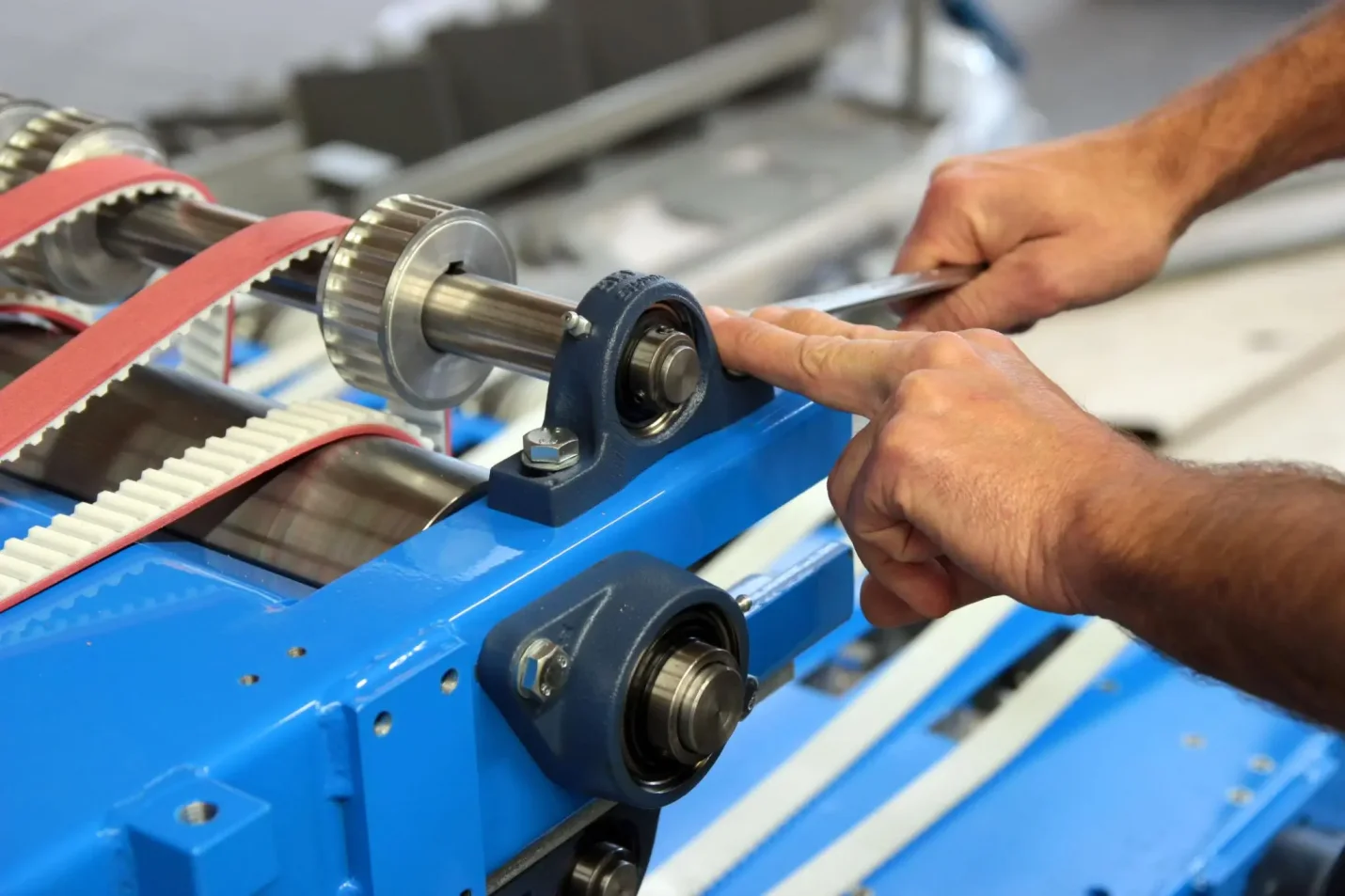
A pillow block bearing carries a rotating shaft and bolts straight onto a support structure, so there’s no separate housing to design or machine. It’s also called a plummer block or mounted bearing unit, and it shows up on conveyor systems, agricultural equipment, industrial fans, and most equipment where a shaft needs support somewhere along its length rather than just at the ends. This guide covers the main types, how sizing works, what to check before buying, and how to install and maintain one — whether you’re a maintenance engineer, a procurement specialist, or a design engineer speccing mounted bearings for a new build.
What Is a Pillow Block Bearing?
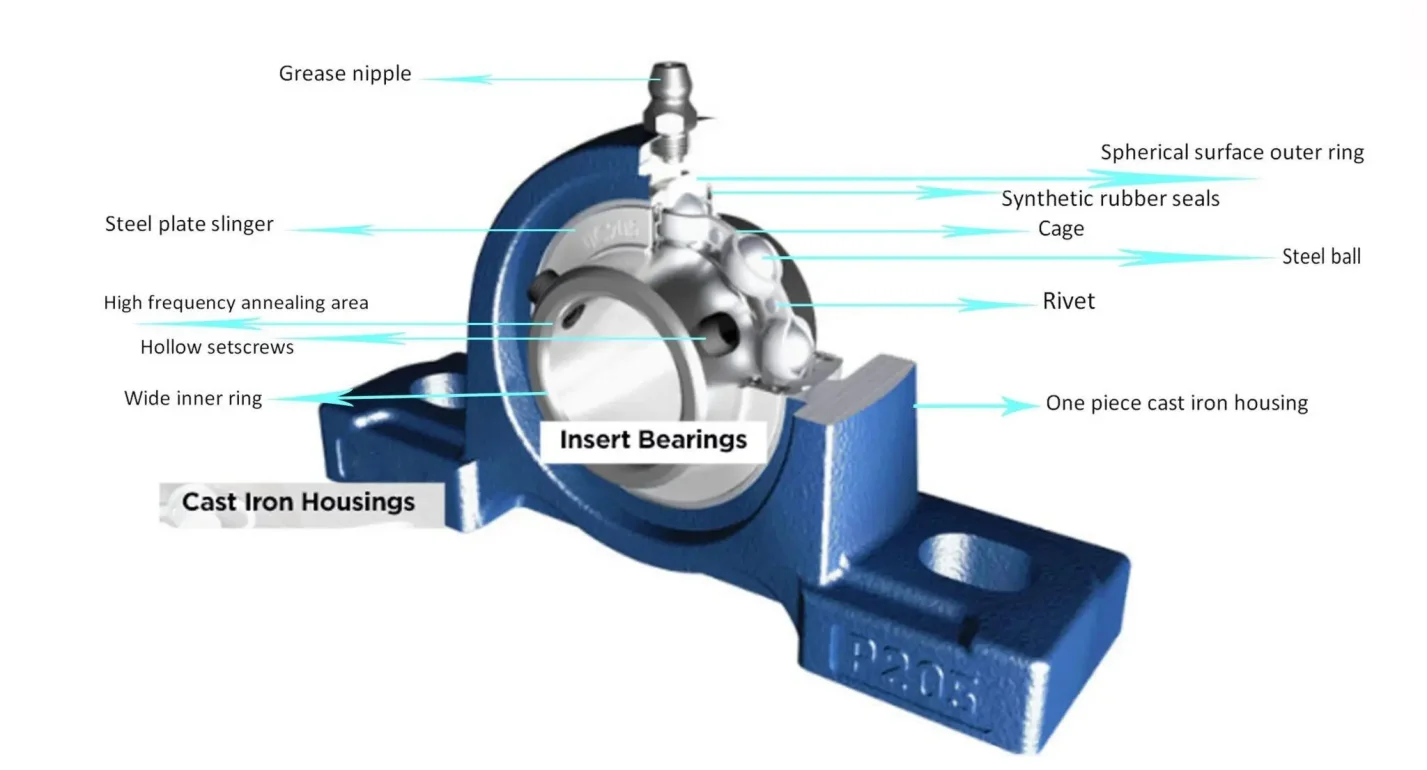
A pillow block bearing is a mounted unit: a bearing insert housed inside a metal block with a mounting base. The housing — cast iron, stamped steel, or composite — bolts to the support structure, while the insert carries the rotating shaft. Because the bearing and housing arrive pre-assembled, installation is simpler than fitting an unmounted bearing into a custom-machined housing.
The name comes from the housing’s shape, which resembles a pillow when viewed from the side. In many industrial markets, pillow block and plummer block are used interchangeably, although plummer block can also refer specifically to larger split bearing housings.
Inside the housing, the insert is typically a radial insert ball bearing based on deep groove ball bearing geometry, with a spherical outer ring that allows self-alignment; heavier split housings often carry a spherical roller bearing insert instead.
These units turn up wherever a shaft needs support partway along its length — conveyor idlers, fan shafts, line shafts, screw conveyors, and similar processing equipment. The self-aligning insert typically compensates for a few degrees of initial mounting misalignment, depending on the bearing design and manufacturer. This helps accommodate minor installation errors and reduces uneven loading caused by shaft and housing misalignment.
Types of Pillow Block Bearings
Pillow block bearings are sorted three ways: by housing design (split or solid), by bearing series (UCP, UCF, UCFL, UCT), and by housing material. Getting all three right matters more than any one of them alone.
Split vs. Solid Pillow Block Bearings
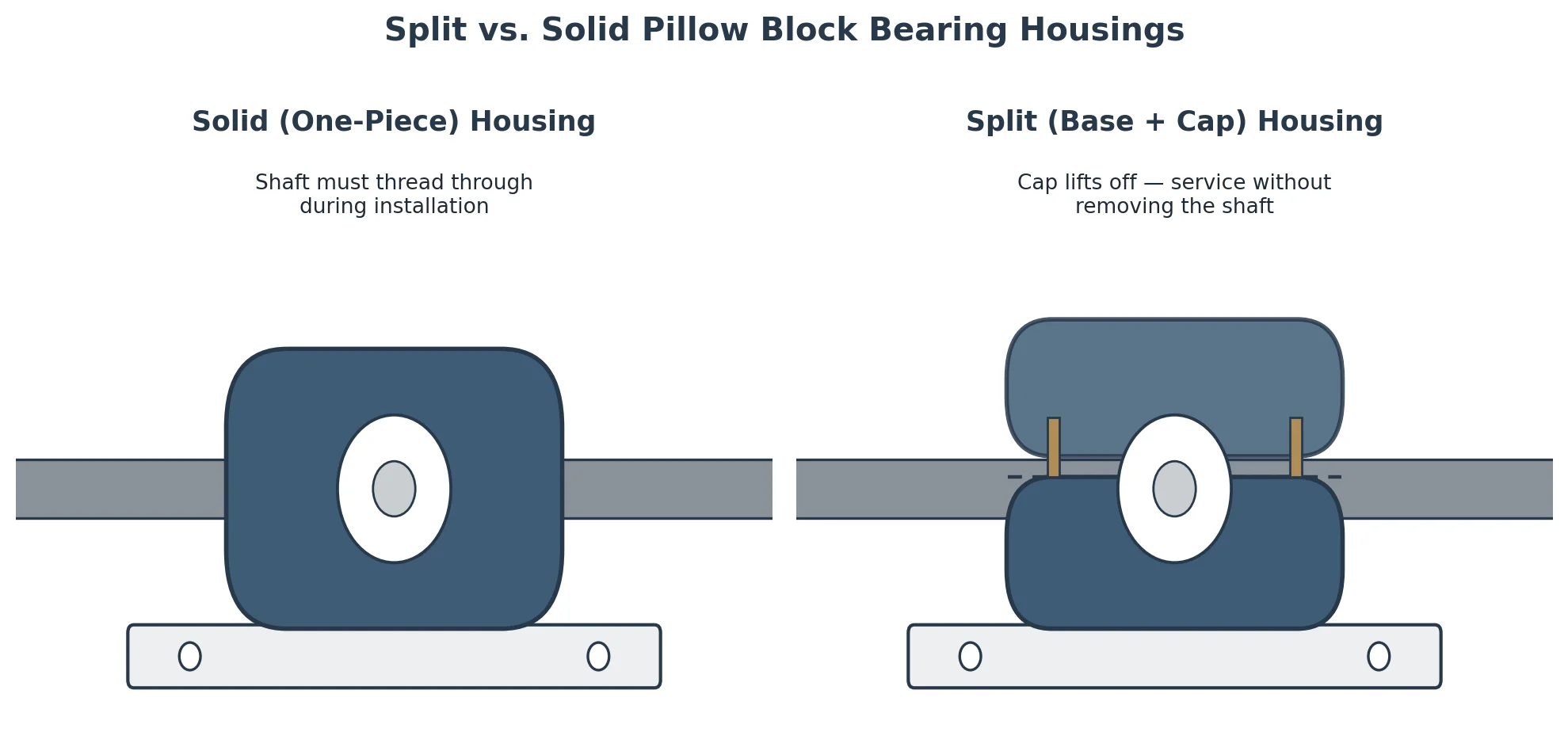
A split housing separates into two halves — a base and a cap — so the insert can be inspected or replaced without pulling the shaft. That makes split units the standard choice in paper mills, mining conveyors, and steel lines, where removing the shaft would mean a planned outage.
A solid housing is one piece, so the shaft has to be threaded through it during installation. That makes solid units cheaper but harder to service later — a reasonable trade-off for agricultural equipment, small conveyors, and fans, where the shaft is easy to reach anyway.
| Split Housing | Solid Housing | |
|---|---|---|
| Serviceability | Replace insert without removing shaft | Shaft must be removed / threaded through |
| Typical cost | Higher | Lower |
| Typical use | Paper mills, mining conveyors, steel lines | Agricultural equipment, small conveyors, fans |
Bearing Series Designations
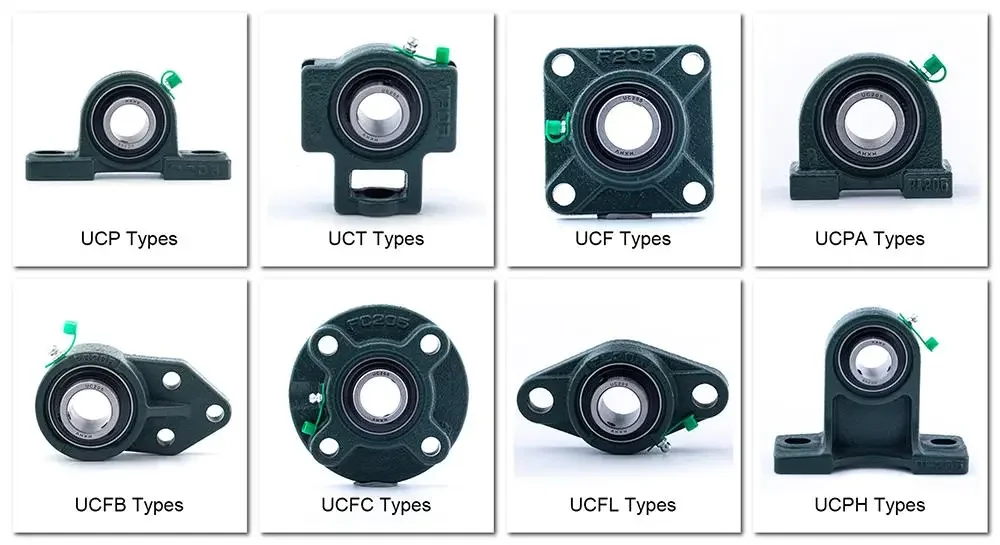
UCP, UCF, UCFL, and UCT all use the same family of insert bearings; only the housing changes. “UC” identifies the insert itself — a wide inner-ring, deep groove ball bearing with a spherical outer diameter, locked to the shaft with set screws or an eccentric collar. Per SKF’s own designation system, the letter (or letters) that follow “UC” identify the housing style:
- UCP bearing — rectangular base, two bolt holes. The default for a flat, horizontal mounting surface and the most widely used of the four, generally available from UCP201 through UCP220.
- UCF bearing — square four-bolt flange, for vertical surfaces or machine frames where a flat base won’t work.
- UCFL bearing — round or oval four-bolt flange, used when the mounting pattern is circular rather than square — common on fans and blowers.
- UCT bearing — take-up unit with a slotted, adjustable base, used where the shaft position needs to move to hold belt tension, such as conveyor tail pulleys.
Housing Materials
- Cast iron — the default for most industrial units, valued for strength and vibration damping. With standard grease, plan on roughly -20°F to +220°F (-30°C to 105°C) — see the FAQ for higher-temperature options. Uncoated cast iron only has moderate corrosion resistance and will rust in wet or chemically aggressive settings; use a composite or coated/stainless housing there instead.
- Stamped steel — lighter and cheaper, common on agricultural equipment and consumer products. Less rigid than cast iron, but adequate for low-load, low-speed duty.
- Composite / engineered polymer — corrosion-resistant and light, the usual pick for food processing, chemical plants, and washdown areas where a metal housing would corrode.
Pillow Block Bearing Applications
Pillow block bearings show up anywhere a rotating shaft needs support at a point along its length rather than only at its ends. A few industries account for most of the demand:
- Conveyor systems — supporting idler rollers, drive shafts, and take-up pulleys on belt and roller conveyors in warehouses and distribution centers.
- Agricultural machinery — mounted on harvesters, augers, and rotary equipment, where the self-aligning insert tolerates the flexing and misalignment common on farm equipment.
- Industrial fans — supporting fan shafts in HVAC and industrial ventilation systems, where balanced, low-vibration running matters for bearing life.
- Food processing equipment — composite or stainless housings with NSF H1 grease handle frequent washdown without corroding.
- Packaging machines — supporting the many short shaft runs found on packaging and bottling lines, where compact housings and easy replacement matter.
- Textile machinery — supporting rollers and shafts that run continuously at moderate speed, where consistent lubrication and sealing keep fibers and dust out.
- Material handling systems — supporting shafts on lift, sortation, and transfer equipment, typically split housings where downtime for bearing replacement is costly.
Key Selection Criteria
Sizing a mounted bearing means weighing several factors together, not picking the biggest number on one spec sheet and moving on. For a full framework, see our bearing selection guide.
Shaft Size and Fit
Shaft diameter is where sizing starts. Most of these units grip the shaft with set screws or an eccentric locking collar rather than an interference fit, so the insert’s bore is deliberately made with a light clearance: with the set screws backed off, the shaft should slide in by hand. To match that clearance, machine the shaft to an h6–h9 tolerance (per ISO 286). Measure carefully — an undersized shaft lets the inner ring creep and spin under load, scoring both parts, while an oversized one can crack the insert during installation or preload the bearing and run hot.
Load Rating and Direction
Every unit carries a rated dynamic load capacity (C) and static capacity (C0). Check both radial load (perpendicular to the shaft) and axial/thrust load (parallel to it) — UCP units generally handle radial load better than thrust. If thrust loading is significant, look at angular contact inserts or pair the pillow block with a separate thrust bearing, and confirm against the manufacturer’s load rating tables rather than assuming.
Operating Speed
Speed limits depend on the insert type, lubrication, and seal design. Standard greased units typically run up to 3,000–5,000 RPM depending on size; higher speeds call for lower-friction seals and premium grease. Elevated temperature and continuous duty both derate the speed limit, so check the actual rating against your operating conditions rather than the nominal maximum.
Sealing and Contamination Protection
Seal choice is often the difference between a bearing that lasts five years and one that fails in six months. Standard rubber lip seals handle ordinary dust and moisture well enough. For washdown or wet environments, step up to stainless insert bearings with triple-lip seals. For high-temperature or high-speed duty, non-contact seals cut friction while still excluding larger contaminants.
Operating Environment
Ambient temperature, moisture, chemical exposure, and particulate levels all shape the selection. High-temperature applications need special grease and heat-stabilized bearing materials. Food-grade environments call for stainless or composite housings paired with NSF H1-registered lubricant. Outdoor installations benefit from corrosion-resistant coatings and enhanced sealing against rain and humidity. Learn more about common bearing failure causes and how environment affects bearing life.
Pillow Block Bearing Sizes and Dimensions
The UC insert series shared by UCP, UCF, UCFL, and UCT housings follows a dimensional convention rooted in JIS standards for insert bearings and their housings, which is a large part of why a UCP205 from one manufacturer interchanges with a UCP205 from another on the key mounting dimensions. The table below lists common UCP series figures as a reference — always verify against the manufacturer’s spec sheet before ordering, since minor variations exist between brands.
| Bearing No. | Shaft Dia. (mm) | H (mm) | L (mm) | A (mm) | Bolt Size | Weight (kg) |
|---|---|---|---|---|---|---|
| UCP201 | 12 | 30.2 | 127 | 38 | M10 | 0.33 |
| UCP204 | 20 | 33.3 | 140 | 42 | M10 | 0.40 |
| UCP206 | 30 | 42.9 | 165 | 48 | M12 | 0.70 |
| UCP208 | 40 | 49.2 | 184 | 54 | M12 | 1.00 |
| UCP210 | 50 | 57.1 | 206 | 60 | M14 | 1.40 |
| UCP212 | 60 | 69.8 | 241 | 70 | M16 | 2.20 |
| UCP215 | 75 | 82.6 | 265 | 76 | M16 | 3.00 |
| UCP218 | 90 | 95.2 | 304 | 86 | M20 | 4.50 |
Note: UCP bearing dimensions may vary slightly between manufacturers. Always confirm shaft diameter, bolt spacing, and housing dimensions before ordering. Browse our full range of pillow block bearing products for current availability.
For UCF, UCFL, and UCT dimensions, check the manufacturer’s catalog directly — bolt pattern and center height vary by housing style even though the insert bearing itself is shared.
Installation Guide
Proper installation is what actually delivers a mounted bearing’s rated service life. The steps below cover the general sequence.
- Prepare the mounting surface — make sure it’s flat, clean, and free of burrs or paint lumps. Check flatness with a straightedge; deviations greater than 0.05 mm per 100 mm can distort the housing and cause binding.
- Inspect the shaft — confirm the shaft diameter matches the bearing bore tolerance, and remove any burrs, rust, or weld spatter. Apply a thin film of anti-seize compound where the bearing will mount.
- Position the unit — slide the mounted bearing onto the shaft and position it at the desired support point. Don’t hammer or press the housing — the insert is self-contained and only the locking collar needs engagement.
- Align the housing — rotate it so the mounting bolt holes line up with the surface holes, and check with a spirit level or laser alignment tool that the base is parallel to the shaft axis. Misalignment here causes binding and accelerated wear.
- Tighten the mounting bolts — torque them evenly in a cross pattern to the manufacturer’s specification. Over-tightening distorts the housing bore and pinches the insert; under-tightening lets the unit move and wear out the bolt holes.
- Secure the bearing to the shaft — for set-screw units, tighten the screws to spec in alternating sequence. For eccentric locking collars, rotate the collar in the direction of shaft rotation and lock it with the setscrew.
- Check shaft rotation — turn the shaft by hand to confirm smooth, free rotation. Any binding, scraping, or roughness points to misalignment or housing distortion that needs correcting before start-up.
- Apply initial lubrication — if the bearing shipped without grease (common with some split designs), inject grease through the fitting until fresh grease purges from the seals.
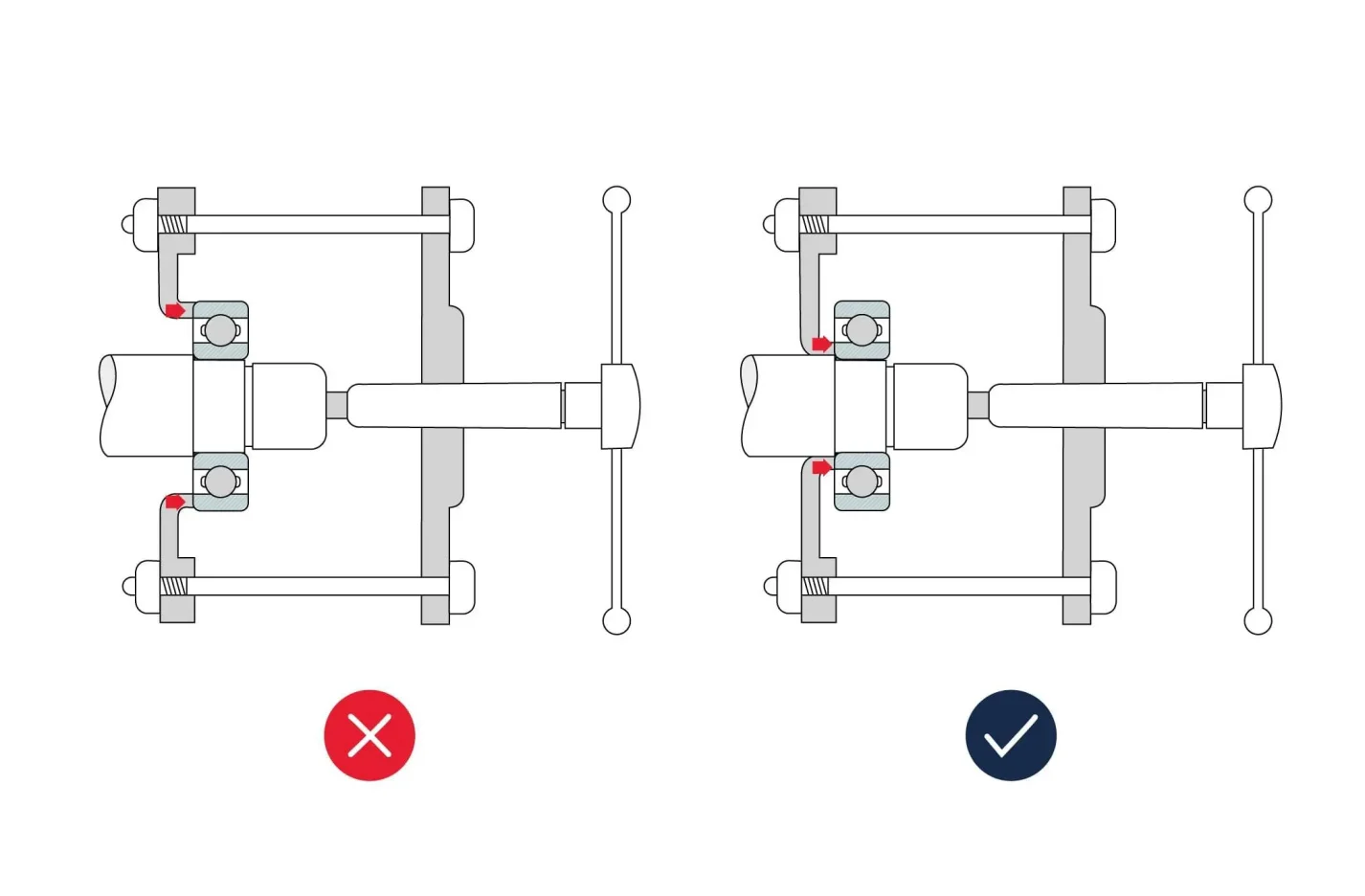
For more detail than fits here, SKF publishes step-by-step mounting and dismounting instructions for its ball bearing units, and NTN’s bearing units technical data reference covers the same ground for their product line.
Maintenance and Lubrication
Regular maintenance is what stands between a pillow block bearing hitting its rated life and an unplanned shutdown. That comes down to three things: lubrication, inspection, and knowing when to replace.
Lubrication Schedule
Most pillow block units are pre-greased at the factory and fitted with a grease fitting for re-lubrication. How often depends on speed, temperature, and how contaminated the environment is:
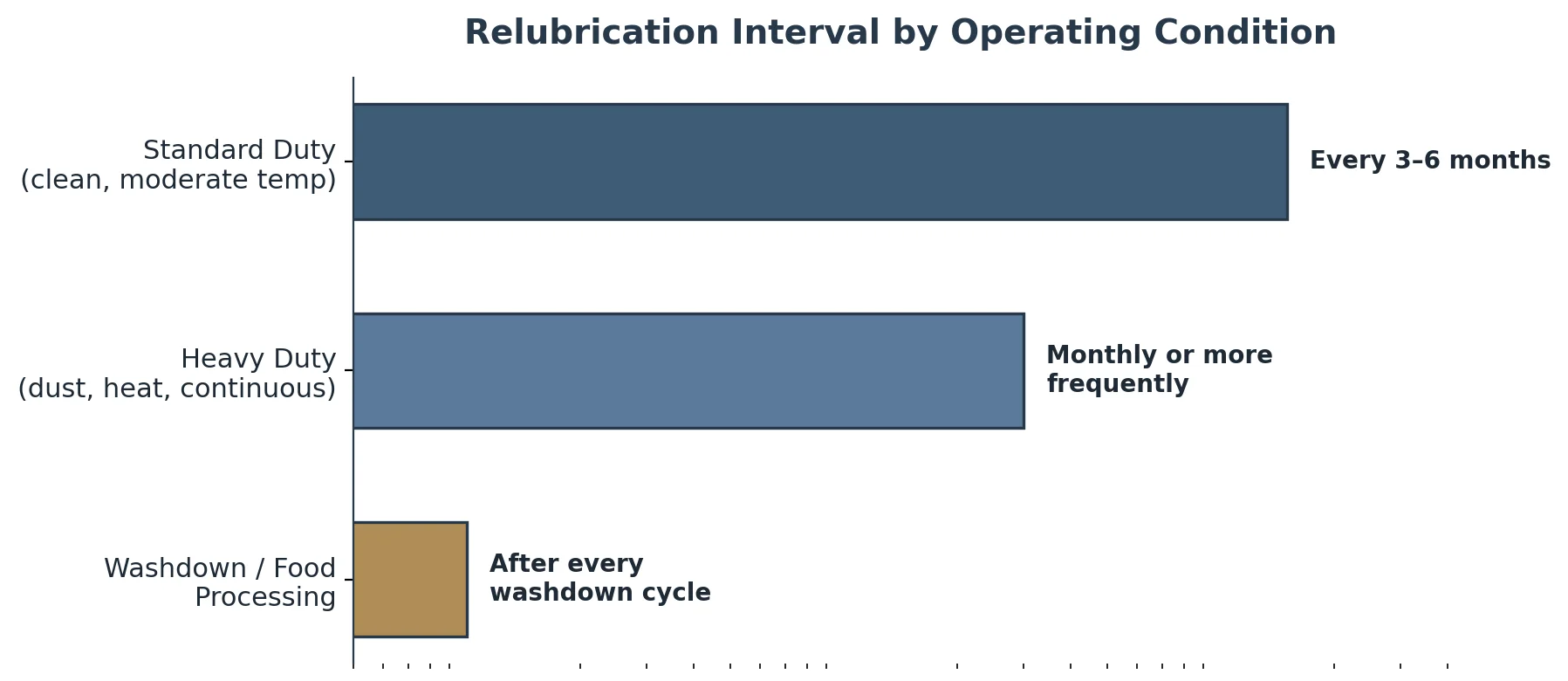
- Standard duty (clean, moderate temperature, 1,000–2,000 RPM): re-grease every 3–6 months
- Heavy duty (dusty, high temperature, continuous operation): re-grease monthly or more often
- Washdown / food processing: use NSF H1 food-grade grease and re-grease after every washdown cycle
When re-greasing, apply grease while the bearing turns slowly if possible, and stop as soon as fresh grease appears at the seal — over-greasing causes seal damage and overheating just as reliably as running dry does.
Inspection Checklist
- Noise — grinding, clicking, or whining points to contamination, insufficient lubrication, or damage
- Vibration — an increase suggests wear, misalignment, or imbalance in the rotating assembly
- Temperature rise — housing running more than 40°F above ambient signals lubrication failure, over-tightening, or bearing distress
- Seal leakage — grease past the seals means over-greasing or seal wear letting contaminants in
- Housing cracks or corrosion — structural damage to a cast iron or stamped steel housing calls for immediate replacement
When to Replace
Even with good maintenance, mounted bearings have a finite service life. Plan for replacement once any of the warning signs above don’t clear up with re-lubrication or re-alignment. For critical equipment, scheduled replacement by hours of operation — typically 10,000–20,000 hours for standard industrial duty — is worth considering, though load, speed, and environment shift that range considerably.
Frequently Asked Questions
What is the difference between a pillow block bearing and a plummer block?
They are related terms, but they are not always used to describe exactly the same type of bearing unit.
A pillow block bearing usually refers to a mounted bearing unit consisting of a housing and a bearing insert, commonly used in general industrial applications such as conveyors, fans, and machinery.
A plummer block traditionally refers to a split bearing housing designed for larger bearings and heavier industrial applications, where easy inspection and replacement are required without removing the shaft.
How do I choose between a split and a solid pillow block bearing?
Choose split when the shaft is hard to remove or access to the bearing is limited — the split housing lets you replace the insert without disturbing the shaft coupling or adjacent components. Choose solid for lighter-duty applications where cost matters more and shaft access is straightforward. Split units cost more but pay that back in maintenance flexibility on heavy industrial equipment.
What does UCP bearing mean?
“UC” identifies the insert itself — a wide inner-ring, deep groove ball bearing with a spherical outer diameter and set-screw locking. The letter that follows identifies the housing: “P” for a two-bolt pillow block base, giving UCP; the same insert in a four-bolt square flange is a UCF, in a round flange a UCFL, and in an adjustable slotted frame a UCT. The number after the letters is a bore code — for codes 04 and above, multiply by 5 to get the bore in millimeters (UCP206 → 06 × 5 = 30 mm).
How do I determine the correct pillow block bearing size for my shaft?
Measure the shaft diameter with a micrometer. Sizes are indexed by shaft diameter — a 30 mm shaft takes a UCP206, 40 mm a UCP208, 50 mm a UCP210 (see the size table above). Confirm the shaft tolerance too; standard bearings assume an h6–h9 clearance-fit shaft. For non-standard metric diameters, adapter or tapered sleeve options may cover the gap.
Can a pillow block bearing handle axial (thrust) loads?
Standard units with deep groove ball bearing inserts tolerate moderate axial load in both directions, but they’re designed primarily for radial load. For significant thrust loading, look at angular contact inserts or pair the pillow block with a separate thrust bearing, and check the manufacturer’s axial load rating against your actual thrust requirements before installing.
What is the maximum operating temperature for pillow block bearings?
Standard cast iron units with standard grease run from about -20°F to +220°F (-30°C to +105°C) — the grease, not the housing, is normally the limiting factor. Special high-temperature versions may operate at significantly higher temperatures depending on grease, seals, and bearing materials. Beyond that, talk to a bearing specialist about ceramic bearings or specialized lubrication.
How often should I lubricate my pillow block bearing?
It depends on the operating conditions. For standard applications at moderate speed (1,000–2,000 RPM) in a clean environment, re-grease every 3–6 months; for high-speed, high-temperature, or contaminated conditions, monthly or even weekly. Follow the manufacturer’s grease recommendation, and don’t mix incompatible greases — that can break down the lubricant and cause failure.
How to Choose a Reliable Pillow Block Bearing Supplier
Selecting the right pillow block bearing supplier is as important as choosing the correct bearing type — the best spec on paper still fails if the parts don’t match it consistently. A reliable supplier should be able to speak to each of the following without hedging.
Check Bearing Quality and Standards
- Material quality — ask what grade of steel or cast iron is used and whether mill certificates are available on request.
- Manufacturing tolerance — confirm the bearing is held to a stated ISO or ABMA tolerance class, not just “standard.”
- Bearing grade — check the dynamic and static load ratings are published, not estimated.
- Inspection process — ask whether units are batch-tested or individually inspected before shipping.
Verify Product Range and Compatibility
A supplier that stocks the full UCP, UCF, UCFL, and UCT range — not just the fastest-moving sizes — saves you from sourcing replacements from a second vendor later. Also confirm OEM replacement availability, so a discontinued housing doesn’t strand the rest of a working assembly.
Consider Customization and OEM Support
- Custom labeling and packaging — useful if the bearings will be resold or installed under your own brand.
- Private brand programs — worth asking about if you’re ordering at volume and want consistent branding across a product line.
- Bulk order terms — confirm minimum order quantities and lead times before committing to a supplier for recurring purchases.
Evaluate Technical Support
Bearing selection assistance, load calculation help, and application-specific recommendations matter most when a project falls outside the standard size charts — that’s when a supplier’s engineering support (or lack of it) actually gets tested.
Conclusion
Choosing the right pillow block bearing comes down to matching load, speed, environment, and shaft dimensions to the right housing and series. From the general-purpose UCP bearing to split housings built for heavy industrial duty, each configuration is built for a specific job. Start by confirming your shaft diameter and operating conditions, then match those against the selection criteria and size tables above to land on a mounted bearing that will actually hold up in service.
Before placing a bulk order, run through this checklist:
- Bearing load rating and tolerance grade — matched against your actual radial and axial loads, not just the shaft diameter.
- Housing material and corrosion resistance — appropriate for the environment the bearing will actually run in.
- Available sizes and replacement compatibility — so future replacements don’t depend on a single source.
- Production capacity and delivery time — especially for recurring or high-volume orders.
- Quality inspection reports — available on request, not just claimed.
- OEM customization capability — if you need private labeling, packaging, or branding.
If you need help selecting the correct pillow block bearing for your application, contact our engineering team with your shaft size, load requirements, and operating conditions — we’ll help you match it to the right series and housing before you order.