Choosing the right bearing shaft fit tolerance is one of the most consequential decisions in rotating machinery design — yet it is also one of the most misunderstood. Get it wrong and a bearing can creep on its shaft, lose its internal clearance, overheat, or fail months before its rated life. Get it right and the same bearing runs quietly for years. This guide explains what bearing shaft fit tolerance means, how the ISO 286 system classifies shaft tolerance classes such as j6, k6, and m6, and how to select the correct bearing shaft fit tolerance for your load conditions. Whether you are a design engineer, a maintenance technician, or a procurement professional sourcing replacement bearings, this essential reference will help you avoid the fit-related failures that account for a large share of premature bearing breakdowns.
What Is Bearing Shaft Fit Tolerance?
Bearing shaft fit tolerance is the permissible range of deviation between the nominal shaft diameter and the actual machined shaft diameter, expressed as an ISO 286 tolerance class such as k6 or m6. The fit between a bearing’s inner ring bore and the shaft determines whether the connection is a clearance fit, a transition fit, or an interference fit.
The bearing’s own bore is not exactly the nominal diameter either. Under ISO 492, a P0 (ABEC 1) bearing with a 25 mm bore is manufactured between 24.990 mm and 25.000 mm — in other words, the bore tolerance is 0/−10 μm. The shaft tolerance class is chosen relative to that fixed bore tolerance. Together, the two determine the actual tightness of the connection at assembly.
Three fit types result from the combination:
- Clearance fit — the shaft is always smaller than the bore; the inner ring can slide or float (classes like g6, f6).
- Transition fit — the connection may be a slight clearance or a slight interference depending on the actual dimensions (h6, j6).
- Interference fit — the shaft is always larger than the bore; the inner ring is locked onto the shaft (k6, m6, n6, p6).
Because the inner ring is thin and elastic, an interference fit expands it radially. That expansion is what holds the bearing firmly on the shaft — and it is also what reduces the bearing’s internal radial clearance, a trade-off explored later in this guide. Getting the bearing shaft fit tolerance right at the design stage prevents most of these problems before they start.
How Bearing Shaft Fit Tolerance Is Classified
Bearing shaft fit tolerance follows the ISO 286 limits and fits system, the international standard for linear size tolerances. Each class is written as a letter plus a grade — the letter defines the position of the tolerance zone relative to the nominal size (the fundamental deviation), and the grade number defines the width of the zone (IT grade). A higher grade number means a wider tolerance band.
ISO 286 Shaft Tolerance Classes Used with Bearings
For bearing applications, the practical classes are g6, h6, j6, k6, m6, n6, and p6. The following table lists the deviation ranges for these classes across common bearing bore sizes, in micrometres (μm). The upper value is the maximum shaft oversize (es) and the lower value is the minimum (ei):
| Shaft Diameter (mm) | g6 (μm) | h6 (μm) | j6 (μm) | k6 (μm) | m6 (μm) | n6 (μm) | p6 (μm) |
|---|---|---|---|---|---|---|---|
| 25 (6205) | −7/−20 | 0/−13 | +9/−4 | +15/+2 | +21/+8 | +28/+15 | +35/+22 |
| 40 (6208/6308) | −9/−25 | 0/−16 | +11/−5 | +18/+2 | +25/+9 | +33/+17 | +42/+26 |
| 60 (6212/6312) | −10/−29 | 0/−19 | +13/−6 | +21/+2 | +30/+11 | +39/+20 | +51/+32 |
| 90–120 | −12/−34 | 0/−22 | +16/−6 | +25/+3 | +35/+13 | +45/+23 | +59/+37 |
Reading the table: a 25 mm shaft machined to k6 must measure between 25.002 mm and 25.015 mm. Every ISO-compliant machine shop in the world interprets k6 identically, which is why the system makes sourcing and cross-referencing so reliable.
How the Fit Is Calculated
The actual fit is the difference between the shaft deviation and the bearing bore deviation. For a 6205 deep groove ball bearing (25 mm bore, P0 tolerance 0/−10 μm) the resulting fits are:
| Shaft Class | Shaft Range (μm) | Tightest Fit (μm) | Loosest Fit (μm) | Fit Type |
|---|---|---|---|---|
| g6 | −7/−20 | +3 | −20 | Transition (clearance-leaning) |
| h6 | 0/−13 | +10 | −13 | Transition |
| j6 | +9/−4 | +19 | −4 | Transition (interference-leaning) |
| k6 | +15/+2 | +25 | +2 | Full interference |
| m6 | +21/+8 | +31 | +8 | Full interference |
| n6 | +28/+15 | +38 | +15 | Interference, heavier |
| p6 | +35/+22 | +45 | +22 | Heavy interference |
k6 is the industrial default for good reason: it guarantees a minimum of +2 μm interference under every tolerance combination, preventing inner ring creep, while keeping the maximum interference modest enough to preserve internal clearance.
Why Bearing Shaft Fit Tolerance Matters in Practice
The correct bearing shaft fit tolerance is not a cosmetic detail — it directly controls three failure mechanisms: creep, clearance loss, and fretting. Understanding the load conditions that drive the choice is the difference between a bearing that lasts and one that fails early.
Rule 1: Match the Fit to the Rotating Load
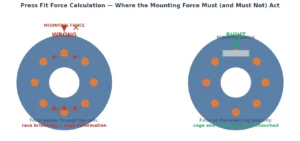
The most important rule of bearing shaft fit tolerance selection is that the ring subjected to a rotating load must be mounted with an interference fit. If the inner ring rotates with the shaft while the radial load direction stays fixed (the most common case — motor shafts, pump shafts, conveyor rollers), the load rotates relative to the inner ring. That ring must be locked to the shaft with an interference fit, or it will slowly creep around the shaft, wearing the journal and generating heat, vibration, and fretting corrosion.
Conversely, if the outer ring rotates with the load (wheel hubs, pulley arrangements), the outer ring must be interference-fitted into the housing while the inner ring can use a looser fit such as g6 or h6. The rule of thumb engineers use: “whoever carries the rotating load gets the interference fit.” Applying this rule correctly is the single biggest factor in bearing shaft fit tolerance selection, and it is documented in the ISO 492 rolling bearing tolerance standard that governs bearing bore and outside diameter deviations.
Rule 2: Scale the Interference to the Load Magnitude
Once the rotating ring is identified, the amount of interference is scaled to the load ratio P/C (equivalent dynamic load ÷ basic dynamic load rating):
| Load Condition | P/C Ratio | Ball Bearings | Roller Bearings |
|---|---|---|---|
| Light / variable load | P ≤ 0.07C | j6 | k6 |
| Normal load | 0.07C < P ≤ 0.15C | k6 | m6 |
| Heavy / shock load | P > 0.15C | m6 | n6 |
| Very heavy, thin rings, high speed | — | n6 / p6 | p6 |
Roller bearings are specified one class tighter than ball bearings of the same size because cylindrical and spherical roller bearings cannot absorb axial misalignment the way deep groove ball bearings can — the ring must be held firmly to keep the rolling elements correctly aligned in their raceways.
Rule 3: Account for Internal Clearance Loss
An interference fit stretches the inner ring outward, consuming radial internal clearance. The clearance loss is roughly 60–80% of the interference value for a solid shaft. A 6205 bearing mounted with k6 (average interference ≈ 8 μm) loses roughly 5–7 μm of radial clearance. Standard C0 (Normal) clearance for a 6205 is only about 5–20 μm, so a heavy fit can leave very little clearance — or none at all.
When the fit is m6 or tighter, or when operating temperatures expand the shaft faster than the housing, select a bearing with C3 increased clearance to keep a positive running clearance. An insufficient clearance (not excessive) after mounting causes overheating, vibration, or even seizure — a common failure mode that is often misdiagnosed as a lubrication problem.
Rule 4: Respect the Surface Finish
Interference is calculated on nominal surfaces, but real surfaces have roughness peaks. During press fitting, those peaks crush down — typically cancelling roughly 60% of the roughness height — so a rough shaft can silently remove 5–8 μm of effective interference. This is a leading reason why a k6 fit still creeps in the field, and it is why the recommended bearing shaft fit tolerance always assumes a properly finished journal. Machine the shaft journal to Ra ≤ 0.8 μm (0.4–0.8 μm recommended), hold roundness and cylindricity to about one-third of the tolerance band, and verify the shaft shoulder radius is smaller than the bearing’s chamfer so the inner ring seats fully.
Practical Shaft Fit Guide for Common Bearing Sizes
For the most common deep groove ball bearing sizes under normal rotating-inner-ring loads, the standard recommendation is k6 (j6 for light loads, m6 for heavy loads). The following table gives the machined shaft diameter ranges for the standard k6 recommendation:
| Bearing Size | Bore (mm) | Recommended Fit | Shaft Range (mm) |
|---|---|---|---|
| 6203 / 6303 | 17 | k6 | 17.002 – 17.012 |
| 6204 / 6205 | 20 / 25 | k6 | 25.002 – 25.015 |
| 6206 / 6306 | 30 | k6 | 30.002 – 30.015 |
| 6208 / 6308 | 40 | k6 | 40.002 – 40.018 |
| 6210 / 6310 | 50 | k6 | 50.002 – 50.018 |
| 6212 / 6312 | 60 | k6 | 60.002 – 60.021 |
| NU207 | 35 | m6 | 35.009 – 35.025 |
Bearings manufactured to ISO 492 P0 tolerance — including Talos deep groove ball bearings — conform to the same bore tolerance classes as SKF, NSK, FAG, and NTN equivalents, so the recommended shaft tolerance applies identically regardless of brand. The dimension standards guarantee that a Talos 6201 ZZ bearing, for example, is functionally interchangeable with premium-brand equivalents and accepts the same k6 shaft.
Common Misconceptions About Shaft Fit Tolerance
Misconception 1: “An interference fit is always better”
An interference fit is only required on the ring that carries a rotating load. Applying k6 or tighter to a stationary inner ring (tensioning pulleys, idler rollers) makes assembly and disassembly unnecessarily difficult and can consume clearance you need for thermal expansion. Match the fit to the load condition, not to habit.
Misconception 2: “The tolerance class on paper is what I get in practice”
A k6 callout is meaningless if the machinist measures the shaft with a worn micrometer, if the surface finish is rough, or if the shaft is out-of-round. Roughness peaks crush during mounting and eat effective interference; out-of-round journals only grip at the high spots. Always measure the finished journal and verify surface finish before assembly — the actual bearing shaft fit tolerance in service is the one you measure, not the one you specified.
Misconception 3: “ABEC rating changes the fit I need”
ABEC/ISO precision grades (P0, P6, P5, P4) describe the bearing’s own dimensional and running accuracy — they do not change the shaft fit selection logic. A P5 bearing still needs a k6 shaft under rotating load; the tighter precision grade simply narrows the bearing’s own bore tolerance band. Do not substitute an ABEC upgrade for a correct fit.
Misconception 4: “I can sand the shaft to fix a tight fit”
Hand-sanding a shaft to make an interference fit go together destroys roundness and surface finish, guaranteeing premature failure. If the fit is too tight, re-machine the journal to the correct tolerance or switch to a lighter fit class. If it creeps, check for roughness-induced interference loss before blaming the bearing.
Frequently Asked Questions
What is the recommended bearing shaft fit tolerance for a rotating inner ring?
For a normal load on a rotating inner ring, the standard recommendation is k6 for ball bearings (j6 for light loads, m6 for heavy loads) and m6 for roller bearings. Under a 25 mm bore, k6 means the shaft must measure 25.002–25.015 mm. This bearing shaft fit tolerance table is the one most bearing manufacturers publish, and it applies to any ISO-compliant bearing regardless of brand.
What is the difference between j6, k6, and m6 shaft fits?
j6 is a transition fit (possible clearance or light interference, +9/−4 μm at 25 mm), k6 is a guaranteed light interference (+15/+2 μm at 25 mm), and m6 is a heavier interference (+21/+8 μm at 25 mm). Moving from j6 to m6 increases the holding force but consumes more internal clearance.
Does a tight shaft fit reduce bearing internal clearance?
Yes. An interference fit stretches the inner ring outward and consumes roughly 60–80% of the interference value from the radial internal clearance. With heavy fits (m6 and tighter) or large temperature differentials, specify C3 clearance so the bearing retains a positive running clearance. Insufficient clearance causes overheating, vibration, and seizure — this is why the bearing shaft fit tolerance and the clearance class must always be specified together, never independently.
Can I use the same shaft tolerance for ball and roller bearings?
No. Roller bearings are normally specified one class tighter than ball bearings (k6 → m6, m6 → n6) because cylindrical and spherical roller bearings cannot tolerate ring movement or misalignment the way deep groove ball bearings can.
Is a Talos bearing manufactured to the same tolerance standards as SKF or NSK?
Yes. Talos bearings are manufactured to ISO 492 P0 (ABEC 1) tolerance with C0 (Normal) clearance as standard, making them effectively equivalent to SKF, NSK, FAG, and NTN bearings of the same designation. The same ISO 286 shaft tolerance classes apply, so a Talos 6201 ZZ accepts the identical k6 shaft as a premium-brand 6201-2Z.
What surface finish should the shaft journal have?
The shaft journal should be machined to Ra ≤ 0.8 μm (0.4–0.8 μm recommended) for bearing mounting. Rough surfaces crush during press fitting and silently remove several micrometres of effective interference, which is a common cause of inner ring creep despite a correct nominal fit.
Conclusion
Selecting the correct bearing shaft fit tolerance comes down to four rules: match the fit to the rotating load, scale interference to the P/C ratio, protect internal clearance, and respect surface finish. In most rotating-shaft applications, k6 is the safe, proven default for ball bearings — it guarantees positive interference without starving the bearing of clearance. When in doubt, consult the ISO 286 tables, verify the machined journal, and consider C3 clearance for heavy fits or high thermal differentials. For detailed mounting procedures that complement this guide, see our bearing mounting techniques guide, and for the manufacturer-side dimensional rules behind the fit, refer to the SKF bearing mounting guidelines.
Need reliable deep groove ball bearings for your application? Browse our Deep Groove Ball Bearings collection — including the 6202ZZ and 6201 ZZ — or contact our team for technical assistance with shaft fit selection and mounting recommendations.