Grease compatibility decides whether a bearing keeps running smoothly or fails months early. When two different brands, thickeners, or base oils are mixed, the combined grease can harden into a stiff mass that starves the rolling elements, or soften into a watery film that leaks past the seals. Both outcomes shorten bearing life. This guide explains what grease compatibility really means, how thickeners and base oils interact when they meet inside a bearing, and the six essential rules that keep thickening and softening from ever becoming your problem.
What Grease Compatibility Means for a Bearing
Grease is not a single substance. It is a three-part system: roughly 70–95% base oil that carries the load, 5–20% thickener that holds the oil in a three-dimensional network, and 0–10% additives that fight oxidation, wear, and corrosion. Think of the thickener as a sponge and the base oil as the water inside it. In a rolling bearing, that sponge-oil system is the component that actually separates the rolling elements from the raceways.
Grease compatibility is the property that describes what happens when two of these systems are combined. Compatible greases blend without any meaningful change in structure. Incompatible greases react: the mixed thickener network can stiffen (thickening), collapse (softening), or release its oil (separation). The result is never neutral — it is a grease that no longer behaves like either of the two products you intended to use.
This matters more than most maintenance teams realise. The vast majority of rolling bearings in industry are grease-lubricated — SKF’s engineering material on rolling bearing lubrication treats grease as the decisive factor in bearing reliability — and a bearing is only as good as the film inside it. When relubrication or a grease change is done carelessly, the bearing does not fail on the day of the mix — it fails weeks or months later, usually attributed to “lubrication failure” rather than to the incompatible top-up that caused it.
How Grease Compatibility Is Judged: Thickener, Base Oil, and Test Data
Three independent factors decide whether two greases can share a bearing: the thickener chemistry, the base oil family, and the measured test data that confirm the blend stays stable.
Thickeners: the primary grease compatibility gate
The thickener is responsible for most incompatibility problems. Common rolling-bearing thickeners include lithium soap (the industry workhorse), lithium complex, polyurea, calcium sulfonate complex, aluminum complex, and organoclay (bentonite). Each forms a different physical network, and those networks do not cooperate when mixed.
| Mixed thickener pair | Grease compatibility verdict | Typical result in service |
|---|---|---|
| Lithium + lithium complex | Compatible | No meaningful change |
| Lithium + aluminum complex | Compatible | No meaningful change |
| Lithium + calcium sulfonate | Marginal | Check test data before mixing |
| Lithium + polyurea | Incompatible | Grease hardens, starvation, overheating |
| Soap + organoclay (bentonite) | Incompatible | Thickener network collapses, oil separates |
| Sodium soap + other soaps | Incompatible | Softening and water emulsification |
| Polyurea + any soap thickener | Incompatible | Hardening |
The pattern to remember: the classic failure mixes are lithium plus polyurea (hardening), soap plus clay (oil separation), and anything involving sodium soap (softening). The same thickener family from different brands is normally safe to mix, but the next two gates still apply.
Base oil families: mineral, PAO, ester, PAG, silicone, PFPE
Even with a compatible thickener, the base oils must be miscible. Mineral oils (Group I–III) and PAO (Group IV) are both hydrocarbons and mix freely — that is why mineral-oil and PAO greases are generally interchangeable from a base-oil standpoint. Ester greases (Group V) are polar and usually blend acceptably, but the thickener and seal materials must be checked. The true danger zone is PAG, silicone, and PFPE: none of these mix with hydrocarbon oils, and the blend separates or forms sludge instead of a working film.
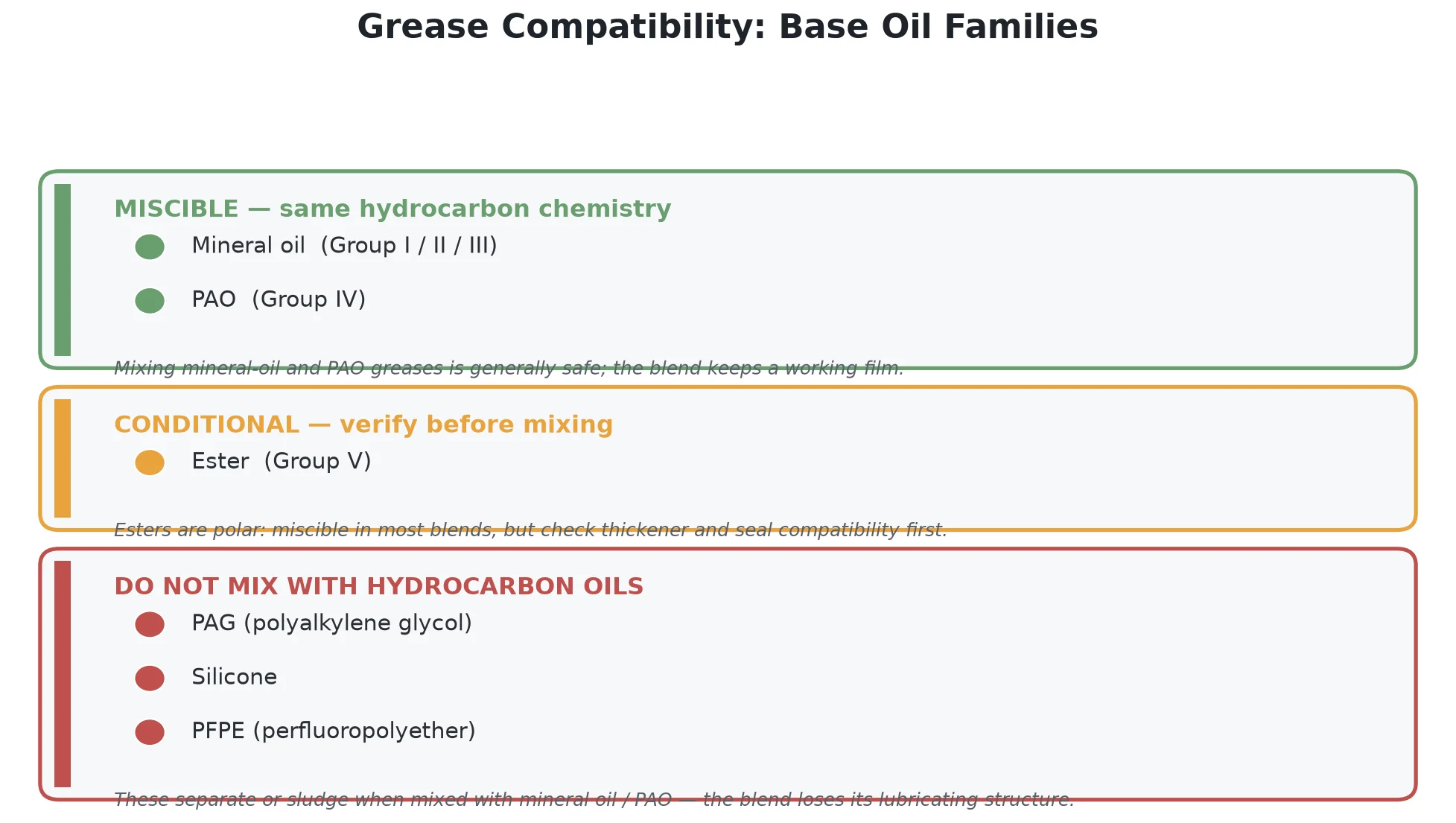
Practical rule of thumb: if the two greases are hydrocarbon-based (mineral or PAO), the base oils are not the problem. If one of them is a specialty grease (PAG, silicone, PFPE, or a heavily ester-based formulation), treat the mix as incompatible unless the manufacturer says otherwise.
ASTM D6185: the standard grease compatibility test
When compatibility is genuinely in doubt, the industry answer is ASTM D6185, the Standard Practice for Determining Compatibility of Lubricating Greases. The method blends the two greases 50/50, then measures the worked penetration (ASTM D217) and the dropping point (ASTM D566 or D2265) of the mixture against the two originals. As a practical benchmark, a change in worked penetration of more than about 25 units (0.1 mm) or a significant drop in dropping point flags the pair as incompatible.
Two caveats are worth knowing. First, ASTM D6185 results are temperature- and time-dependent: a pair can pass the test and still drift apart at operating temperature over months. Second, the test uses a 50/50 blend, so a small top-up that looks harmless on paper can still trigger a slow incompatibility reaction. Test data and manufacturer charts beat guesswork every time.
The 6 Essential Rules to Avoid Thickening or Softening
Rule 1: Never mix different thickener families
The single most reliable way to keep grease compatibility problems out of a bearing is to check the thickener before any top-up. The thickener type is printed on the container or data sheet of every reputable grease — lithium, lithium complex, polyurea, calcium sulfonate, aluminum complex, clay. If the thickener families differ, do not mix them. If they match, you still have to clear the next four rules.
Rule 2: Match the base oil family
Hydrocarbon base oils (mineral and PAO) mix safely, so a mineral-oil grease and a PAO grease with the same thickener are effectively compatible. Esters need confirmation. PAG, silicone, and PFPE greases must be treated as incompatible with hydrocarbon greases regardless of thickener — the oils simply do not mix, and the result is separation, sludge, and a bearing that runs dry in patches.
Rule 3: Align NLGI grade and viscosity, not just chemistry
Two lithium greases can still disappoint if they are different grades. NLGI 2 is the standard consistency for rolling bearings; mixing it with an NLGI 0 grease pulls the blend down to roughly NLGI 1, which may be too soft for the application and leak past seals. The same logic applies to base-oil viscosity: a heavy ISO VG 220 grease topped up with an ISO VG 32 grease produces a film that may no longer carry the load. Match thickener, base oil family, NLGI grade, and viscosity before mixing anything.
Rule 4: Know the classic incompatible pairs by heart
Some combinations fail so reliably that they deserve to be memorised: lithium plus polyurea hardens into a stiff, channeling mass; soap-based greases mixed with organoclay greases lose their structure and bleed oil; sodium-soap greases soften and emulsify with water. Whenever one of these pairs appears in a relubrication plan, stop and check the grease compatibility chart published by the grease manufacturer before proceeding.
Rule 5: Purge thoroughly when changing grease — never just top up
If the old grease and the new grease are not proven compatible, the change must be a purge, not a top-up. Relubricate the bearing until fresh grease appears at the drain or relief fitting, run the machine briefly, then purge again to flush residual old grease from the rolling-element path. Clean the housing cavity and refill to about one-third to one-half of the free space — a fully packed housing traps heat and forces grease out past the seals. A thorough purge costs minutes; a soft or hardened mix costs a bearing.
Rule 6: Verify with a small-batch test or the manufacturer’s chart
When you must mix or change grease and the data is not clear, run the verification the standard way: blend a small sample of the two greases 50/50, work it by hand or in a small mixer, and compare the consistency and oil release against the originals. A stiff, crumbly, or weeping blend is a failed ASTM D6185-style check, no matter what the labels claim. Wherever a manufacturer publishes a grease compatibility chart — most major grease and bearing brands do — use it as the final authority. When in doubt, the safest answer is always the same grease you already use.
How to Spot the Damage: Hardening vs Softening Symptoms
Knowing the symptoms of an incompatible mix turns a mystery failure into a preventable one. Hardening shows up as rising torque and operating temperature, a dry or channelled grease path, and eventual lubricant starvation — the classic prelude to overheating and seizure. Softening shows up as oil bleeding, grease weeping past the seals, and a progressively thinner film, which invites wear and lets contamination in through the same leak path.
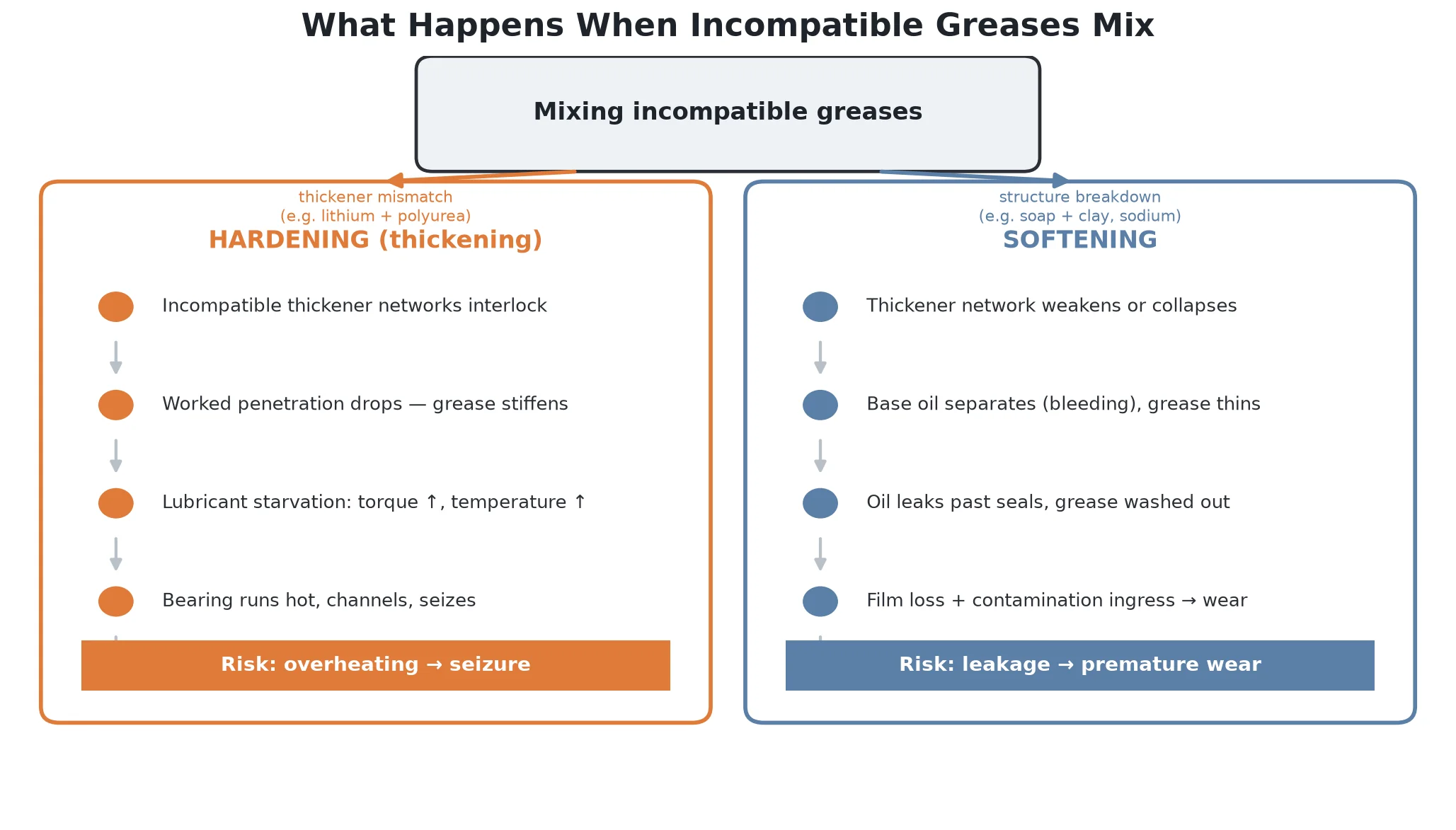
| Failure direction | Typical symptoms | End state if ignored |
|---|---|---|
| Thickening (hardening) | Torque rise, higher temperature, starvation, channeling | Overheating, seizure |
| Softening | Oil bleeding, leakage past seals, thin film | Wear, contamination ingress |
Contamination is frequently the silent partner in this story: a softened grease that leaks also opens the door for the particles that do most of the real damage. Our guide to bearing contamination control shows how even micron-level particles cut rated life dramatically once the grease film is compromised. And because an incompatible mix usually surfaces as a failure, not as a grease problem, it is worth ruling out lubricant compatibility before blaming the bearing itself — SKF’s bearing failure analysis material and our own bearing failure analysis guide both walk through the failure modes in that order.
For buyers of sealed bearings, the compatibility question starts at the factory: a sealed deep groove ball bearing arrives with a specific grease already locked inside. Talos sealed bearings such as the Talos 6201 ZZ bearing and the Talos 6205 2RS bearing are pre-packed with a lithium-soap NLGI 2 grease — the same family used by SKF LGMT and most standard motor greases — so field relubrication with any quality lithium-based NLGI 2 grease keeps grease compatibility intact without a purge. That detail matters: it is one less variable between the factory and the field.
Common Misconceptions About Grease Compatibility
“Same colour means compatible”
Colour is dye, not chemistry. A red lithium grease and a red polyurea grease are still incompatible, and a manufacturer can tint any chemistry any colour. Read the thickener and base oil on the label, never the colour.
“Same brand always means compatible”
A single brand’s catalogue spans lithium, lithium complex, polyurea, calcium sulfonate, and specialty greases. Two tubes from the same brand can be as incompatible as two brands. The brand is irrelevant; the thickener and base oil family are what matter.
“Mineral and synthetic greases never mix”
This one is backwards. Mineral oil and PAO are both hydrocarbons and mix freely, which is why the most common “synthetic” greases are safely compatible with mineral-oil lithium greases. The real danger pairs are lithium plus polyurea, soap plus clay, and PAG, silicone, or PFPE oils with hydrocarbon oils.
“A small top-up of incompatible grease won’t hurt”
Even a 10% addition can seed a slow incompatibility reaction that takes months to show. ASTM D6185 tests a 50/50 blend, so a small top-up is not automatically safer — it is just slower to fail. Small mixes deserve the same chart check as full changes.
“Hardening just means the grease dried out”
Hardening is often mistaken for age or heat alone. If the grease was recently topped up with a different chemistry, the stiffness may be an incompatibility reaction — and adding more of the same foreign grease will only harden it further. Check the compatibility question before adding anything.
Frequently Asked Questions
Can you mix different brands of bearing grease?
Only if they are compatible. Compare the thickener type, base oil family, NLGI grade, and viscosity first. Different brands that use the same lithium-soap, mineral-oil NLGI 2 chemistry are normally safe to mix; different thickener families are not.
What happens if you mix lithium and polyurea grease?
The two thickener networks interlock into a harder structure, so the blend stiffens. The hardened grease channels and starves the bearing, raising torque and temperature until the bearing overheats or seizes. This is the classic grease compatibility failure.
Can you mix mineral and synthetic grease?
Usually yes, when the synthetic base oil is PAO — mineral oil and PAO are both hydrocarbons and miscible. Ester and specialty synthetics need a chart check, and PAG, silicone, and PFPE greases must not be mixed with hydrocarbon greases at all.
How is grease compatibility tested?
The standard method is ASTM D6185: blend the two greases 50/50 and measure the worked penetration and dropping point of the mixture against the originals. A change in worked penetration beyond roughly 25 units, or a significant dropping-point drop, flags incompatibility.
What does a grease compatibility chart show?
A compatibility chart maps thickener families against each other as compatible, marginal, or incompatible. It is the fastest pre-mix check: find the two thickener types, read the intersection, and only proceed if the verdict is compatible — then verify NLGI grade and base oil on top.
Is Talos bearing grease compatible with SKF LGMT 2?
Effectively compatible. Talos sealed bearings are pre-packed with a lithium-soap NLGI 2 grease, the same chemistry family as SKF LGMT 2 and most standard motor greases. Re-lubricating a Talos bearing with any quality lithium-based NLGI 2 grease preserves grease compatibility without a purge.
Conclusion
Grease compatibility is not a lab curiosity — it is the difference between a bearing that runs its full service life and one that dies prematurely after an innocent-looking top-up. Check the thickener first, match the base oil family, align the NLGI grade and viscosity, memorise the classic incompatible pairs, purge instead of topping up when you change grease, and verify with a chart or a small-batch test when anything is uncertain. The full deep groove ball bearing range at Talos ships with a standard lithium-based NLGI 2 grease, so the compatibility question is answered before the bearing reaches your machine — and our oil vs grease lubrication guide helps you decide whether grease is even the right choice for the duty.
Need bearings that arrive ready to run — or advice on relubrication for an existing installation? Browse the Talos deep groove ball bearing range for pre-greased sealed options, or contact our engineering team with your application details — we respond to technical and quote requests within 24 hours.