Deep groove ball bearings are the default choice for rolling-element support in industrial machinery, automotive systems, and household appliances — and for good reason. A row of balls running in deep, continuous raceway grooves lets the bearing carry radial loads and moderate axial loads in both directions, with less friction than almost any other bearing geometry.
This guide walks through the main types, standard sizes and dimensions, typical applications, and the selection factors that actually matter when you’re specifying one. If you’re choosing between a single row bearing for an electric motor and a double row bearing for a gearbox, the differences below should make the decision straightforward.
What Is a Deep Groove Ball Bearing?
A deep groove ball bearing is a radial rolling bearing with deep, continuous grooves machined into both the inner and outer raceways. The ball complement sits in these grooves, and the geometry lets the bearing take radial loads, axial loads in either direction, and combined loading — all in a compact envelope.
What sets this design apart is how closely the raceway’s curvature radius matches the ball diameter. That close conformity spreads contact stress over a larger area of each ball, which is why deep groove bearings carry more load than shallow-groove or non-grooved designs of the same size.
Manufacturing is governed by ISO 492, ABEC/ANSI, and DIN 620 tolerance standards, and the size range runs from miniature bearings under 10 mm bore up to large industrial units above 400 mm. Open, shielded, sealed, and snap-ring variants cover most operating environments. SKF and NSK, among other major manufacturers, publish full technical catalogs for their product lines.
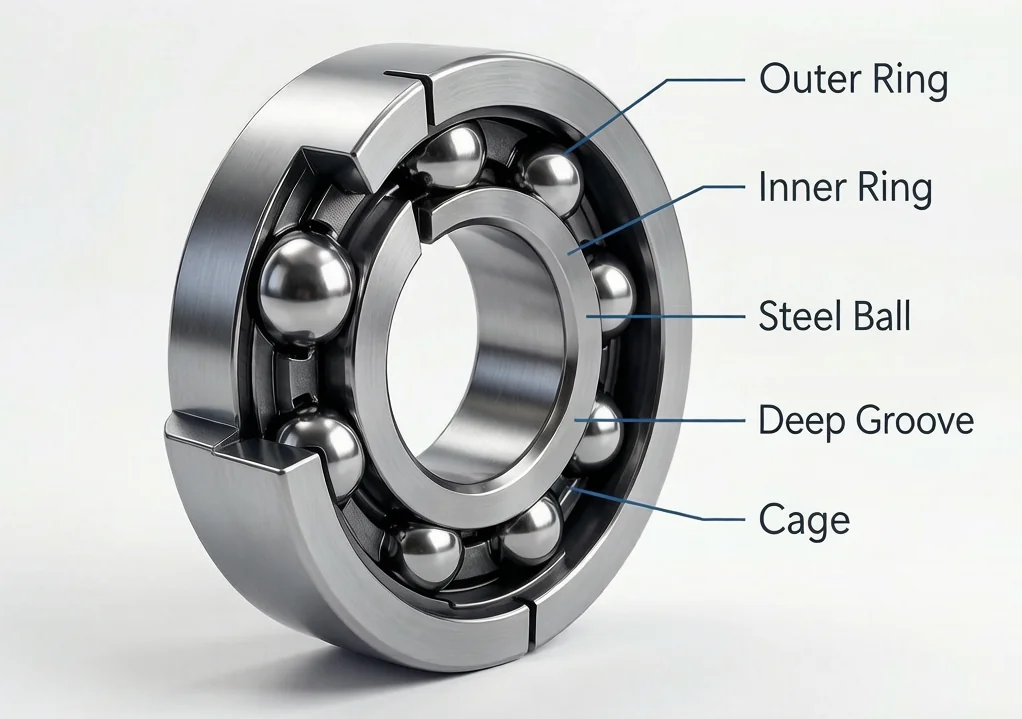
Figure 1: Deep groove ball bearing cross-section, showing the outer ring, inner ring, ball complement, deep raceway groove, and cage.
Types of Deep Groove Ball Bearings
Deep groove ball bearings break down into a few subtypes based on row configuration, sealing method, and ring design — and picking the right one matters more than it might seem.
Single Row Deep Groove Ball Bearing
The single row design is the workhorse of the category — it accounts for the majority of ball bearing applications worldwide. A single row of balls between the inner and outer rings gives the best overall balance of load capacity, speed, and cost. You’ll find these in electric motors, pumps, conveyors, fans, and automotive components like alternators and gearbox shafts.
Standard metric series are 60, 62, 63, and 64 (per ISO 15), with bore diameters from 10 mm to 200 mm covering most common sizes. Popular industrial choices include the 6201ZZ and 6202ZZ deep groove ball bearings. They come open (no seals), shielded (ZZ), or sealed (2RS).
Double Row Deep Groove Ball Bearing
Double row bearings pack two rows of balls into a single inner and outer ring assembly, which pushes radial load capacity up by roughly 60–80% over a single row bearing of the same bore — without giving up bidirectional axial load handling.
They show up in gearboxes, pumps, industrial fans, and heavy-duty conveyors, anywhere higher capacity has to fit in limited space. The trade-off is speed: double row bearings run slower than their single row counterparts. Standard series are 42 and 43.
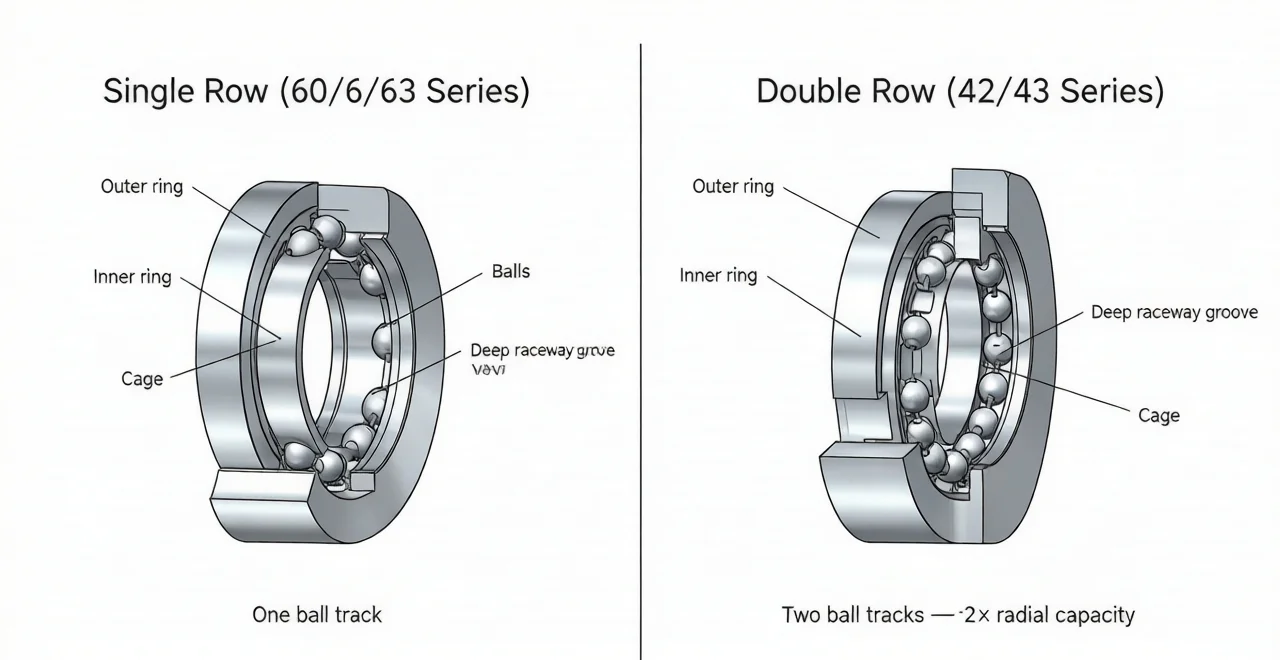
Figure 2: Single row bearings (60/62/63 series) use one ball track; double row bearings (42/43 series) use two, roughly doubling radial capacity in a similar envelope.
Sealed and Shielded Deep Groove Ball Bearings
Protecting the internal rolling elements from contamination is critical for bearing service life. These bearings are commonly fitted with:
- Metal shields (ZZ / 2Z) — stamped steel, non-contact or low-friction. They keep out large debris with almost no added torque. Good for moderate contamination.
- Rubber seals (2RS / 2RU) — elastomeric seals bonded to a metal insert, contact or non-contact. Contact seals (RS) give the best protection and hold grease longest, at the cost of some extra friction.
- Open (no seals) — for clean environments, or where an external lubrication system already handles contamination control.
Deep Groove Ball Bearings with Snap Ring Groove
Some bearings have a groove machined into the outside diameter of the outer ring, sized for a snap ring (circlip) that locates the bearing axially in the housing. It’s a simple way to cut housing machining and simplify assembly. You’ll see this on automotive transmissions, electric motors, and pump assemblies where there isn’t room for a conventional retaining method.
For a full selection of configurations, visit our deep groove ball bearings category page to browse available types and dimensions.
Deep Groove Ball Bearing Sizes and Dimensions
Getting the dimensions right is the difference between a bearing that lasts and one that doesn’t. ISO 15 sets the boundary dimensions — bore diameter d, outside diameter D, and width B — for each metric series. The chart below covers the most commonly specified sizes in the 60, 62, and 63 series.
| Bearing Designation | Bore (d) — mm | Outside Dia. (D) — mm | Width (B) — mm | Dynamic Load Cr (kN) | Static Load Cor (kN) |
|---|---|---|---|---|---|
| 6004 | 20 | 42 | 12 | 9.95 | 5.00 |
| 6005 | 25 | 47 | 12 | 10.5 | 5.85 |
| 6006 | 30 | 55 | 13 | 13.8 | 8.30 |
| 6204 | 20 | 47 | 14 | 13.5 | 6.65 |
| 6205 | 25 | 52 | 15 | 14.8 | 7.80 |
| 6206 | 30 | 62 | 16 | 20.3 | 11.2 |
| 6304 | 20 | 52 | 15 | 16.8 | 7.80 |
| 6305 | 25 | 62 | 17 | 23.4 | 11.6 |
| 6306 | 30 | 72 | 19 | 29.5 | 16.0 |
| 6308 | 40 | 90 | 23 | 41.0 | 24.0 |
This is a snapshot, not the full picture — for complete dimensional data across every series and tolerance class, check the relevant ISO standard or your supplier’s technical catalog. Our ball bearings category page has detailed specs for each product.
Bore and outside diameter aren’t the whole story, though. Radial clearance (C2, CN, C3, C4) and tolerance class (P0/P6/P5/P4) both affect running accuracy, heat generation, and service life, so factor them into the bearing selection too.
Common Applications of Deep Groove Ball Bearings
Deep groove ball bearings turn up almost everywhere something rotates. Here’s where they’re used most.
Electric Motors
Electric motors are the biggest single application by volume. From fractional-horsepower fan motors up to large industrial induction motors, single row bearings support the rotor, absorb belt tension loads, and accommodate thermal expansion. The 62 and 63 series dominate motor end-bell assemblies.
Pumps and Compressors
Centrifugal pumps, vacuum pumps, and air compressors all use them to support impeller shafts and keep shaft position precise. Pump applications generally call for sealed or shielded variants to keep coolant or process fluid out.
Gearboxes and Transmissions
In gearboxes, they locate shafts axially and carry the radial loads generated by gear mesh forces. Higher-load positions often call for double row bearings, while single row bearings work fine on high-speed input shafts. Get the internal clearance class right — typically C3 — to handle thermal expansion during operation.
Conveyors and Material Handling
Conveyor rollers, belt tensioners, and idler pulleys typically use sealed variants to keep dust and debris out in warehouse and mining environments. Snap-ring groove bearings simplify housing design here too.
Automotive Applications
A modern vehicle has dozens of them — alternators, water pumps, A/C compressors, wheel hub units, tensioner pulleys, steering columns. Automotive demand is what pushes seal design, grease formulation, and NVH (noise-vibration-harshness) performance forward.
Agricultural and Construction Machinery
Tractors, harvesters, excavators, and loaders use them in pulley systems, fan drives, and PTO shafts. These outdoor environments call for heavy-duty sealed variants with better corrosion resistance.
If combined axial-radial loads exceed what a standard deep groove bearing can handle, angular contact ball bearings are the usual alternative.
Advantages and Limitations
Advantages
- Versatile load handling — radial, axial, and combined loads in one bearing, so you often need fewer bearings per shaft.
- Low friction, high speed — the ball-on-raceway contact gives the lowest running torque of any rolling-element bearing, which is why speed ratings run so high.
- Wide size range — miniature bores under 10 mm up to large-bore variants past 400 mm.
- Cost-effective — high production volumes and mature manufacturing make these among the cheapest bearing types per unit of load capacity.
- Standardized dimensions — ISO 15 means an SKF 6205 and an NSK 6205 share the same boundary dimensions, full stop.
- Low maintenance — sealed and shielded variants are pre-lubricated for life under normal operating conditions.
Limitations
- Moderate axial load capacity — lower per unit of size than angular contact or thrust bearings, even though they handle axial loads in both directions.
- Speed limits in sealed variants — contact rubber seals generate additional friction and heat, which, combined with grease limitations, reduce the maximum permissible speed compared to open bearings.
- Sensitive to misalignment — shaft misalignment or housing deflection isn’t their strength; self-aligning ball bearings or spherical roller bearings handle that better.
- Noise at very high speed — push past the limiting speed and ball inertia plus cage instability can get noisy.
Common Misconceptions
Myth 1: All deep groove ball bearings are interchangeable. Boundary dimensions are standardized, but internal clearance, cage material, tolerance class, and grease type aren’t. Swap one in without checking those and you’re risking premature failure.
Myth 2: A sealed bearing never needs maintenance. Sealed variants stretch out maintenance intervals, sure — but extreme temperatures, contamination that gets past the seal, and grease breaking down over time can still force replacement before the expected L10 life.
Myth 3: Bigger bearing means longer life. Oversizing adds torque, heat, and cost without a matching gain in life. Run the numbers with ISO 281 load-life calculations instead of guessing sizes up.
Frequently Asked Questions
What is the difference between single row and double row designs?
A single row bearing has one row of balls and covers most applications with a good balance of load capacity and speed. A double row bearing packs two rows into the same assembly for roughly 60–80% more radial load capacity, at the cost of a lower speed rating.
How do I read bearing dimensions from the designation?
Metric designations follow a standard pattern: the first digit is the series (6 = single row deep groove), the second is the width or load series (0, 2, 3, or 4), and the last two digits × 5 give the bore in millimeters. A 6205, for example, works out to 05 × 5 = 25 mm bore. Below 20 mm bore, check the manufacturer’s dimensional catalog instead — the pattern doesn’t hold cleanly.
What is the difference between ZZ and 2RS sealed bearings?
ZZ (or 2Z) means metal shields on both sides — they block large debris and cut grease leakage without adding contact friction. The 6201ZZ bearing and 6202ZZ bearing are common examples of this configuration. 2RS (or 2RU) means rubber contact seals on both sides, which protect against contamination and hold grease better, but add friction and lower the maximum speed rating.
Which internal clearance class should I choose for my application?
CN (standard/normal clearance) covers most applications with steel shafts and housings at room temperature. Go to C3 when operating temperature causes the shaft and housing to expand at different rates — common in electric motors and gearboxes. C4 is for high-temperature or high-interference-fit applications.
What is the normal operating temperature range?
Standard grease-lubricated bearings run reliably from −30°C to +120°C. High-temperature variants, with specialized grease and heat-stabilized steel, go up to +200°C. Check the grease’s temperature rating specifically — it’s usually the limiting factor, not the bearing steel.
Can I replace a deep groove bearing with an angular contact bearing?
Yes, when you need more axial load capacity or combined-load support — but angular contact bearings need to be mounted in pairs (back-to-back or face-to-face) to handle axial loads in both directions. Our angular contact ball bearings category has specs if you want to compare.
How do I use a ball bearing size chart correctly?
A size chart lists boundary dimensions — bore d, outside diameter D, width B — plus load ratings for each designation. Start by measuring your shaft diameter, available housing space, and axial space, then check that the dynamic load rating (Cr) clears your applied load by whatever safety factor your reliability target requires.
Conclusion
Deep groove ball bearings are about as mature and standardized as bearings get, which is exactly why they show up in nearly every rotating machine you’ll find. Single row for high-speed motors, double row for heavy-duty gearboxes — knowing the types, sizes, and application fit is most of what correct selection comes down to. Between the size chart, the application breakdown, and the FAQ above, you should have what you need to spec the right bearing for the job.
Browse our complete inventory of deep groove ball bearings to find the right type for your application. Need help selecting the correct size or configuration? Contact our engineering team for expert application support.