Choosing the right bearing material is one of the most consequential decisions in any rotating-equipment design. The classic ceramic vs steel bearing question is really a three-way comparison: chrome steel (SAE 52100), stainless steel (AISI 440C), and ceramic (silicon nitride, Si3N4). Each material carries a distinct balance of load capacity, corrosion resistance, speed capability, temperature range, and price. This guide compares chrome steel, stainless steel, and ceramic bearings across the dimensions that actually matter in industrial applications, so you can match the material to your operating conditions instead of guessing.
Quick Comparison Table: Chrome Steel vs Stainless Steel vs Ceramic
| Property | Chrome Steel (52100) | Stainless Steel (440C) | Ceramic (Si3N4) |
|---|---|---|---|
| Typical hardness | 60–66 HRC | 58–60 HRC | ~80 HRC equivalent (1500 HV) |
| Density | 7.81 g/cm³ | 7.70 g/cm³ | 3.2 g/cm³ (≈40% of steel) |
| Max. continuous operating temp. | ~120–150 °C | ~150–200 °C | 800 °C+ (material limit; bearing limit depends on cage and lubrication) |
| Corrosion resistance | Poor — requires protection | Good — suited to washdown and marine | Excellent — chemically inert |
| Electrical insulation | No (conductive) | No (conductive) | Yes — resists electrical pitting |
| Magnetic | Yes | Yes (440C); martensitic | No |
| Load rating | Reference baseline | ≈80–90% of 52100 | Comparable at low speed; superior in high-speed, low-load duty |
| Relative material cost | 1× | 2–3× | Hybrid 5–10×; full ceramic 15–30× |
| Typical applications | General industrial, motors, gearboxes, automotive | Food, pharma, marine, chemical washdown | High-speed spindles, EV traction motors, vacuum, medical, aerospace |
One rule of thumb keeps this table honest: every percentage of density you remove from the rolling elements pays back directly in high-speed capability, while every step up in corrosion resistance and temperature costs money. The ceramic vs steel bearing trade-off is therefore not about which material is “better” in the abstract — it is about which operating constraint dominates your application.
Chrome Steel (SAE 52100) Bearings — The Performance Baseline
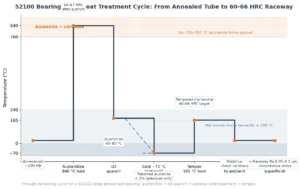
SAE 52100 chrome steel (GCr15 outside the US) is the default bearing steel for a reason: roughly 90% of industrial bearings are made from it. Its chemistry — about 1.0% carbon and 1.5% chromium — is engineered for one job: after hardening and tempering it reaches 60–66 HRC, giving bearings exceptional resistance to rolling contact fatigue, the failure mode that ends most bearing lives.
Because the entire manufacturing ecosystem is built around 52100, chrome steel bearings deliver the highest load ratings per dollar. The material’s high elastic modulus and toughness allow thin, hard rings that survive shock loads and misalignment far better than any brittle alternative. For 90% of industrial duty — motors, pumps, gearboxes, conveyors, agricultural machinery — a quality 52100 bearing such as the Talos 6201 ZZ deep groove ball bearing is the rational, cost-effective choice.
Pros and Cons of Chrome Steel Bearings
- Pros: lowest cost, highest standard load ratings, excellent toughness and shock resistance, proven millions of hours of field data, easily available in every size and type.
- Cons: corrodes without protection — rust from moisture or condensation quickly attacks raceways; limited to roughly 120–150 °C continuous service; conductive and magnetic, so electrical pitting and magnetic-particle contamination are real risks.
Chrome steel’s weakness is never mechanical — it is environmental. If the application stays dry, clean, and below 150 °C, nothing beats it on value — in the ceramic vs steel bearing debate, chrome steel remains the value champion. The corrosion question is exactly what pushes buyers toward the stainless steel bearing market.
Stainless Steel (AISI 440C) Bearings — Corrosion Resistance Without the Ceramic Price Tag
When bearings must survive washdown, steam cleaning, marine air, or chemical exposure, stainless steel bearings take over. The most common bearing grade, AISI 440C, carries roughly 16–18% chromium, which forms a self-healing oxide layer that resists corrosion far better than 52100. Food processing, pharmaceutical, beverage, and marine equipment are its home turf — anywhere hygiene or moisture is a daily reality.
The trade-off is mechanical. 440C hardens to roughly 58–60 HRC — a few points below 52100 — and its load ratings typically run 10–20% lower for the same size. That means a stainless steel bearing needs to be upsized in borderline applications. It also costs roughly 2–3× more than chrome steel, because 440C is more expensive to melt, machine, and grind. Operating temperature is a moderate improvement over chrome steel (about 150–200 °C continuous), and it remains both conductive and magnetic, so it does not solve electrical pitting problems.
Pros and Cons of Stainless Steel Bearings
- Pros: genuine corrosion resistance for washdown and marine duty, moderate temperature improvement over chrome steel, no ceramic price premium, available in standard metric and inch sizes.
- Cons: lower load ratings than 52100, higher cost, still conductive and magnetic, and 440C is not immune to aggressive chemicals — pitting chlorides (seawater) or strong acids can still attack it over time.
When you need corrosion resistance and your loads are moderate, stainless steel is the pragmatic middle path. When the environment is truly brutal — or the requirement is speed, temperature, or electrical isolation — the ceramic vs steel bearing discussion moves to silicon nitride.
Ceramic (Si3N4) Bearings — Speed, Heat, and Electrical Isolation
Ceramic bearings use silicon nitride (Si3N4), an engineering ceramic with roughly double the hardness of bearing steel, 40% of its density, and none of its corrosion or electrical problems. The low density is the headline: at high speed, a ball’s centrifugal force grows with the square of speed, and a Si3N4 ball weighs 60% less than a steel ball of the same size. That single fact is why hybrid ceramic bearings routinely run 30–50% faster than steel equivalents before the same load limits are reached.
Ceramic also brings a list of hard-to-fake advantages: it is electrically insulating, so it stops fluting and pitting in variable-frequency-drive motors; it is non-magnetic and chemically inert, so it suits vacuum, medical MRI, and process equipment; and the material itself survives far beyond any steel’s temperature ceiling. High-speed machine-tool spindles, EV traction motors, turbomolecular pumps, and aerospace actuators are the classic applications.
There are two ceramic bearing architectures, and the distinction matters more than the material alone:
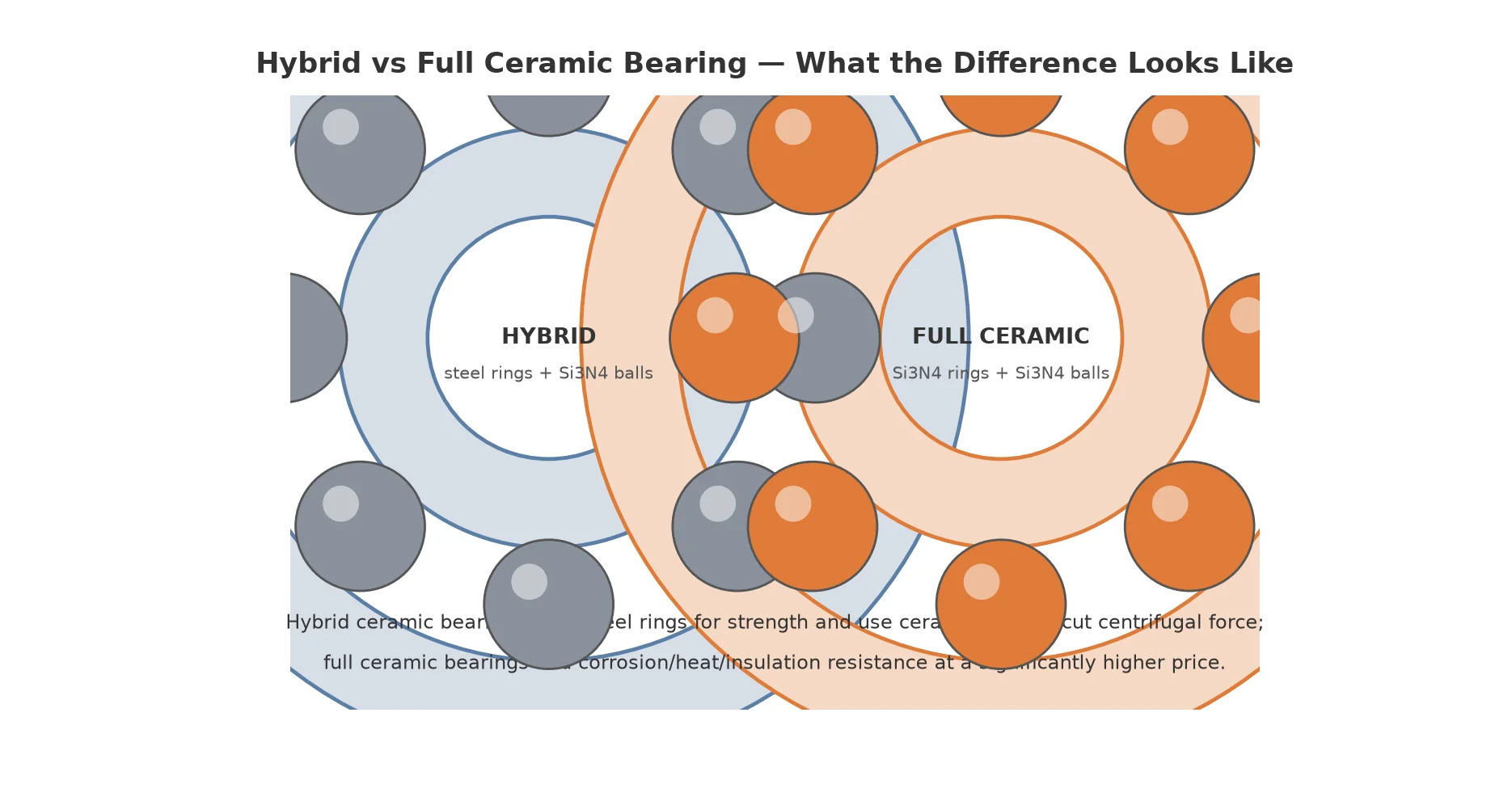
- Hybrid ceramic bearings — steel rings with Si3N4 balls. They capture most of the speed and electrical-isolation benefit at 5–10× the cost of chrome steel, while keeping steel’s toughness in the rings. This is the right choice for 90% of ceramic applications, including motor bearings.
- Full ceramic bearings — Si3N4 rings and balls. They add extreme corrosion resistance, non-magnetic behavior, and 800 °C+ capability, but cost 15–30× more and are brittle: shock loads, edge loading, or poor mounting can fracture a ceramic ring that a steel ring would survive.
Pros and Cons of Ceramic Bearings
- Pros: 30–50% higher speed capability, electrical insulation against VFD pitting, non-magnetic, immune to corrosion, extreme temperature capability in full-ceramic form.
- Cons: cost — hybrid runs 5–10× and full ceramic 15–30× chrome steel; brittleness under shock or edge loading; reduced tolerance to misalignment; special handling and mounting discipline required; lower static load capacity in full-ceramic form.
If the ceramic vs steel bearing question has a short answer, it is this: ceramic earns its premium wherever steel’s limits are the constraint — speed, heat, corrosion, or electrical damage. If none of those limits apply, ceramic is a costly luxury.
Head-to-Head: Which Bearing Material Wins for Your Application?
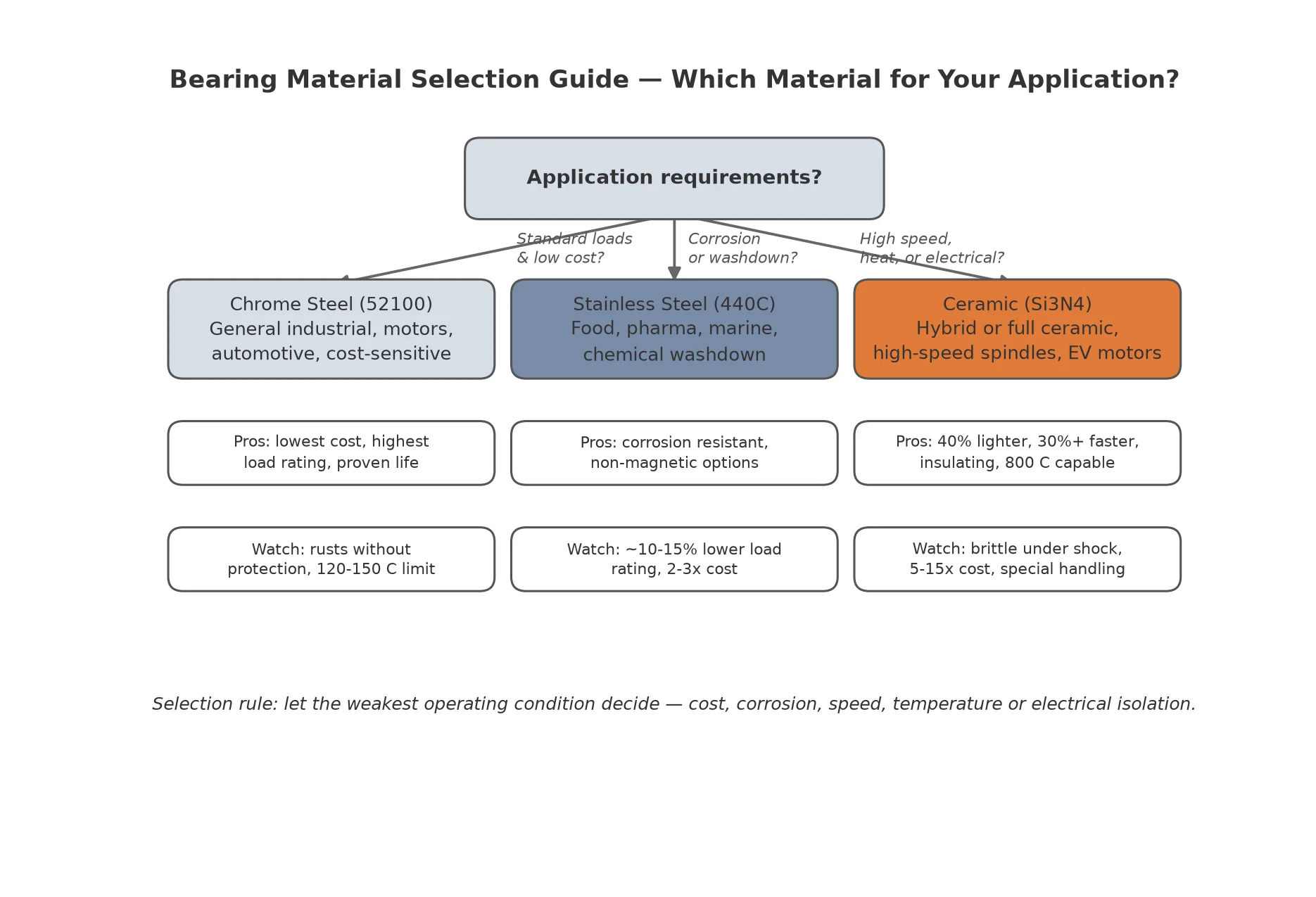
The ceramic vs steel bearing selection chart above condenses the decision into three branches: standard industrial duty points to chrome steel, corrosion and washdown duty points to stainless steel, and speed, heat, or electrical exposure points to ceramic.
Best for general industrial duty and value
The ceramic vs steel bearing question almost always starts here — general rotating machinery where none of the exotic constraints apply.
Chrome steel wins outright. Motors, pumps, gearboxes, conveyors, and most machinery run dry, cool, and clean. A quality 52100 bearing from the deep groove ball bearings range delivers the maximum load rating per dollar, and its field-proven fatigue life is the reference every other material is measured against.
Best for washdown, food, and marine environments
Stainless steel wins on cost-effectiveness. Food and beverage lines, pharmaceutical plants, and coastal equipment need corrosion resistance every shift, not ceramic’s speed or insulation. 440C handles the moisture, and the 2–3× premium is justified by uptime. Only move to full ceramic when chemicals or seawater defeat even stainless steel — at which point the ceramic vs steel bearing comparison has resolved itself entirely in ceramic’s favor.
Best for high-speed spindles and VFD motors
Ceramic wins, and hybrid is the sweet spot. In a 30,000 rpm spindle or a traction motor fed by a variable-frequency drive, steel balls’ centrifugal load and electrical fluting are the failure mechanisms — hybrid ceramic bearings solve both. The bearing clearance guide shows why internal clearance must also be revisited when you step up to higher speed classes.
Best for extreme temperature
Full ceramic wins without contest. Chrome steel degrades above roughly 150 °C, and stainless steel gives out around 200 °C. Si3N4 rings and balls operate at 800 °C and beyond with the right cage and lubrication strategy — the reason gas turbines and high-temperature process equipment specify full ceramic bearings.
Verdict: How to Choose Your Bearing Material
Start from your constraints, not from marketing. A disciplined ceramic vs steel bearing evaluation weighs four factors in order: corrosion exposure, operating speed, temperature, and budget. The same constraint-first logic underpins the official SKF bearing selection process, which starts from operating conditions rather than material preference. If your dominant requirement is cost and load capacity in a normal industrial environment, choose chrome steel and stop reading. If moisture or washdown is the daily reality, choose stainless steel. If speed, electrical isolation, or temperature pushes you past steel’s limits, choose hybrid ceramic first and full ceramic only when the environment truly demands it.
Also remember that material is only half the selection problem. Fit, internal clearance, lubrication, and sealing decide how long any bearing lasts, regardless of material — the shaft fit tolerance guide and the 6201 SKF cross-reference guide cover those decisions in depth.
Brand matters less than material integrity, but it is still worth buying from a manufacturer that documents its steel sources and heat treatment. For standard chrome steel duty, brands like Talos deliver ISO-standard dimensions and load ratings that are effectively equivalent to the major European and Japanese houses at a significantly lower cost — the Talos 6201 ZZ, for example, is dimensionally and functionally interchangeable with SKF 6201-2Z in the same application envelope. For stainless and ceramic grades, the same discipline applies: verify hardness, corrosion test data, and precision class before you commit a serial production line to a supplier.
FAQ: Ceramic vs Steel Bearing Questions, Answered
Are ceramic bearings worth the extra cost?
Only when steel’s limits are your constraint. The ceramic vs steel bearing cost gap narrows quickly once downtime, replacement labor, and production loss are priced into the comparison. In high-speed spindles, VFD motors, or corrosive/vacuum environments, ceramic bearings pay for themselves through longer life and reduced downtime. In a standard motor running below 3,000 rpm in a clean shop, a chrome steel bearing will outlast the machine and the ceramic premium is wasted.
In the ceramic vs steel bearing debate, where do stainless steel bearings fit?
Stainless steel sits between chrome steel and ceramic on cost and corrosion, and it can replace chrome steel bearings in most standard sizes with two caveats: load ratings run roughly 10–20% lower for the same size, so upsizing may be required, and cost is 2–3× higher. Where corrosion is not a factor, chrome steel remains the stronger and cheaper choice.
What is the difference between hybrid and full ceramic bearings?
Hybrid ceramic bearings combine steel rings with silicon nitride balls, capturing most of the speed and electrical-insulation benefit at a moderate premium. Full ceramic bearings use ceramic rings and balls, adding extreme corrosion resistance, non-magnetic properties, and 800 °C+ capability at 15–30× the cost — plus brittleness that demands careful mounting.
Which bearing material is best for high-speed applications?
Hybrid ceramic. In any ceramic vs steel bearing comparison at high speed, the 60% lighter Si3N4 balls reduce centrifugal load, allowing 30–50% higher speeds than steel bearings of the same size — the clearest single result in any ceramic vs steel bearing comparison, while the steel rings keep the assembly tough enough for normal handling and mounting.
Is a Talos 6201 ZZ bearing equivalent to SKF 6201-2Z?
Yes for standard chrome steel duty. The Talos 6201 ZZ matches the SKF 6201-2Z on ISO 492 dimensional tolerances and published load ratings, and is functionally interchangeable in the same application. If your application is stainless or ceramic, specify the material grade explicitly and ask for the material certificate.
Conclusion
The ceramic vs steel bearing decision comes down to three honest questions: is corrosion present, is speed or heat past steel’s limits, and is electrical pitting a risk? Answer no to all three and chrome steel is the correct, most economical choice; answer yes to moisture and stainless steel earns its premium; answer yes to speed, heat, or electricity and ceramic — hybrid first — is the engineering answer. Material selection is the foundation; fit, clearance, and lubrication built on top of it determine how many hours that bearing actually delivers.
At Talos Bearing, the ceramic vs steel bearing conversation usually ends with chrome steel for general duty and a clear upgrade path to stainless or hybrid ceramic when the environment demands it. When you need standard chrome steel bearings in industrial quantities, Talos Bearing supplies ISO-standard deep groove, cylindrical, spherical, tapered, and angular contact bearings with documented steel grades and competitive export pricing. Browse the ball bearings range or contact the sales team with your operating conditions — speed, load, temperature, and environment — and get a material recommendation matched to your machine.