Every bearing, from a sealed deep groove ball bearing in a conveyor to a precision spindle in a machining center, needs lubrication to survive. The oil vs grease lubrication decision is one of the most common engineering questions in rotating equipment — and one of the most misunderstood. Grease is a lubricant with a thickener: it holds oil in place, while oil is a liquid that must be delivered, circulated, and contained. Both do the same fundamental job — separating the rolling elements from the raceways — but they do it under very different conditions. This guide compares grease and oil bearing lubrication across the five critical factors that decide which one your application needs: speed, temperature, contamination, relubrication access, and system cost.
Quick Comparison Table: Grease vs Oil Lubrication
| Factor | Grease Lubrication | Oil Lubrication |
|---|---|---|
| Speed capability (DN limit) | ~150,000–300,000 typical; sealed bearings lower | 300,000+; circulating oil removes heat at very high DN |
| Temperature range | −30 °C to +150 °C typical grease; special grades higher | Depends on oil viscosity; wider with synthetic oils |
| Sealing / contamination | Excellent — grease blocks contaminants | Requires seals + filtration; splash can ingest dirt |
| Relubrication | Long intervals; sealed-for-life bearings need none | Continuous or periodic; needs an oil system |
| Heat removal | Poor — no circulation to carry heat away | Excellent — oil circulates and removes heat |
| Friction at start-up | Higher (churning, especially cold) | Lower — quicker film formation |
| First-fill & system cost | Low — just the grease charge | Higher — reservoir, pump, filter, lines |
| Typical applications | Motors, conveyors, fans, pillow blocks, automotive | Gearboxes, spindles, turbines, high-speed machinery |
If 90% of bearings are grease-lubricated, it is not because grease is better — it is because grease is simpler. The oil vs grease lubrication question only becomes interesting when one of the five factors below pushes past grease’s comfort zone.
Factor 1: Speed — The DN Value Decides First
Speed is the single most decisive factor in the oil vs grease lubrication choice. Engineers express bearing speed as the DN value: bore diameter in millimeters multiplied by speed in rpm. A 6201 bearing (12 mm bore) at 10,000 rpm runs at DN = 120,000. A 40 mm spindle bearing at 20,000 rpm runs at DN = 800,000.
Grease performs well up to roughly DN 150,000–300,000 depending on the bearing type and grease grade. Above that, two things happen: the grease base oil thins and migrates, and the churning losses of the thickener generate heat that grease cannot carry away. Oil — especially a circulating or oil-mist system — removes that heat continuously, which is why virtually all very-high-speed spindles and turbines are oil-lubricated.
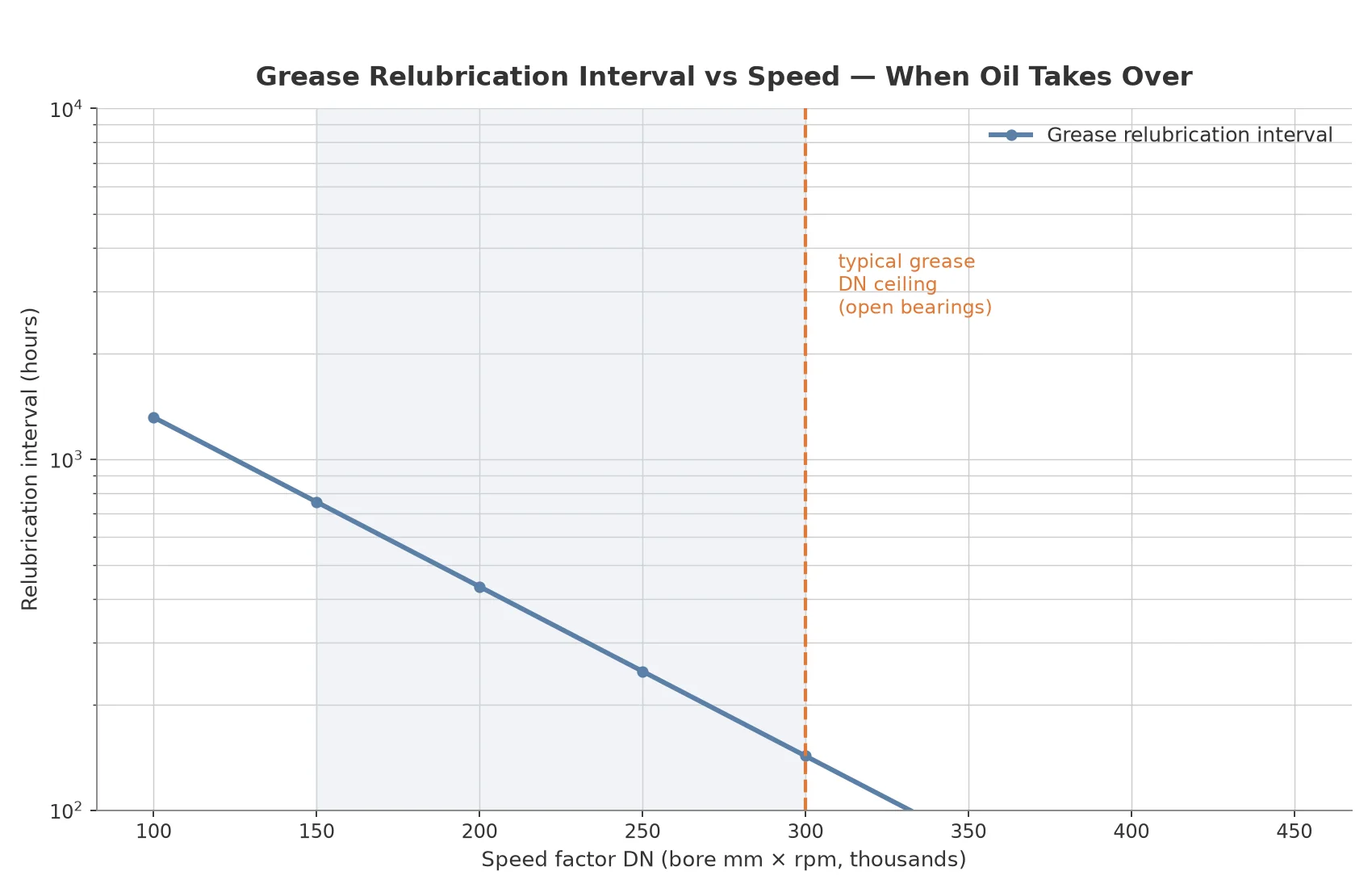
The chart above shows the practical consequence: as DN climbs, the grease relubrication interval collapses. A grease-lubricated bearing at DN 100,000 may need attention every few thousand hours; at DN 300,000 the interval shrinks to the point where an oil system becomes the lower-risk choice. Rule: if your DN exceeds ~300,000, design for oil.
Factor 2: Temperature — Grease Fails Soft, Oil Fails Fast
In the oil vs grease lubrication comparison, temperature behaves differently on each side. Standard lithium-soap greases operate from roughly −30 °C to +120 °C, with high-temperature thickeners (polyurea, calcium sulfonate) extending the upper bound to about 150–180 °C. Above that, the thickener breaks down, the oil bleeds out, and the bearing runs dry. Oil, by contrast, can be selected with a base oil and additive package matched to extreme temperatures — synthetic oils handle −50 °C to +250 °C — and a circulating system can even cool the bearing.
But temperature cuts both ways. A grease-lubricated bearing that overheats degrades gradually — you usually catch it at a scheduled relubrication. An oil-lubricated bearing whose oil degrades or is lost fails quickly and catastrophically, because metal-to-metal contact starts immediately. If your application sits in the moderate 0–100 °C band, grease is the lower-risk choice; if it runs hot continuously, oil’s wider temperature envelope wins.
Factor 3: Contamination and Sealing — Grease as the First Line of Defense
Grease is a solid enough barrier that it physically blocks dust, water, and process debris from reaching the raceways. That is why grease-lubricated bearings in conveyor, agricultural, and washdown duty survive where oil-lubricated equivalents would quickly ingest contamination through seals. For a sealed or shielded bearing — like the Talos 6201 ZZ deep groove ball bearing — the grease charge is factory-fitted and the shields do the sealing: the assembly is maintenance-free for its design life.
Oil systems must manage contamination actively. A circulating oil system relies on filtration to keep particles out, and any seal leak becomes a contamination path. In dirty environments, oil lubrication demands disciplined filtration and monitoring that many plants do not maintain. If dust or water is your environment, grease is usually the safer answer — contamination control is the factor where oil vs grease lubrication stops being close.
Factor 4: Relubrication Access — Sealed-for-Life or Scheduled Maintenance
Relubrication access is where the oil vs grease lubrication decision becomes a maintenance question as much as an engineering one. Grease shines operationally here: Grease-lubricated bearings with grease fittings need servicing every 500–4,000 operating hours depending on speed and duty — and sealed or shielded bearings need none at all. That simplicity is why pillow block bearings and motor bearings are overwhelmingly grease-filled: the maintenance staff adds a few grams of grease on a schedule, and the bearing runs for years.
Oil lubrication is a system, not a fill. It needs a reservoir, a pump or wick, filters, sight glasses, and monitoring. The oil itself must be checked for viscosity, contamination, and additive depletion, and changed on a schedule. In a plant without a dedicated lubrication technician, oil systems are frequently the source of premature bearing failure — not because oil is worse, but because the system is neglected. If your plant cannot commit to oil-system maintenance, grease is the pragmatic default.
Factor 5: Cost and System Complexity — The Whole-Life Picture
The first-fill cost comparison is lopsided: grease costs pennies, while an oil-circulation system costs thousands in hardware alone. But the whole-life picture is more honest. A grease-lubricated bearing that fails early from overheating or contamination costs far more in downtime than the oil system that would have prevented the failure. Conversely, an oil system on a slow, clean, low-value application is pure waste — a reminder that the oil vs grease lubrication choice is cost-driven in both directions.
Oil also wins on friction and energy. Oil-lubricated bearings, particularly with oil mist or minimal-quantity lubrication, run with lower churning losses and lower operating temperature — measurable energy savings on large motor and turbine installations. Grease’s higher start-up friction and churning losses are negligible on small bearings but real on large ones. Decide on life-cycle cost, not first-fill price.
Head-to-Head: Which Lubrication Wins for Your Application?
Best for general industrial motors and fans
Grease, decisively. A standard motor bearing is sealed or shielded, factory-lubricated, and runs within grease’s speed and temperature envelope for years. The bearing clearance guide explains why a correctly selected C3 clearance motor bearing paired with the right grease charge outlasts the motor itself.
Best for high-speed spindles and turbines
Oil, decisively — this is the oil vs grease lubrication factor that leaves no room for debate. Above DN 300,000, circulating oil or oil mist is the only practical way to lubricate and cool. This is non-negotiable territory — no grease grade solves a 500,000 DN spindle.
Best for dirty, wet, or washdown environments
Grease. The thickener’s barrier action plus shields or seals keeps contamination out, and the relubrication schedule is forgiving. Food-grade greases and stainless steel housings cover the washdown niche; see the material comparison guide for how stainless and ceramic bearings behave in those environments.
Best for extreme temperatures
Oil, with synthetic base oils. Where grease thickeners decompose above 150 °C, synthetic oils carry the bearing through 250 °C and beyond with proper system design.
Verdict: The 5-Factor Decision Framework
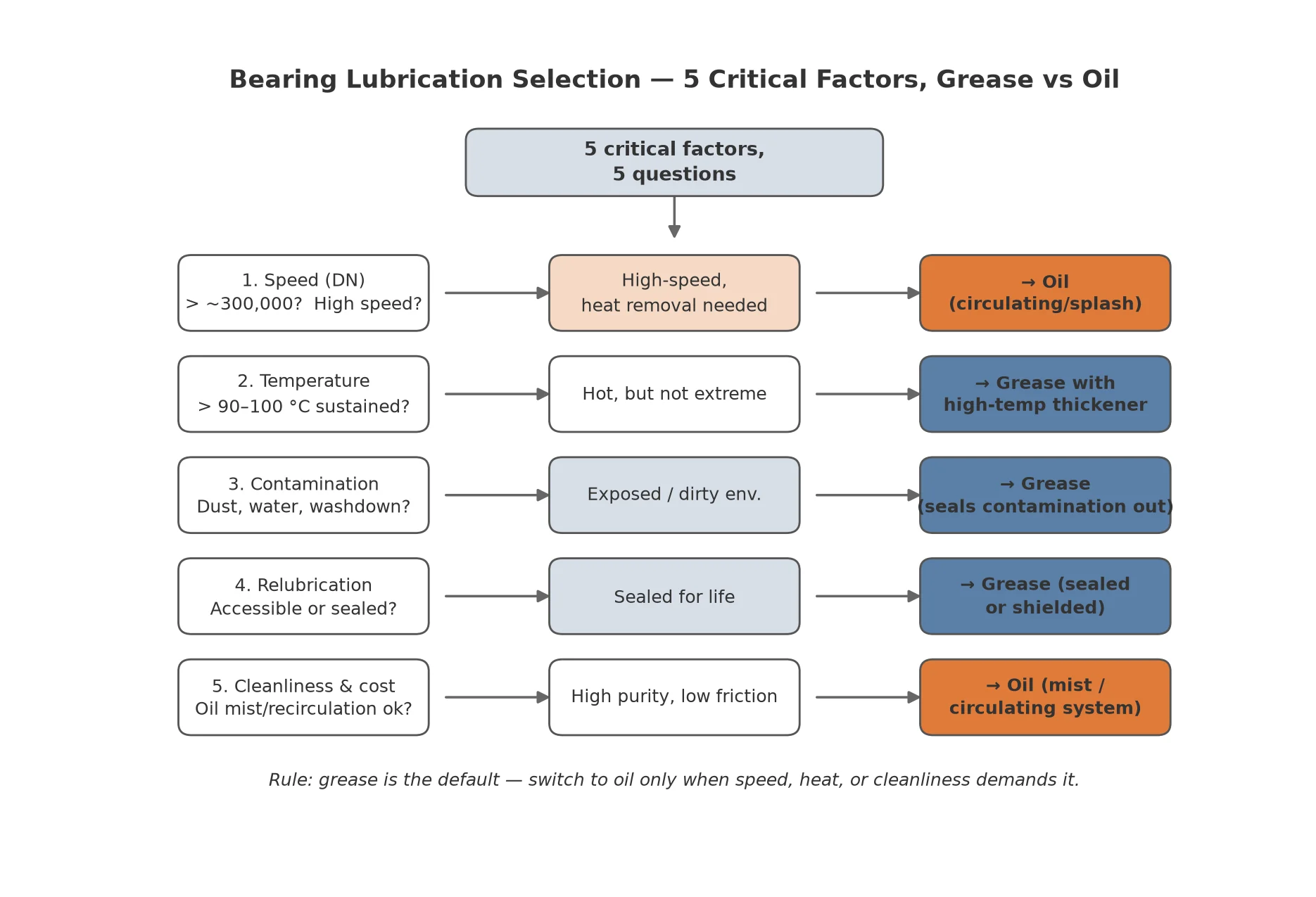
Work through the five factors in order, and the oil vs grease lubrication choice resolves itself:
- Speed: DN over ~300,000 → oil. Below → grease is viable.
- Temperature: sustained over ~120 °C → consider high-temp grease or oil; over ~180 °C → oil.
- Contamination: dust, water, washdown → grease (sealed or shielded).
- Relubrication access: sealed-for-life or simple fittings → grease; existing oil system → oil.
- Cost: small, slow, clean application → grease; high-speed or high-value machine → oil pays for itself.
When grease is the answer — and it is, for the majority of industrial bearings — the remaining decisions are grease type (lithium, polyurea, calcium sulfonate), consistency grade (NLGI 2 is the industrial default), and relubrication interval. When oil is the answer, the decision shifts to viscosity grade, delivery method (splash, circulating, mist, jet), and filtration. Both paths are covered in depth by the official SKF lubrication guide and its global bearing lubrication reference.
One point worth repeating for buyers: the lubricant matters as much as the bearing. A premium bearing starved of the right lubricant fails faster than a budget bearing correctly lubricated. At Talos Bearing, standard chrome steel bearings such as the 6201 ZZ ship factory-greased with a lithium-based grease effectively equivalent to the fill used by the major European and Japanese brands, with the same ISO 492 dimensional tolerances and published load ratings — so the lubrication you plan for in your maintenance program is the lubrication you actually get. See the shaft fit tolerance guide for the mounting-side decisions that complete the installation.
FAQ: Oil vs Grease Lubrication Questions, Answered
Is grease better than oil for bearings?
Neither is universally better. The oil vs grease lubrication question has no one-size-fits-all answer — Grease wins on simplicity, sealing, and low cost; oil wins on speed, heat removal, and cleanliness. The correct choice depends on the five factors above — most bearings should be grease-lubricated, and high-speed or high-temperature bearings should be oil-lubricated.
How often should I grease my bearings?
Sealed-for-life bearings need no relubrication. Regreasable bearings typically need fresh grease every 500–4,000 operating hours, depending on speed, temperature, and duty — the higher the DN value and temperature, the shorter the interval. Use the manufacturer’s relubrication chart rather than a fixed calendar interval.
What is the DN limit for grease lubrication?
As a rule of thumb, grease lubrication is reliable up to DN ≈ 150,000–300,000 depending on bearing type and grease grade. Above that, oil lubrication is required for adequate heat removal and film formation.
Can I mix grease and oil lubrication on the same bearing?
No — never mix grease types, and never add oil to a grease-lubricated bearing or vice versa. Incompatible thickeners or base oils can separate, thin out, or harden, causing starvation and premature failure. Flush and re-pack before switching lubricants.
Which grease grade should I use?
NLGI 2 is the industrial default for most bearings. Use NLGI 3 for low-speed or vertical applications where the grease must stay put, and softer NLGI 0–1 for centralized lubrication systems or low-temperature service. Match the base oil viscosity to the bearing speed — lower viscosity for higher speed.
Conclusion
The oil vs grease lubrication decision is a five-factor engineering call, not a preference. Speed sets the hard ceiling — above roughly DN 300,000, oil is mandatory. Temperature, contamination, relubrication access, and life-cycle cost then refine the choice for the majority of bearings that stay below that ceiling, where grease’s simplicity, sealing, and economy make it the right answer. When you specify your next bearing, specify its lubricant with the same care: the pair of them decides your machine’s uptime.
Once the oil vs grease lubrication decision is made, the rest is specification detail. Whether your application calls for grease-filled sealed bearings or you are planning around oil lubrication, Talos Bearing supplies ISO-standard deep groove, cylindrical, spherical, tapered, and angular contact bearings with documented factory grease and competitive export pricing. Browse the deep groove ball bearings range or contact the sales team with your speed, temperature, and environment data for a lubrication-matched recommendation.