When selecting components for rotating machinery, engineers often face a fundamental decision: bearing or bushing? Both reduce friction between moving parts and support loads, but their design principles, performance characteristics, and ideal applications differ significantly. Choosing incorrectly can lead to premature failure, higher maintenance costs, and reduced equipment efficiency.
This guide compares bearings and bushings across every major decision factor — load capacity, speed capability, friction behavior, lubrication needs, cost, and service life — so that by the end you know which component fits your application. If you are dealing with bearing damage, also see our bearing failure causes guide for diagnosis and prevention tips.
Quick Comparison Table
| Comparison Dimension | Bearing | Bushing |
|---|---|---|
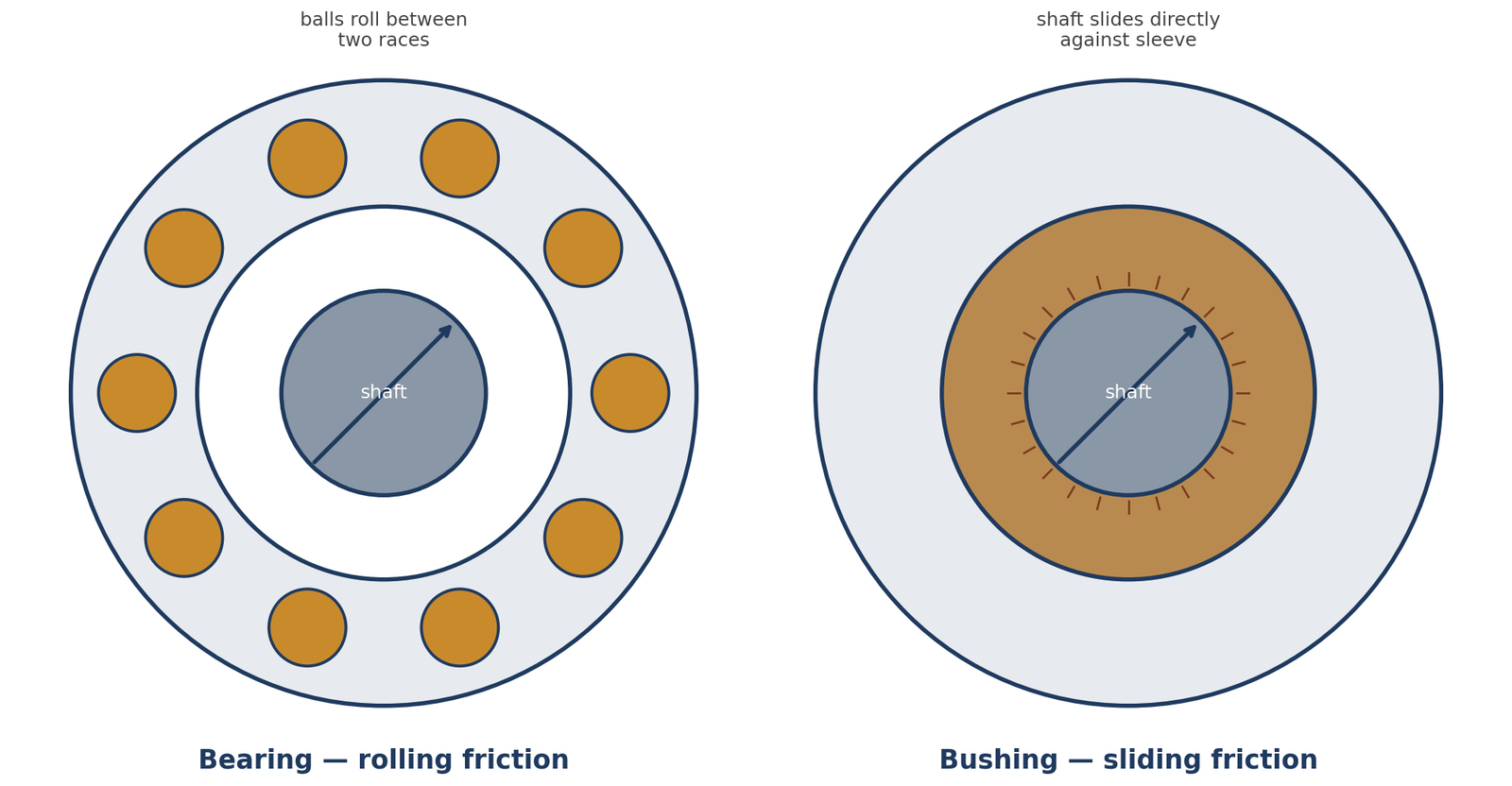
| Friction type | Rolling friction — balls or rollers between two races | Sliding friction — shaft bears directly on the sleeve |
| Starting friction | Low; rolling elements break away easily | Higher; static friction must be overcome first |
| Speed rating | Excellent — routinely used well above 10,000 RPM | Moderate — heat from sliding contact limits speed |
| Load capacity | Excellent radial and thrust capacity (varies by type) | Good radial capacity; limited thrust capacity |
| Precision / runout | High — precision grades available (e.g., ABEC 1–9) | Lower — depends on clearance fit |
| Noise / vibration | Lower — rolling motion is inherently smoother | Can develop stick-slip or squeak at low speed |
| Lubrication | Grease-packed or oil-lubricated; sealed options available | Needs ongoing oil/grease, or a self-lubricating material |
| Maintenance | Minimal — sealed bearings are effectively maintenance-free | Periodic re-lubrication or replacement |
| Cost | Higher upfront cost (roughly $5–$500+ depending on type/size) | Lower upfront cost (roughly $1–$50 for most sizes) |
| Service life | Longer under proper conditions — commonly 10,000–100,000+ hours | Shorter; wears gradually, especially with debris present |
| Misalignment tolerance | Limited, unless a self-aligning type is used | Better — clearance fit absorbs minor misalignment |
| Shock load resistance | Moderate — hard races can brinell under heavy impact | Excellent — softer material absorbs and dampens impact |
| Operating temperature | -40°C to +150°C standard; up to +300°C with special materials | Depends on material; PTFE/bronze types up to ~260°C |
| Contamination resistance | Good with intact seals; poor once seals are damaged | Moderate — soft material can embed abrasive particles |
Bearing Overview
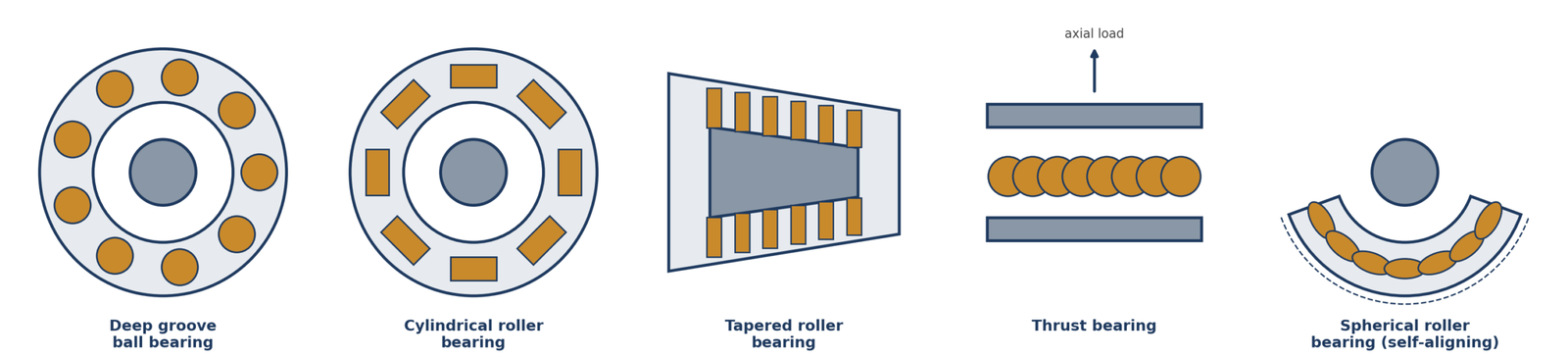
A bearing is a machine element that permits constrained relative motion — typically rotation — between two parts while reducing friction. Bearings use rolling elements (balls, cylindrical rollers, tapered rollers, or spherical rollers) positioned between two concentric rings called races. This rolling contact is what gives bearings their defining advantage: low rolling friction, even at high speed.
Common Bearing Types
- Deep Groove Ball Bearings — Most popular type; handles both radial and moderate axial loads. Common in electric motors, pumps, and conveyors. Browse deep groove ball bearings →
- Cylindrical Roller Bearings — High radial load capacity for heavy machinery and gearboxes. View cylindrical roller bearings →
- Tapered Roller Bearings — Combined radial and thrust loads in automotive wheel hubs and gearboxes.
- Thrust Bearings — Designed specifically for axial (thrust) loads in vertical shafts and automotive transmissions.
- Spherical Roller Bearings — Self-aligning; ideal where shaft deflection or misalignment is expected. Explore spherical roller bearings →
When Bearings Excel
Bearings are the superior choice when an application demands high-speed operation, low starting torque, high precision, or long maintenance-free service life. It’s worth noting that this includes the great majority of electric motors, regardless of size or speed: rolling-element bearings are the standard choice for motor shaft support because of their low friction, long life, and tolerance for the moderate axial loads motors produce. Precision spindles and automotive wheel hubs are other textbook bearing applications.
The main trade-off is cost: a quality sealed bearing can run 5–10 times the price of a comparable bushing. Bearings are also more susceptible to damage from shock loads and contamination if their seals are compromised.
Bushing Overview
A bushing — also called a plain bearing or sleeve bearing — is the simplest form of bearing: a cylindrical sleeve fitted between a shaft and its housing. Unlike rolling-element bearings, bushings have no internal moving parts. The shaft rotates or slides directly against the inner surface, creating sliding friction rather than rolling friction.
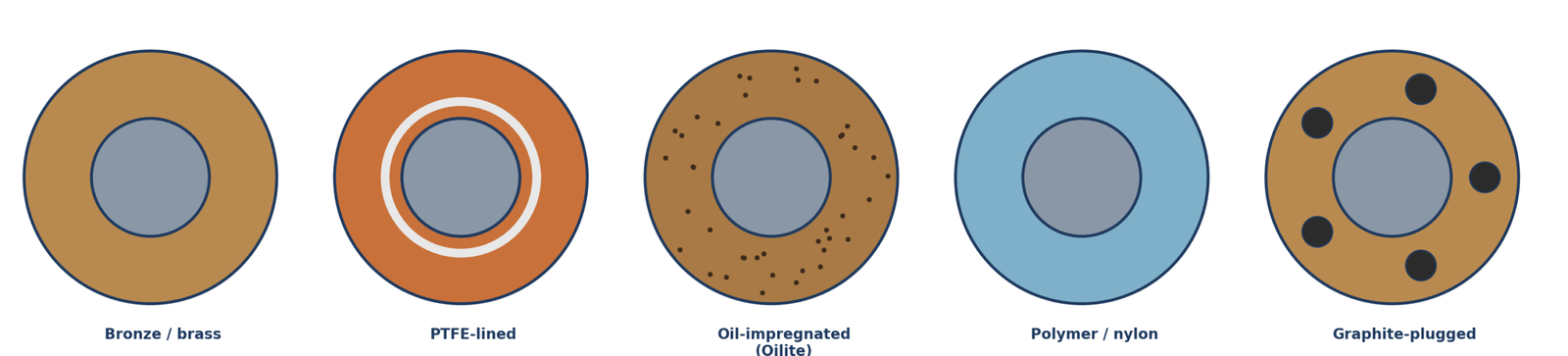
Common Bushing Materials
- Bronze / Brass — Traditional material with good wear resistance and heat dissipation. Common in agricultural and construction equipment.
- PTFE (Teflon) Lined — Low friction without external lubrication. Popular in food-processing equipment where oil contamination isn’t acceptable.
- Oil-Impregnated (Oilite) — Porous bronze impregnated with oil; self-lubricating for moderate loads and speeds.
- Polymer / Nylon — Lightweight, corrosion-resistant, low-cost. Suited to light-duty and wet environments.
- Graphite-Plugged — Bronze bushing with graphite plugs, for high-temperature applications where oil would degrade.
When Bushings Excel
Bushings shine in oscillating or reciprocating motion (rather than continuous rotation), heavy shock loads, misaligned shafts, or corrosive environments. They’re also the economical choice for low-speed, high-load applications: construction-equipment pivot points, vehicle suspension bushings, and agricultural-machinery linkages.
A key advantage is simplicity — no rolling elements to fail, no cage to break, no seal to rupture. When a bushing wears out, it typically fails gradually rather than catastrophically, giving operators time to schedule replacement. The downside is higher friction, which generates heat and limits operating speed.
Head-to-Head: Which Wins for What
Best for High-Speed Applications → Bearing
Above roughly 2,000–3,000 RPM, rolling-element bearings are the clear winner: rolling friction generates far less heat than sliding friction at speed. Turbine spindles and CNC machine-tool spindles rely on precision bearings for this reason. Deep groove ball bearings are the default for general high-speed use; angular-contact bearings handle combined loads at high RPM.
Best for Heavy Shock Loads → Bushing
When an application involves impact loading — excavator linkages, press machines, mining equipment — bushings absorb and dampen shock far better than bearings. A bearing’s hardened races can develop brinell marks (permanent indentations) from a single heavy impact, leading to noise and premature failure. Bronze or polymer bushings simply deform elastically and recover.
Best for Precision Runout Control → Bearing
If an application demands minimal shaft runout or precise positioning — a machine-tool spindle, a printing-press roller, a servo-motor output shaft — bearings win decisively. Precision-ground races and rolling elements maintain a consistent shaft centerline within microns, a level of repeatability plain bushings cannot match.
Best for Misaligned or Flexible Shafts → Bushing
Long shafts that flex under load, or applications where perfect alignment isn’t practical, favor bushings: a clearance fit allows some angular misalignment without binding. For more extreme cases, spherical plain bearings or self-aligning bushings add further compliance. Where rolling-element efficiency is also needed alongside misalignment tolerance, spherical roller bearings are worth considering.
Best for Cost-Sensitive Applications → Bushing
For simple, low-speed applications — conveyor rollers, door hinges, light machinery — a low-cost bronze bushing often performs as well as a pricier bearing. Bearings can still win on total cost of ownership thanks to longer service intervals, but the upfront cost advantage of bushings is hard to beat on a tight budget.
Best for Maintenance-Free Operation → Bearing (Sealed)
Modern sealed and shielded bearings (2RS or ZZ types, for example) are grease-packed for life and need no re-lubrication, often running tens of thousands of hours before replacement. Most bushings need periodic re-greasing or oil replenishment, though self-lubricating materials like Oilite or PTFE-lined types close much of that gap.
Best in Contaminated or Wet Environments → Depends on Material
Stainless bearings with contact seals do well in wash-down environments such as food processing and marine use. But where contamination is abrasive — sand or dust — polymer or bronze bushings are often preferred, since a bushing’s softer material can embed particles rather than grinding them through a raceway the way a bearing might.
Verdict / Recommendation
There’s no universally better component — the right choice depends on an application’s specific demands. General bearing-selection practice, echoed across manufacturer guides such as SKF’s bearing selection principles, is to weigh load, speed, lubrication, and environmental conditions together rather than picking on cost or speed alone. Industry guidance on plain bearings similarly points to oscillating motion and heavy, lower-speed loads as their sweet spot.
| Choose a Bearing When… | Choose a Bushing When… |
|---|---|
| Operating speed is above roughly 2,000–3,000 RPM | Speed is low (well under 500 RPM) or motion is oscillating |
| Low starting torque is critical | Higher starting torque is acceptable |
| Precision or low runout is required | Precision tolerance is moderate |
| A maintenance-free design is desired | Periodic lubrication is acceptable |
| Budget allows a higher upfront cost | Low component cost is the priority |
| The application needs 10,000+ hours of life | The application sees heavy shock or impact loads |
| Ambient temperature is moderate | Environment is extreme, dirty, or corrosive |
For most general industrial applications running at moderate speeds and loads, deep groove ball bearings are the safest default, offering a good balance of performance, life, and reliability. For heavy, slow-moving machinery with impact loads, bronze bushings remain the industry standard. Many machines — particularly in agricultural and construction equipment — use both: bearings where precision and speed matter, bushings where durability and cost matter. Learn how to identify and prevent common bearing failure causes to maximize the service life of whichever component you choose.
Frequently Asked Questions
Can a bushing be substituted for a bearing?
In some low-speed applications, yes — but only if speed and load stay within the bushing’s rating. Substituting a bushing into a high-speed electric motor would cause rapid overheating and failure within hours. The reverse can also fail: putting a bearing into a shock-loaded excavator pivot can brinell the races prematurely.
Is a bushing cheaper than a bearing?
Yes, typically 1/5 to 1/10 the price of a comparable rolling-element bearing — a bronze sleeve bushing for a 20 mm shaft might run $2–$5, versus $10–$25 for a comparable deep groove ball bearing. Total cost of ownership should still factor in lubricant consumption, maintenance labor, and downtime, where sealed bearings often close the gap.
Which is better for high-speed applications: bearing or bushing?
Bearings, without much debate. Rolling friction generates far less heat than sliding friction at elevated RPM. Most standard bushings are limited to a few thousand RPM, while precision ball bearings can run reliably at 10,000+ RPM with proper lubrication.
What is the difference between a bushing and a plain bearing?
None — they’re the same component: a single-piece sleeve with no rolling elements. “Bushing” is more common in automotive and construction contexts; “plain bearing” is the formal engineering term. Both are contrasted with rolling-element bearings (ball or roller types), which use rolling contact to cut friction.
How do I know if my application needs a bearing or a bushing?
Check three things: operating speed, load type, and precision requirement. If speed is above roughly 2,000–3,000 RPM or precision is critical, choose a bearing. If shock loads are present or the motion oscillates rather than rotates continuously, choose a bushing. At moderate speeds with no shock loading, either can work — the deciding factor is usually budget and expected service life. Browse our ball bearing selection for bearing options.
Can I replace a bearing with a bushing in my motor?
Generally no. Motor shaft speeds (commonly 1,500–3,600 RPM), precision requirements, and axial thrust loads are matched to rolling-element bearings by design. Swapping in a bushing typically causes overheating, excessive vibration, and early failure. For motor applications, stick with the specified bearing type.
Conclusion
Bearings deliver superior speed, precision, and maintenance-free life at a higher upfront cost; bushings offer rugged simplicity, shock absorption, and economy at lower speeds. Weigh your application’s speed, load type, precision needs, and budget, and the right choice usually becomes clear. When in doubt, consult a bearing specialist or a manufacturer’s selection guide to validate the decision against your actual operating conditions.
Need help choosing the right bearing or bushing for your project? Browse our complete bearing catalog or contact our engineering team for personalized application support. We stock deep groove ball bearings, pillow block units, and mounted bearings ready for fast shipping on most standard sizes.