Bearing Contamination Control: How Micron-Level Particles Dramatically Shorten Service Life
Every bearing engineer has seen it: a machine that should run for years dies in months, and when the bearing is pulled apart, the raceway is covered in tiny dents. That is bearing contamination in action. Particles measured in microns — far too small to see with the naked eye — get crushed between the rolling elements and the raceway, and each one quietly steals weeks or months of service life. This guide explains exactly how micron-level particles damage bearings, how much life they cost in engineering terms, and what you can do to control bearing contamination before it controls your maintenance budget.
What Bearing Contamination Means — and Why It Is the Number One Controllable Killer
Bearing contamination is the presence of foreign solid particles, water, or other debris inside the bearing. The classic industry statistics attribute roughly 14% of premature bearing failures directly to contamination, with poor lubrication at about 36%, fatigue at 34%, and mounting issues at 16%. Those numbers understate the real damage, because contamination is a chain amplifier: contaminated grease gets counted as a lubrication failure, and dent-induced spalling gets counted as fatigue. When the indirect chains are included, SKF’s bearing failure analysis material and other manufacturer publications commonly estimate that contamination-related damage lies behind the majority of premature failures.
The key insight is that contamination is the most controllable failure cause in the list. Fatigue is a matter of load and bearing size. Lubrication chemistry is chosen by the designer. But the dirt that kills a bearing usually enters after the bearing leaves the factory — during storage, mounting, or operation — and every one of those entry points can be managed. That is what makes cleanliness control so valuable: it is the one lever that does not require a bearing redesign.
How Thin Is the Lubricant Film? The Sub-Micron Reality
To understand why micron-level particles are lethal, you first need to know how thin the lubricating film inside a rolling bearing really is. In elastohydrodynamic (EHL) lubrication, the load is carried by a pressurized oil film squeezed between the rolling elements and the raceway. For a 6205 deep groove ball bearing running at moderate speed and load, the calculated minimum film thickness is roughly 0.07–0.16 μm — about one thousandth of a millimetre. Even at high speed, the film rarely exceeds 1 μm.
| Reference size | Dimension (μm) | Compared with the oil film |
|---|---|---|
| EHL oil film, 6205 bearing (calculated) | 0.07–0.16 | baseline |
| Raceway roughness Ra (standard grade) | 0.05–0.20 | same order |
| 1 μm hard particle | 1 | ≈ 10× the film |
| Workshop airborne dust | 1–10 | up to 100× the film |
| Radial internal clearance of a 6205 CN | 5–20 | larger than the film by an order of magnitude |
| Red blood cell | 7–8 | ~50–80× the film |
| Human hair | 70–100 | ~700–1,000× the film |
The numbers explain the threat. A single 5 μm particle of quartz dust is roughly 50 times thicker than the oil film in a typical 6205 application. It cannot ride through the contact on the film — it is physically too big. The raceway surface finish, the film thickness, and the particles that matter in practice all live in the same sub-100 μm world, which is exactly why workshop air, tooling dust, and even fresh-looking grease are all contamination risks. A deeper look at how surface finish interacts with film thickness is covered in our guide to raceway surface finish and running stability.
How Bearing Contamination Damages the Raceway: From One Micron Particle to Spalling
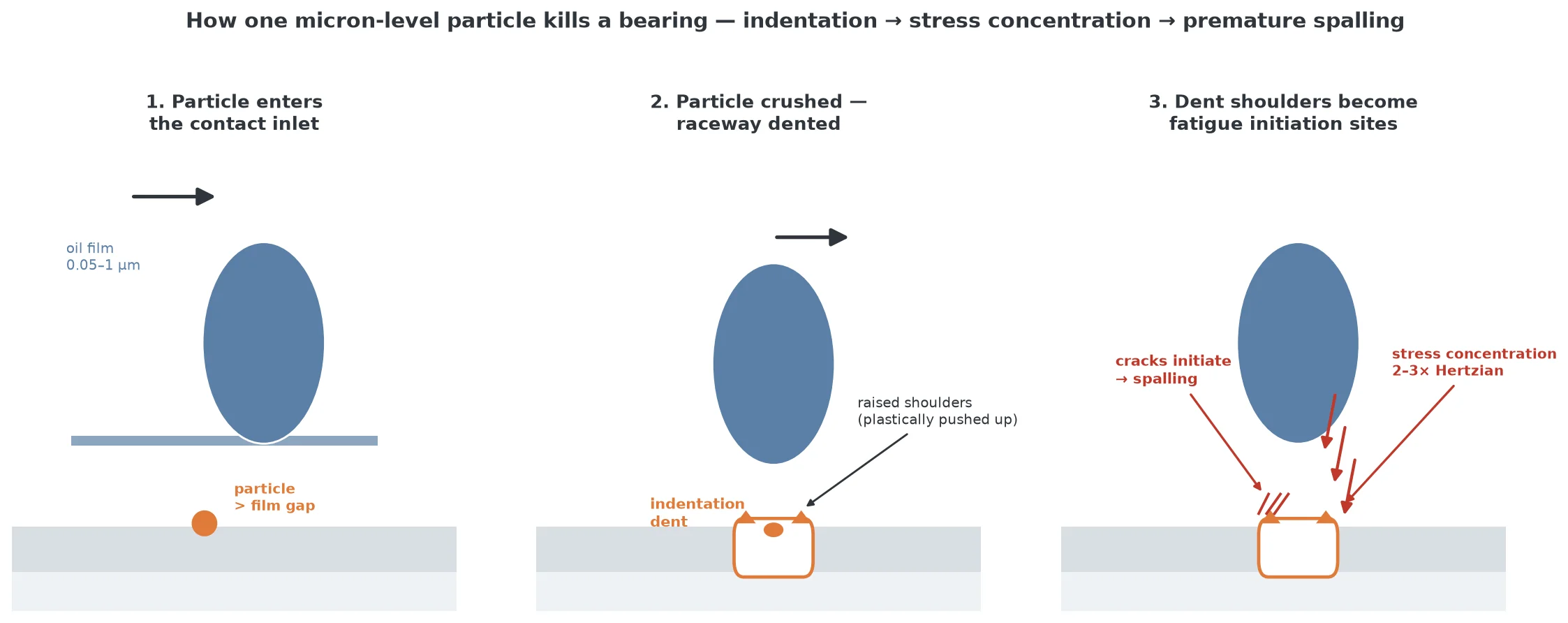
When a hard particle larger than the film thickness reaches the loaded contact zone, something has to give. The particle is trapped between the rolling element and the raceway, and the contact pressure — typically 1,500–3,000 MPa — is far above the yield strength of bearing steel. Hard particles such as sand, grinding swarf, metal chips, and weld spatter plastically dent the raceway. The displaced material is pushed up around the dent to form raised shoulders, and the particle itself is often crushed into fragments that continue circulating through the bearing.
Those dent shoulders are the real killers. Each shoulder is a stress concentration site where the local stress can reach two to three times the nominal Hertzian contact stress. Fatigue cracks initiate at the shoulders far earlier than they would on an undamaged raceway, and the cracks quickly grow into spalling — the familiar flaking of the raceway surface. Spalling then generates more wear debris, which creates more dents, which accelerate the damage. A single particle can therefore start a chain reaction that ends the bearing’s life.
Soft contaminants such as carbon dust, fibres, and plastic debris do less mechanical damage because they cannot dent hardened steel, but they are still a problem: they clog filters and breathers, contaminate the grease, and reduce the effective viscosity of the oil film. Water deserves its own mention — as little as 0.01–0.05% water in the oil can accelerate fatigue through hydrogen embrittlement and micro-cracking, often before any visible rust appears. Water is a form of bearing contamination, and it is one of the most destructive kinds.
How Much Service Life Does Bearing Contamination Steal? ISO 281 Quantifies It
Engineers do not have to guess at the cost of contamination. ISO 281:2007, the international standard for bearing life calculation, introduced the life modification factor a_iso, which reduces the calculated L10 life based on the contamination level (through the contamination factor η_c) and the lubrication condition (through the viscosity ratio κ). The table below shows the typical magnitude of the effect for a medium-size bearing with adequate viscosity.
| Operating cleanliness | Contamination factor η_c (typical) | a_iso (κ ≈ 1) | Resulting life vs. rated L10 |
|---|---|---|---|
| High cleanliness (particles smaller than the film) | 0.8–1.0 | ≈ 1.3–1.5 | 130–150% |
| Normal cleanliness | 0.6–0.8 | ≈ 0.5–1.0 | 50–100% |
| Slight contamination | 0.4–0.6 | ≈ 0.4 | ~40% |
| Typical contamination | 0.2–0.4 | ≈ 0.2–0.4 | 20–40% |
| Severe contamination | 0.0–0.2 | ≈ 0.1–0.2 | 10–20% |
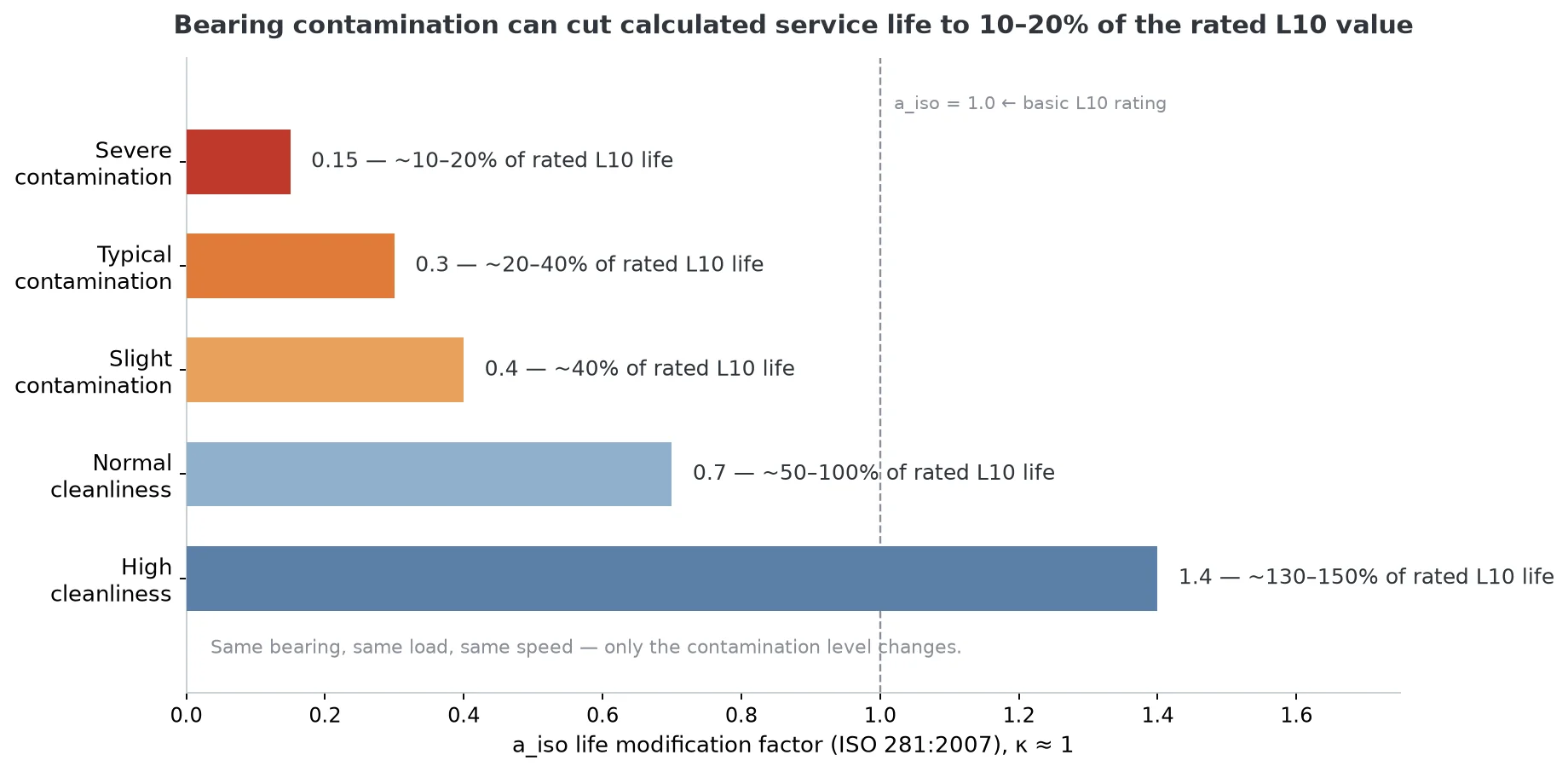
The same bearing, same load, same speed — only the contamination level changes — can deliver 130% of its rated life in a clean environment and just 10–20% under severe contamination. That is an 8- to 15-fold swing, and the official maximum value of a_iso in the standard (50, for exceptionally clean, well-lubricated applications) makes the full theoretical range even wider. This is why the ISO 281:2007 revision exists: the 1990 edition assumed clean, well-lubricated conditions that field experience showed were rarely met. Real-world life is dominated by cleanliness, and the standard now says so explicitly.
Where Does Bearing Contamination Come From?
New bearings leave the factory clean — raceways are ground and honed, assembled bearings are washed, noise-tested, and packed with VCI rust protection. The contamination that kills them almost always enters after the bearing leaves the factory. The main entry points are consistent across every industry:
| Stage | How contamination enters |
|---|---|
| Storage | Damaged packaging, humid environments that defeat VCI protection, bearings stored open or on dirty shelving |
| Mounting (the biggest entry point) | Dirty hands and gloves, contaminated tools and workbenches, unclean shaft journals and housings, hammer strikes, dirty grease guns and fresh grease |
| Operation | Worn or undersized seals, leaking shaft seals, unfiltered breathers, contaminated oil top-ups, wear debris recirculating from gears and other components, machining dust from nearby processes |
Proper bearing mounting techniques exist precisely because the mounting stage is where most contamination enters. Shafts should be cleaned and wiped before fitting, bearings should stay in their packaging until the last moment, and tools and work surfaces should be spotless. It is worth remembering that the machinery is usually dirty long before the bearing is — the bearing is simply the component that pays the price.
Bearing Contamination Control: Six Measures That Actually Work
1. Mounting discipline
Clean gloves, dedicated tools, covered work surfaces, and a clean shaft are the first line of defence. Precision bearings destined for machine tools and spindles should be mounted in a cleanroom or at least a controlled, dust-free area (ISO 14644 classifications apply here). No matter how good the bearing is, it cannot survive being installed with a handful of dirt.
2. Choose the right seal
The bearing’s own sealing is the cheapest insurance available. Open bearings rely entirely on the machine’s shaft seals; sealed bearings carry their own protection. The right choice depends on the environment:
| Configuration | Protection | Best for |
|---|---|---|
| Open bearing + machine shaft seal | Depends on the housing design | High speed, oil lubrication, controlled environments |
| ZZ (metal shields) | Large-particle protection, low friction | Moderate dust, higher speed |
| 2RS (contact rubber seals) | Fine-particle and moisture protection | Dusty, damp, washdown environments |
| Talos 6205-2RS (sealed deep groove ball bearing) | Contact seals both sides, grease-locked | Pumps, fans, conveyors, agricultural machinery |
A sealed bearing such as the Talos 6205 2RS bearing is functionally interchangeable with major brand equivalents like the SKF 6205-2RS1, yet it is manufactured to the same ISO 492 P0 tolerances and tested for running noise and seal integrity before dispatch. For exposed applications, contact seals are the difference between years of service and months of it. If the application also carries heavy radial loads, the Talos deep groove ball bearings range covers both sealed and open configurations in the same ISO dimension system.
3. Keep the lubricant clean
Oil-lubricated systems need filtration sized to the bearing, not just to the machine. The ISO 4406 cleanliness code expresses particle counts per millilitre at three size thresholds — ≥4 μm, ≥6 μm, and ≥14 μm — for example 18/16/13 (roughly NAS 1638 Class 8), which is a common target for hydraulic and industrial gearbox systems. Filter ratings are expressed with beta ratios; a β6(c) ≥ 200 filter captures 99.5% of particles at 6 μm. The three coded thresholds map directly onto the micron-level particles discussed throughout this guide, which is why oil analysis is the most direct way to monitor bearing contamination in circulating systems. Grease-lubricated bearings need the same discipline: never overfill, use a clean dedicated grease gun, and wipe the fitting before every top-up. Our oil vs grease lubrication guide covers the trade-offs in detail.
4. Monitor with oil analysis and condition monitoring
Particle counting (ISO 4406), ferrography, and spectrometric oil analysis detect contamination before it destroys the bearing. Rising vibration and noise levels usually appear first, followed by temperature rise and metal debris in the oil. Catching contamination early turns an emergency replacement into a planned one.
5. Store bearings properly
Keep bearings in their original VCI-protected packaging in a dry, temperature-stable store. Open the packaging only at the point of mounting, and never wash pre-greased sealed bearings — the washing removes the grease and defeats the seal.
6. Protect the housing
Shaft seals, labyrinth seals, bearing isolators, and filtered or desiccant breathers keep external dirt out of the housing. In gearboxes and similar enclosed systems, a contaminated breather can ingest more dirt in a year than the bearing would ever see otherwise.
Contamination vs. Other Damage Modes: How to Tell Them Apart
Contamination damage is often confused with other failure modes during inspection. The differences are visible under close examination:
| Damage type | Appearance | Typical cause |
|---|---|---|
| Contamination indentation | Random, irregular small dents with raised shoulders, often accompanied by wear debris | Hard particles crushed in the contact zone |
| True brinelling | Regular dents spaced at the rolling-element pitch | Overload or impact while stationary |
| False brinelling | Polished, fretted areas without raised shoulders | Micro-movement under vibration while stationary |
| Spalling | Flaking or pitting of the raceway surface | Fatigue — frequently initiated by dents or surface defects |
If you see random dents with raised shoulders, bearing contamination was the cause — and the source of the particles needs to be found before the replacement bearing goes in, or the new bearing will die the same way. Our bearing failure causes analysis walks through all six common failure modes and their prevention in more depth.
Common Misconceptions About Bearing Contamination
“Sealed bearings never need maintenance”
Contact seals dramatically slow bearing contamination ingress, but they are not hermetic. Sealed bearings in hot, humid, or abrasive environments still degrade over time, and the grease inside has a finite life. Seal condition should be part of every inspection.
“New grease is always clean”
Fresh grease from an open container is a classic contamination vector. Grease picks up dust from the air, from dirty scoops, and from the sides of the container. Decant grease into a clean, sealable gun and keep containers closed.
“Only visible dirt matters”
The particles that kill bearings are invisible. A 5 μm particle is fifty times the oil film thickness, yet it is completely invisible to the eye and passes through many ordinary filters. Visible contamination is the end of the scale, not the beginning.
“Grease-lubricated bearings do not need filtration”
Grease cannot be filtered in service, which is exactly why grease quality and cleanliness at the point of filling matter so much. For circulating oil systems, filtration is non-negotiable; for grease, the discipline moves to the filling process itself.
Frequently Asked Questions
What is bearing contamination?
Bearing contamination is the presence of foreign particles, water, or other debris inside the bearing — inside the lubricant, between the rolling elements, or on the raceways. It is the most common controllable cause of premature bearing failure in industrial machinery.
How do I know if my bearing has contamination damage?
Listen and inspect. Rising noise and vibration levels are usually the first signs, followed by temperature increase. On disassembly, random small dents with raised edges on the raceways, combined with wear debris in the grease or oil, confirm contamination damage.
What particle size damages bearings?
Any particle larger than the oil film thickness — typically above 1 μm — can dent the raceway under load. Particles of 5–10 μm are the most damaging because they are large relative to the film yet small enough to be drawn into the contact zone.
Does water count as bearing contamination?
Yes, and it is among the most destructive kinds. Water levels as low as 0.01–0.05% in the oil accelerate fatigue through hydrogen embrittlement and micro-cracking, often before visible rust forms.
How long can a bearing last with contamination?
Under severe contamination, ISO 281:2007 life calculations show the L10 life falling to 10–20% of the rated value — a bearing designed for five years can fail in under a year. The same bearing in a clean environment can exceed its rated life.
Are Talos sealed bearings equivalent to SKF sealed bearings?
Effectively equivalent. The Talos 6205-2RS is dimensionally identical to the SKF 6205-2RS1 (25×52×15 mm, ISO 15 boundary dimensions), with the same ISO 492 P0 tolerance class and comparable contact-seal protection. Cross-references: NSK 6205DDU, FAG 6205-2RSR, NTN 6205LLU.
Conclusion: Cleanliness Is a 10× Service Life Multiplier
Micron-level particles are the hidden tax on every bearing installation. The oil film that protects the raceway is only 0.05–1 μm thick, the particles in ordinary workshop air are bigger than that film, and ISO 281:2007 quantifies the consequence: severe bearing contamination can cut the calculated L10 life to a tenth of its rated value, while a clean installation can exceed it. The encouraging part is that every major contamination entry point is controllable — clean mounting, the right seal configuration, clean lubricant, oil analysis, proper storage, and protected housings.
When the application runs in dust, moisture, or washdown conditions, start with the right bearing. Sealed deep groove ball bearings such as the Talos 6205-2RS deliver the same ISO-standard dimensions and load ratings as the major brands while keeping contamination out from day one. Control the particles and you control the service life — often by an order of magnitude.