Every sealed bearing carries a promise: keep grease in, keep dust and water out. But how do you actually verify that promise? That is exactly what seal testing answers. Seal testing is the structured process of proving how much dust and moisture a bearing seal can keep out, and for many engineers the question quickly becomes “what IP rating does this bearing have?” This guide explains how IP ratings are defined for bearings, which test methods produce a real rating, what the digits actually mean in service, and how to tell a verified rating from a marketing claim.
What Bearing Seal Testing Means — and What an IP Rating Really Covers
Seal testing for rolling bearings covers two distinct questions. First, does the bearing itself keep contaminants out — which is a function of the shield or seal design (ZZ metal shields, 2RS contact rubber seals, or special heavy-duty seals)? Second, does the complete installation — bearing, shaft seal, housing, and breathers — achieve a defined ingress protection level?
The IP (Ingress Protection) code, defined by the IEC 60529 standard, expresses protection against solid particles and water as a two-digit code. A crucial precision point: an IP rating is formally assigned to an enclosure — a complete housing, unit, or machine — not to a bare bearing. A deep groove ball bearing is a component; its sealing is described by its seal type and by seal testing performed on the bearing, while the system-level IP rating belongs to the assembled unit. Manufacturers publish IP ratings for housed units such as pillow blocks and insert bearing units precisely for this reason. When you see “IP67 bearing” in a datasheet, the honest engineering question is: was this rating earned by testing the complete unit to IEC 60529, or is it a shorthand for “sealed on both sides”? The rest of this guide gives you the tools to tell the difference.
How IP Ratings Are Classified: Two Digits, Two Test Families
An IP code has the form IP followed by two digits, for example IP67. The first digit rates protection against solid particles (dust), the second against water. Each digit maps to a defined seal testing procedure, which is what makes the rating verifiable rather than decorative.
The First Digit: Dust and Solid Particle Protection
| First digit | Protection level | Test basis (IEC 60529) |
|---|---|---|
| 0 | No protection | No test |
| 4 | Objects > 1 mm (wires, tools) | Probe test |
| 5 | Dust-protected | Dust chamber, 8 hours, limited dust ingress permitted, no harmful deposits |
| 6 | Dust-tight | Dust chamber with vacuum draw, 8 hours, no dust ingress at all |
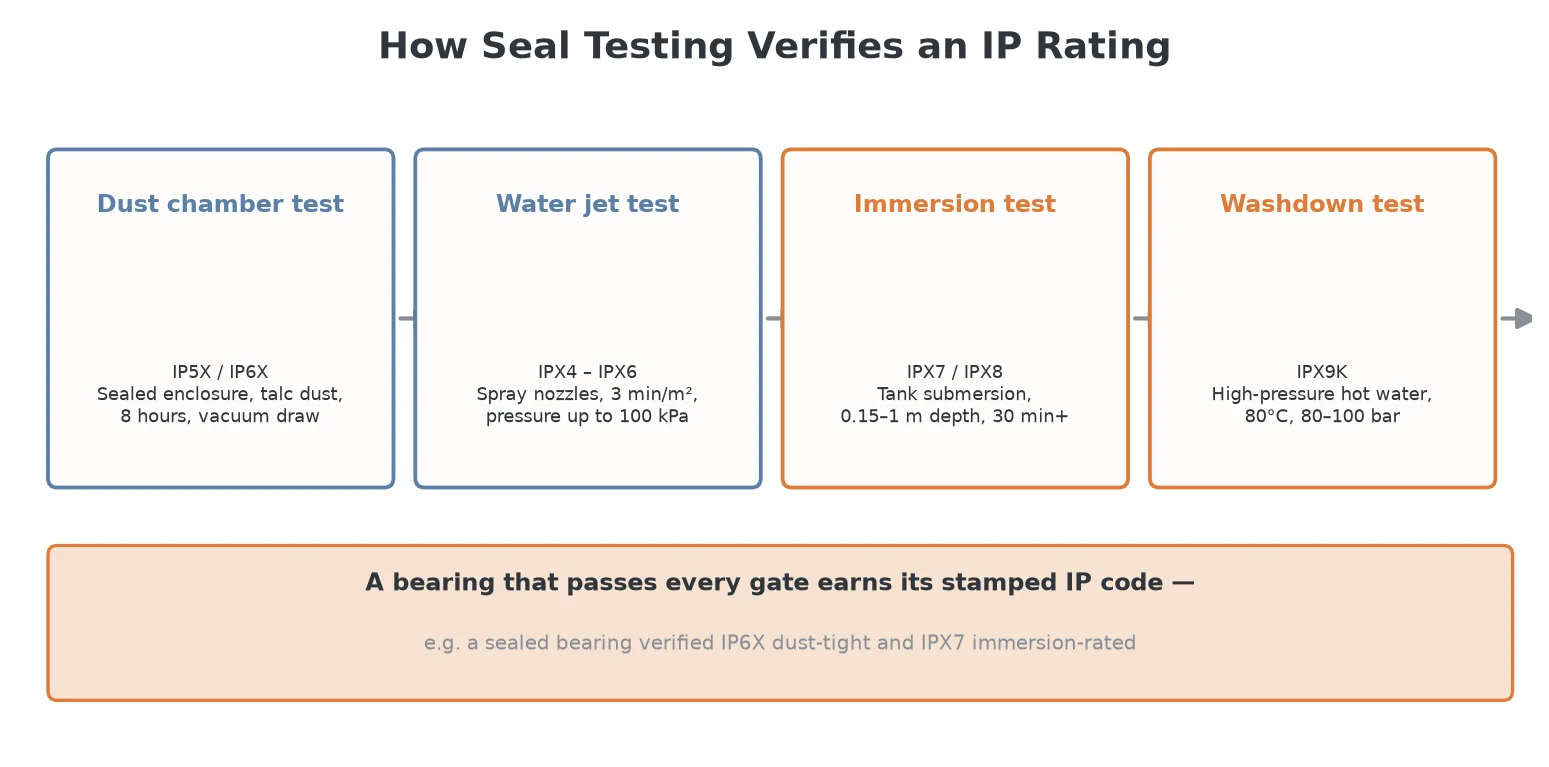
The dust chamber test is the workhorse of dust-related seal testing. The bearing or unit is placed in a sealed chamber filled with fine talc dust, run for eight hours while dust is agitated, and — for the IP6X pass — a slight vacuum is drawn inside the test piece so that any leak path actively pulls dust in. Passing IP6X under vacuum is a demanding result: it demonstrates that the seal excludes fine dust even when the pressure differential encourages ingress. For a bearing application, this matters in agriculture, mining, cement plants, and every environment where fine abrasive dust is airborne.
The Second Digit: Water and Moisture Protection
| Second digit | Protection level | Test basis (IEC 60529) |
|---|---|---|
| 4 | Splashing water | Oscillating spray, 10 minutes |
| 5 | Low-pressure water jets | 6.3 mm nozzle, 30 kPa, 3 minutes per m² |
| 6 | Strong water jets | 12.5 mm nozzle, 100 kPa, 3 minutes per m² |
| 7 | Temporary immersion | 0.15–1 m depth, 30 minutes |
| 8 | Continuous immersion | Depth and duration specified by the manufacturer |
| 9K | High-pressure / steam washdown | ISO 20653: 80 °C water, 80–100 bar, defined angles |
Water testing scales from a simple splash to the brutal IPX9K washdown test used for road vehicles and food-processing equipment, where 80 °C water at up to 100 bar is blasted at the unit from multiple angles. Note that the “K” in IP69K comes from ISO 20653, the road-vehicle variant of the IEC standard — a detail worth checking when a supplier quotes IP69K, because the two standards are close but not identical in procedure.
Bearing Seal Types and What They Achieve in Seal Testing
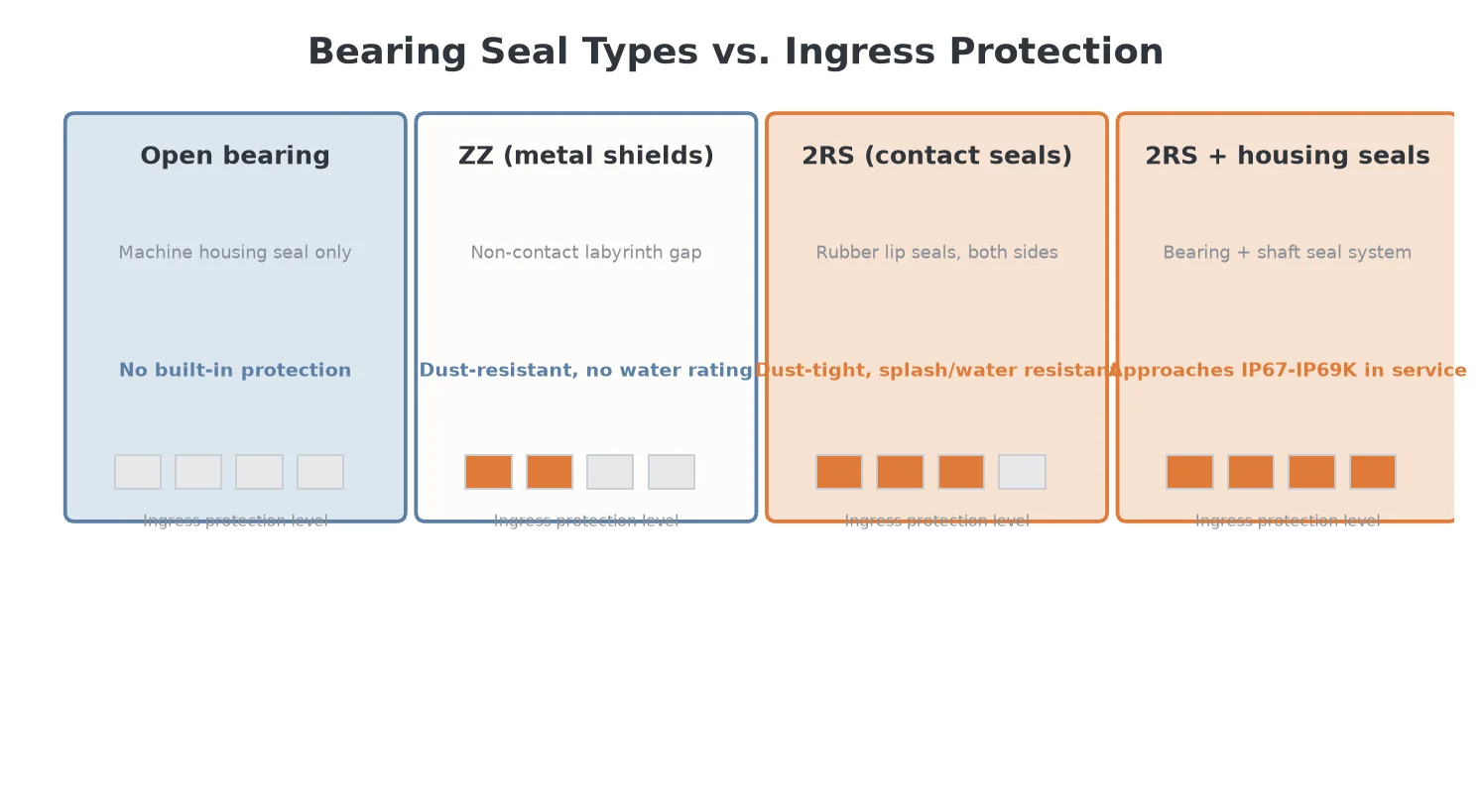
Before a bearing ever enters a test chamber, its seal configuration already tells you a lot about its likely performance. The three common configurations for deep groove ball bearings behave very differently under seal testing:
| Configuration | Seal mechanism | Typical ingress performance | Best suited to |
|---|---|---|---|
| Open bearing | No integral protection | Depends entirely on housing shaft seals | Oil lubrication, controlled environments |
| ZZ (metal shields) | Non-contact labyrinth gap | Blocks large particles; limited fine-dust and water resistance | Higher speed, moderate dust |
| 2RS (contact rubber seals) | Lip seals in contact with the inner ring | Strong dust exclusion and splash-water resistance | Dusty, damp, washdown environments |
| Talos 6205-2RS (sealed, both sides) | Contact seals, grease-locked | Seal-tested for running noise and seal integrity before dispatch | Pumps, fans, conveyors, agricultural machinery |
The engineering distinction that matters: a metal shield is a gap, a contact seal is a lip. In seal testing, contact seals (2RS) consistently outperform shields (ZZ) against fine dust and water because the lip physically wipes the inner ring land and blocks moisture, at the cost of slightly higher friction and a lower speed limit. Our 6201 ZZ bearing guide covers the shield-versus-seal trade-off in detail for the smaller 6201 series, and the same logic scales up through the 62 series.
Why Seal Testing and IP Ratings Matter in Practice
A verified IP rating converts “this bearing seems sealed” into “this unit has been proven to exclude dust and water to a defined level.” That distinction drives real engineering decisions:
- Reliability budgeting. Contamination is the most controllable cause of premature bearing failure — our bearing contamination guide shows how severe contamination can cut rated L10 life to 10–20%. Choosing a seal with a proven test result is the cheapest life insurance available.
- Specification compliance. OEMs supplying equipment into food, pharmaceutical, or outdoor applications increasingly must state an IP class. A seal that has genuinely passed seal testing to IEC 60529 gives you a defensible specification; a guess does not.
- Maintenance planning. A unit rated IP6X/IPX7 changes your inspection intervals and lubrication strategy versus an open bearing behind a marginal shaft seal.
In practice, system-level IP ratings are achieved by the combination of the bearing seal and the housing arrangement. SKF’s engineering resources on bearing sealing solutions make this explicit: the application dictates the sealing strategy, and the housing, shaft seals, and bearing seals must be designed as one system. The SKF bearing failure analysis material, meanwhile, confirms that sealing breakdown is among the most frequent failure triggers in exposed machinery.
For most industrial buyers, the practical takeaway is simpler: in dusty or damp duty, specify contact-sealed bearings and verify the seal quality of your supplier. A sealed deep groove ball bearing such as the Talos 6205 2RS bearing — 25×52×15 mm, ISO 492 P0 tolerance, contact seals on both sides — is effectively equivalent to major brand sealed versions like the SKF 6205-2RS1 and is checked for seal integrity before it leaves the factory. The complete Talos deep groove ball bearing range offers sealed and shielded options in the same ISO dimension system, so the seal choice never forces a mounting redesign.
Common Misconceptions About Bearing IP Ratings and Seal Testing
“2RS means the bearing is IP68”
No. A contact seal is a strong component-level defense, but the IP rating belongs to the complete enclosure, and IP68 requires the manufacturer to specify immersion depth and duration — a bare sealed bearing is not a tested enclosure. Treat “waterproof bearing” as marketing shorthand, and ask for the test report if the claim matters.
“A higher IP number is always better”
Higher ratings come with real trade-offs: contact seals raise friction and lower speed limits, and heavy-duty sealing can overheat a bearing running fast. IP69K-rated equipment is expensive and service-heavy; it is only the right answer where high-pressure washdown actually happens daily.
“Seal testing is only about the rubber lip”
The seal lip matters, but so do the seal-to-ring contact geometry, the grease fill, the shield staking, and the surface finish of the sealing land. That is why manufacturers test assembled bearings — running noise and seal integrity — rather than rating seals in isolation. Our guide to surface roughness Ra Rz explains why finish quality on the sealing surfaces feeds directly into seal performance.
“IP ratings are the same in every standard”
IEC 60529, ISO 20653 (the “K” ratings), and national adoptions of the IEC standard are close but have procedural differences. When comparing datasheets, verify which standard the rating was tested to — an IPX9K rating without the ISO 20653 reference is incomplete information.
Frequently Asked Questions
What IP rating does a sealed bearing have?
A bare bearing does not carry a formal IP rating — the IP code applies to the complete enclosure or housed unit. A contact-sealed bearing such as a 2RS deep groove ball bearing behaves like a dust-tight, splash-resistant component, but an IP67 or IP68 claim must come from testing the assembled unit to IEC 60529.
What does IP67 mean for a bearing application?
IP67 means dust-tight (first digit 6, verified in a dust chamber with vacuum) and protected against temporary immersion in water up to 1 m for 30 minutes (second digit 7). For bearings, that level is normally achieved by a sealed bearing inside a properly sealed housing.
Are sealed bearings waterproof?
Contact-sealed (2RS) bearings are splash-resistant and resist light moisture ingress, but “waterproof” is an overstatement — there is no immersion test on a bare bearing. For continuous submersion, you need a housed unit with a verified IPX8 rating and the right seal system.
How is bearing seal testing performed?
Component-level testing checks assembled bearings for running noise, seal integrity, and grease retention. System-level ingress testing follows IEC 60529: an eight-hour dust chamber test for the first digit (with vacuum draw for IP6X), and water tests from splashing to jets to immersion for the second digit.
What is the difference between ZZ and 2RS seals?
ZZ uses non-contact metal shields that form a narrow labyrinth gap — low friction, higher speed, but limited protection against fine dust and water. 2RS uses contact rubber lip seals that wipe the inner ring — better dust and moisture exclusion at the cost of more friction and a lower speed limit.
Is a Talos 6205-2RS bearing equivalent to an SKF 6205-2RS1?
Effectively equivalent. The Talos 6205-2RS has identical ISO 15 boundary dimensions (25×52×15 mm), the same ISO 492 P0 tolerance class, comparable load ratings, and the same contact-seal configuration, and each bearing is inspected for seal integrity before dispatch. Cross-references include NSK 6205DDU, FAG 6205-2RSR, and NTN 6205LLU.
Conclusion
Seal testing is how the sealing promise becomes a verified fact. An IP rating earned through IEC 60529 dust-chamber and water-jet testing tells you precisely how much dust and moisture a unit excludes; a seal configuration alone tells you how the bearing was built. When you specify bearings for dusty, damp, or washdown duty, choose contact-sealed bearings, check that system-level IP claims come with a test standard behind them, and source from a manufacturer that checks seal integrity on every bearing before it ships.
Need sealed bearings you can trust in dusty or wet environments? Browse the Talos 6205 2RS bearing product page for full specifications, or contact our team for help matching seal type and IP requirements to your application — we respond to technical and quote requests within 24 hours.