Surface Roughness Ra Rz: How Raceway Finish Affects Bearing Running Stability
When an engineer specifies a bearing, most of the numbers on the drawing describe dimensions and tolerances — but the surface the rolling elements travel on matters just as much. Surface roughness Ra Rz values are among the strongest predictors of how quietly, smoothly, and reliably a bearing will run. The rolling contact is only a few micrometers deep: the elastohydrodynamic oil film that separates raceway and rolling elements is typically 0.05 to 0.3 μm thick, and raceway roughness sits in exactly the same range. When surface roughness Ra Rz is controlled properly, the film survives and the bearing stays in a stable full-film regime. When it is not, metal touches metal, noise rises, heat builds, and fatigue life collapses. This guide explains what Ra and Rz actually measure, what values a quality bearing should have, and how finish translates into running stability.
What Do Surface Roughness Ra Rz Values Mean?
Ra (arithmetical mean deviation) is the average absolute height of the surface profile over a sampling length. It is a stable, repeatable number, which is why it appears on almost every drawing and inspection report. Its weakness is that it is an average: a single high peak or a deep scratch barely moves Ra, even though it can destroy a bearing in service.
Rz (maximum height of profile, ISO 4287) is the sum of the largest peak height and the largest valley depth within a sampling length: Rz = Rp + Rv. It is far more sensitive to the extreme features that actually damage rolling contacts. Note that older DIN 4768 and JIS standards defined Rz differently (five-point average and ten-point height), so never compare Rz numbers across those definitions without checking which standard they follow.
| Parameter | What it measures | Why it matters for bearings |
|---|---|---|
| Ra | Average profile height | Overall finish quality; easy to verify, but blind to isolated defects |
| Rz | Largest peak-to-valley height (Rp + Rv) | Oil-film breakdown and fatigue initiation |
| Rp | Largest peak height | Peaks pierce the oil film |
| Rv | Deepest valley depth | Valleys store lubricant for boundary conditions |
| Rq | RMS of the profile | The correct input for oil-film ratio calculations |
How Surface Roughness Is Measured on Bearing Raceways
Surface roughness Ra Rz values only mean something when the measurement follows ISO 4288. The cutoff wavelength (sampling length) must match the surface class: for raceway finishes in the Ra 0.02–0.2 μm range the cutoff is 0.25 mm; for rougher machined surfaces it rises to 0.8 mm or 2.5 mm. The evaluation length is five times the cutoff, and a Gaussian filter (ISO 16610-21) separates roughness from waviness.
This is not just laboratory pedantry. Two suppliers quoting different Ra for the same raceway are usually measuring with different cutoffs or filter settings, and the numbers are then not comparable. Below about Ra 0.05 μm, stylus instruments (tip radius 2–5 μm) start to lose accuracy, and optical methods are preferred. When you buy bearings, ask for the ISO 4288 measurement conditions together with the Ra value — and remember the same discipline applies to the shaft journal, where a finish of Ra ≤ 0.8 μm (ideally 0.4–0.8 μm) is required for a reliable bearing shaft fit tolerance.
Typical Surface Roughness Ra Rz Values for Bearing Components
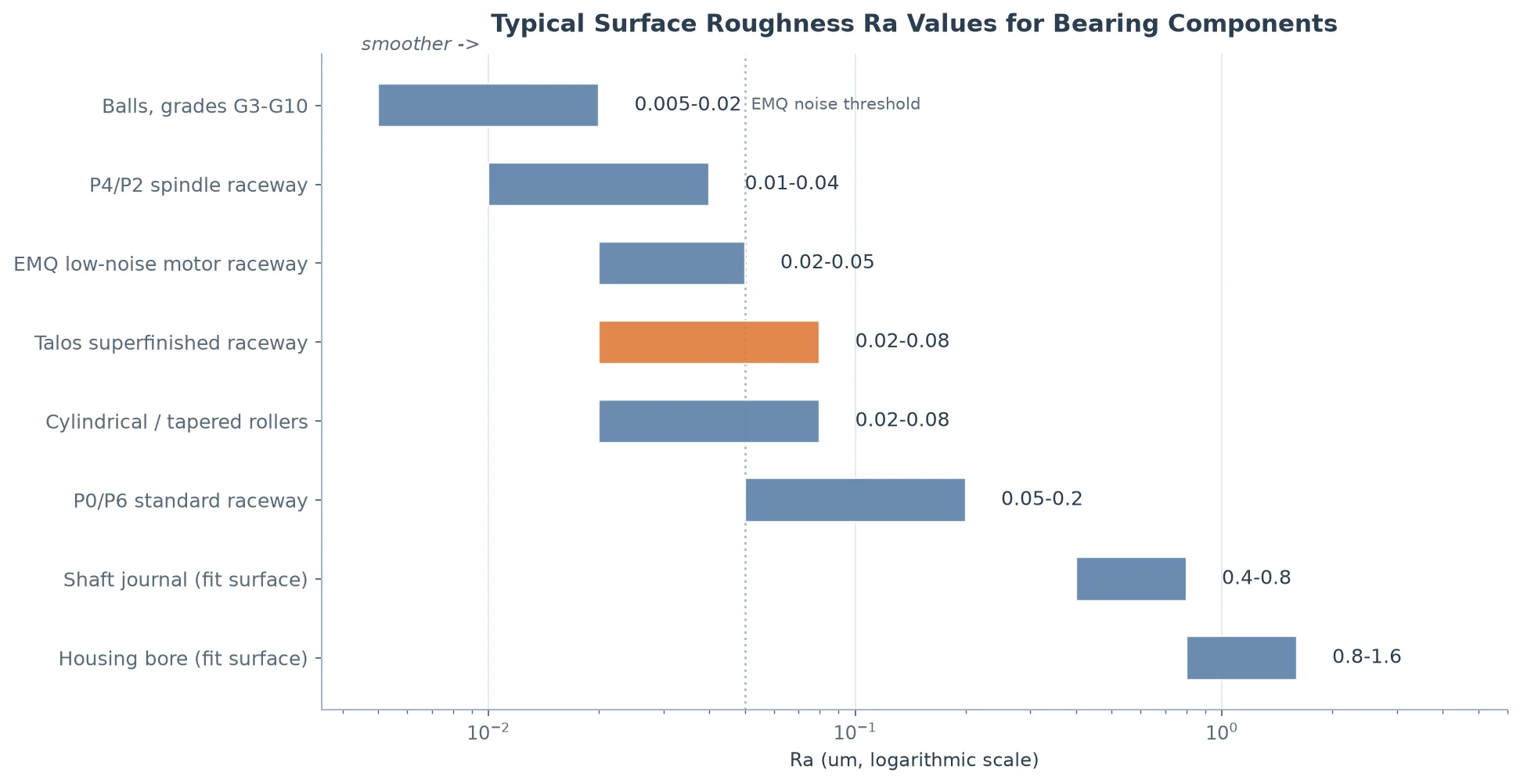
Here are the industry-typical ranges, with the caveat that the Rz/Ra ratio varies from about 4 to 10 depending on the finishing process — never convert between the two with a fixed coefficient.
| Component / grade | Typical Ra (μm) | Typical Rz (μm) |
|---|---|---|
| P4/P2 spindle raceway (superfinished) | 0.01–0.04 | 0.08–0.3 |
| EMQ low-noise motor raceway | ≤ 0.05 | 0.3–0.5 |
| P0/P6 standard raceway (ground + honed) | 0.05–0.2 | 0.3–1.0 |
| Talos superfinished raceway | 0.02–0.08 | 0.15–0.6 |
| Cylindrical / tapered rollers | 0.02–0.08 | 0.15–0.6 |
| Balls, grades G3–G10 (ISO 3290) | 0.005–0.02 | 0.04–0.15 |
| Shaft journal (fit surface) | ≤ 0.8 | ≤ 3.2 |
| Housing bore (fit surface) | ≤ 1.6 | ≤ 6.3 |
Why It Matters in Practice: The Oil Film Ratio λ
The link between surface roughness Ra Rz and running stability is the oil-film ratio, usually called λ (lambda). It compares the minimum elastohydrodynamic film thickness hmin to the combined surface roughness Ra Rz σ of the two contacting surfaces:
λ = hmin / σ, where σ = √(Raraceway² + Rarolling element²)
When λ ≥ 3 the surfaces are fully separated by oil. Between 1 and 3 the bearing runs in mixed lubrication, with the tallest asperities intermittently touching. Below 1 the bearing is in boundary lubrication and metal contacts directly. The table below was computed for a 6205 deep-groove ball bearing at 3000 rpm under 1000 N with ISO VG32 oil: the film thickness is about 0.10 μm, and only the finish changes between rows.
| Raceway finish | Ra (μm) | Combined σ (μm) | λ | Lubrication regime |
|---|---|---|---|---|
| P0 ground raceway | 0.20 | 0.201 | 0.50 | Boundary — direct metal contact |
| P5 superfinished raceway | 0.08 | 0.081 | 1.24 | Mixed — partial asperity contact |
| P4/P2 superfinished raceway | 0.03 | 0.031 | 3.25 | Full film — no contact |
The same bearing, the same load, the same oil — only the finish changed, and it moved the contact from boundary lubrication all the way to a full film. That is why premium manufacturers such as SKF, NSK, and FAG invest so heavily in raceway superfinishing, and why Talos superfinishes its raceways to the same ISO-grade surface standards — you get effectively equivalent running stability and noise performance to the major brands at a significantly better price.
How Surface Roughness Affects Bearing Running Stability
Friction, Heat, and Thermal Drift
Asperity contact raises the friction coefficient from about 0.001–0.002 in a full film to 0.08–0.1 in boundary lubrication — a 50-to-100-fold jump. That friction becomes heat, the bearing expands, and internal clearance shrinks while preload drifts upward, which can cascade into thermal runaway. A rough raceway is therefore often the hidden root cause behind “the bearing ran hot” failures that blame lubrication instead. For the same reason, finish quality interacts directly with bearing preload stability in high-speed spindles.
Noise and Vibration
For any quiet-running application, the surface roughness Ra Rz of the raceway sets the noise floor. Every asperity collision radiates a tiny high-frequency impulse, and at thousands of contacts per second they add up to audible noise and measurable vibration (ISO 15242). Low-noise motor bearings — the EMQ class — hold raceway Ra at or below 0.05 μm for exactly this reason. Keep in mind that roughness drives high-frequency noise; low-frequency rumble usually comes from waviness or roundness error, which Ra does not describe at all.
Fatigue Life and Surface-Initiated Damage
Under load, asperity peaks carry local stresses several times higher than the nominal Hertzian stress, so cracks start at the surface instead of at the classical subsurface depth. The result is surface-initiated fatigue: peeling and micro-spalling that looks like premature failure. The ISO 281:2007 rating-life system accounts for this through the aiso factor and the viscosity ratio κ — the rougher the raceway, the thinner the effective film, the lower aiso, and the shorter the calculated life. This is one of the most common findings in professional bearing failure analysis.
Running-In and Wear Debris
New bearings wear their highest peaks down during running-in. On a rough raceway that process generates far more wear debris, which then acts as a three-body abrasive inside the contact — contaminating the lubricant, lowering the contamination factor ηc, and accelerating damage on both raceways. A properly superfinished surface runs in cleanly and quietly within minutes instead of hours.
Why Rz and Peak Heights Matter More Than Ra Alone
Here is the subtlety that separates good bearing specifiers from the rest: the oil film is pierced by peaks, not by averages. Two raceways can have identical Ra and very different peak heights — and therefore very different stability.
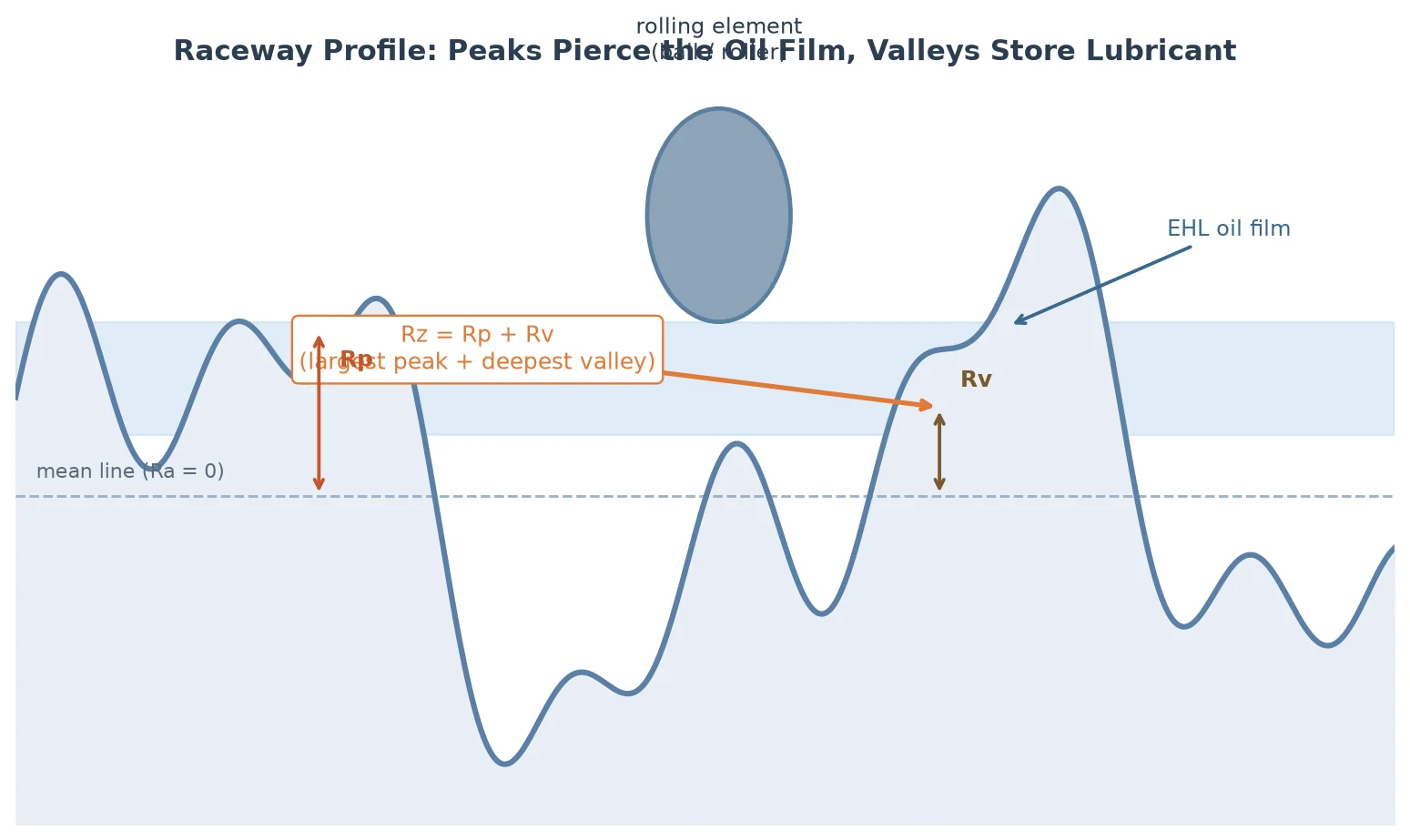
Rz, Rp, and the bearing-area-curve parameters Rpk/Rk/Rvk (ISO 13565-1) describe the features that actually matter: Rpk measures the load-bearing peaks that must be removed, while Rvk measures the valleys that store oil for boundary conditions.
The optimum bearing surface is a negative-skew plateau: high peaks ground flat, deep valleys preserved. This is precisely what superfinishing produces, and it is why a superfinished surface with Ra 0.04 μm can outperform a lapped surface with Ra 0.02 μm in grease-lubricated service. When you specify or audit bearings, control surface roughness Ra Rz as a pair: write the requirement as “Ra ≤ 0.05 μm AND Rz ≤ 0.3 μm, negative-skew plateau surface” — an Ra-only certificate does not prove running stability. And check the mating parts too: combined roughness includes the shaft, so keep the journal to the Ra ≤ 0.8 μm recommended in the bearing shaft fit tolerance guide.
Common Misconceptions About Surface Roughness Ra Rz
- “Lower Ra is always better.” Not true. The goal is a plateau surface with oil-retaining valleys, not a perfectly flat mirror. Beyond the plateau point, extra polishing costs money and buys nothing.
- “Ra pass means the bearing is stable.” A passing surface roughness Ra Rz certificate does not by itself prove stability: Ra is blind to isolated peaks, waviness, and roundness error. Demand Rz/Rpk as well, and separate vibration complaints by frequency: high frequency is finish, low frequency is waviness.
- “Rz is just Ra times five.” The ratio varies from 4 to 10 with the finishing process, and the Rz definition itself changed between ISO 4287 and older DIN/JIS standards. Always ask which standard the Rz value follows.
- “Only the raceway needs to be smooth.” The film ratio uses the combined roughness of both surfaces — raceway and rolling element — and the fit surfaces matter too. A rough journal or housing bore can also eat the interference of the fit, an effect covered in the bearing clearance guide.
FAQ
What is the difference between Ra and Rz in bearing manufacturing?
Ra is the average height of the surface profile, while Rz (ISO 4287) is the sum of the largest peak and deepest valley within a sampling length. Ra describes overall finish; Rz and the related Rp describe the extreme features that pierce oil films and start fatigue cracks. Both are needed to judge surface roughness Ra Rz for bearing stability, so specify them together on bearing drawings.
What surface roughness Ra Rz values should a good bearing have?
Standard P0/P6 bearing raceways are typically Ra 0.05–0.2 μm; low-noise motor (EMQ) bearings are held to Ra ≤ 0.05 μm; and precision P4/P2 spindle bearings reach Ra 0.01–0.04 μm. Talos superfinished raceways sit in the 0.02–0.08 μm range. Rz is typically 4–10 times Ra depending on the process.
Does surface roughness affect bearing noise?
Yes, directly. High-frequency noise and vibration come from asperity collisions between raceway and rolling elements, which is why low-noise bearings are superfinished. Low-frequency noise, by contrast, points to waviness or roundness error rather than Ra roughness.
Can a rough raceway cause premature bearing failure?
Yes. A rough raceway pushes the contact into boundary lubrication, raising friction and temperature, and it initiates surface fatigue (peeling and micro-spalling) that shortens life dramatically — an effect ISO 281:2007 captures through its aiso life factor.
How is surface roughness measured on a bearing raceway?
With a stylus or optical profilometer following ISO 4288: a 0.25 mm cutoff for finishes below Ra 0.2 μm, five sampling lengths of evaluation, and Gaussian filtering to separate roughness from waviness. Optical methods are preferred below about Ra 0.05 μm.
Conclusion: Specify Finish Like You Specify Dimensions
Surface roughness Ra Rz values are not decorative numbers on a certificate — they decide which lubrication regime your bearing runs in, how much noise it makes, how hot it gets, and how long it lasts. A raceway finish of Ra 0.2 μm pushes a typical 6205 into boundary lubrication at moderate speed, while 0.03 μm keeps the same bearing in a full oil film. When you buy bearings, require both Ra and Rz (or Rpk), demand the ISO 4288 measurement conditions, and prefer suppliers who superfinish as standard.
Talos bearings are manufactured with superfinished raceways and effectively equivalent geometry to the leading global brands, at export-direct prices. Browse the deep groove ball bearings range or contact us with your application details — we will confirm the finish grade and fit class your operating conditions require.