Ball bearing hs code is the six-digit Harmonized System number every importer and exporter needs to know before bearings leave the factory. Get it right and customs clearance is routine: duties calculated correctly, documents accepted on the first pass, and no surprise inspection holds. Get it wrong and you face duty underpayment assessments, storage and demurrage charges, and even penalties — on both sides of the transaction. This guide explains what an HS code is, how ball bearing classification works across every major market, and how to build a shipment file that clears customs without friction.
One point up front: a ball bearing hs code is not a single fixed number that applies everywhere. The first six digits are identical in more than 190 countries, but the national extensions that follow — and the duty rates attached to those extensions — differ from market to market. Understanding that structure is the entire key to hassle-free clearance, and it is exactly what this guide walks through.
What Is an HS Code?
The Harmonized Commodity Description and Coding System — the HS — is the international product classification language maintained by the World Customs Organization (WCO). Every traded product, from bearings to bananas, maps to a six-digit code: the first two digits identify the chapter (the sector), the next two the heading (the product family), and the last two the subheading (the specific product). The WCO’s official description of the Harmonized System is the authoritative reference, and its importance is hard to overstate: roughly 98% of international merchandise trade is classified under HS codes.
Countries then extend the six digits with their own national codes, and this is where tariffs, taxes, and trade remedies actually live:
- HTS (United States) — the Harmonized Tariff Schedule extends codes to 8 or 10 digits (for example 8482.10.50) and carries the US duty rate.
- CN / TARIC (European Union) — the Combined Nomenclature adds two digits at EU level; TARIC adds more for measures such as anti-dumping duties.
- HSN (India) — the Indian Harmonized System of Nomenclature is an 8-digit extension tied to GST rates.
Whatever the local name, the first six digits stay the same worldwide. That is why the ball bearing hs code 8482.10 is understood by customs officers in Shanghai, Rotterdam, and Long Beach alike, even though each country charges a different rate under it.
The Ball Bearing HS Code: Heading 8482 Explained
All bearings — ball and roller — sit in heading 8482, “Ball or roller bearings.” Every ball bearing hs code in the world begins with those four digits, and the fifth and sixth digits narrow the classification down to the specific type. The table below shows the complete international structure of heading 8482:
| Subheading | Product | Typical examples |
|---|---|---|
| 8482.10 | Ball bearings | Deep groove, angular contact, self-aligning, thrust ball |
| 8482.20 | Tapered roller bearings | Cone and tapered roller assemblies, wheel bearings |
| 8482.30 | Spherical roller bearings | Heavy radial load, misalignment-tolerant units |
| 8482.40 | Needle roller bearings | Needle rollers with a length/diameter ratio of at least 3 |
| 8482.50 | Other cylindrical roller bearings | NU, NJ, NUP, N, and NN series |
| 8482.80 | Other, including combined ball/roller | Combined radial bearings, other combinations |
| 8482.91 | Balls, needles, and rollers | Unmounted rolling elements presented as parts |
| 8482.99 | Other parts | Rings, cages, shields, and seals for bearings |
For ball bearings specifically, subheading 8482.10 covers every variant: deep groove ball bearings, angular contact ball bearings, self-aligning ball bearings, and thrust ball bearings. A deep groove ball bearing, a precision angular contact pair, and a heavy thrust ball bearing all classify under the same six-digit code — the national extension then separates them for duty purposes. In the United States, for example, 8482.10.10 covers ball bearings with a maximum outside diameter of 9 mm or less, while 8482.10.50 covers all other ball bearings.
What Does NOT Classify Under 8482
Knowing what stays out of heading 8482 is just as important as knowing what goes in. The most common neighbor codes:
- Bearing housings and plain shaft bearings — heading 8483, not 8482.
- Seals, gaskets, and mechanical seals — heading 8484, or rubber/plastic headings depending on composition.
- Loose, unmounted steel balls — heading 7326 (articles of iron or steel) in most cases, not 8482.91.
- Bearings supplied as part of a machine — classified with that machine unless presented separately for customs purposes.
When in doubt between two headings, customs law resolves the question using the General Rules of Interpretation, starting with the most specific description — which is one more reason to keep a broker in the loop on genuinely ambiguous products.
How to Determine the Correct HS Code, Step by Step
Finding the right ball bearing hs code is a four-step process that takes about five minutes once you understand the logic. The diagram below summarizes the decision path:
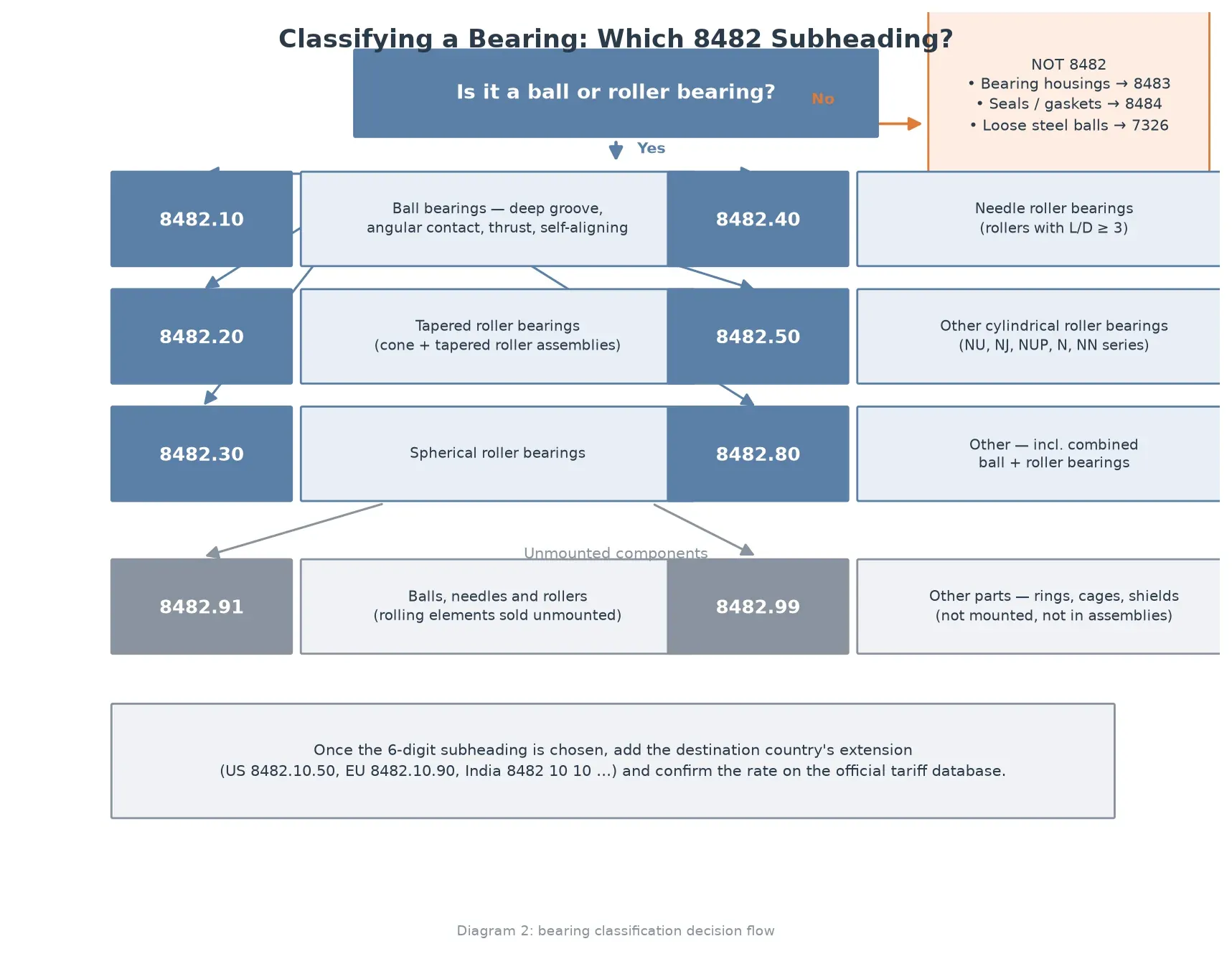
Step 1: Identify the rolling element
Is the product a ball bearing, a roller bearing, or something else entirely? Balls give you 8482.10. Rollers split into four subheadings by geometry: tapered (8482.20), spherical (8482.30), needle (8482.40), and cylindrical (8482.50). If the component is a housing, seal, or loose ball, it leaves heading 8482 altogether — see the exclusion list above.
Step 2: Match the subheading
For most buyers this is a two-second step, because the bearing type is written on the box: a 6201 deep groove needs the ball bearing hs code 8482.10, a 30206 tapered roller uses 8482.20, a 22316 spherical roller uses 8482.30, and so on. The hard cases are combined bearings (8482.80) and components sold unmounted (8482.91 and 8482.99).
Step 3: Add the national extension
Your ball bearing hs code is only complete once it carries the destination country’s extension. Exporting from China to the United States? Your invoice should state the full 10-digit HTS line such as 8482.10.50, not just 8482.10 — US customs requires it, and the duty rate attaches to the 10-digit line.
Step 4: Verify on the official tariff database
Never rely on a third-party lookup site alone. Check the code against the official database of the destination market: the US Harmonized Tariff Schedule for the United States, the EU TARIC database for Europe, and the CBIC portal for India. These tools are free, current, and authoritative — and they show the exact duty rate for the code you have chosen.
Tariff Classification by Market: US, EU, and India
The ball bearing hs code determines how much duty you pay, and the same code number can carry very different amounts in different countries. The chart below compares the indicative duty levels for ball bearings in the three largest markets:
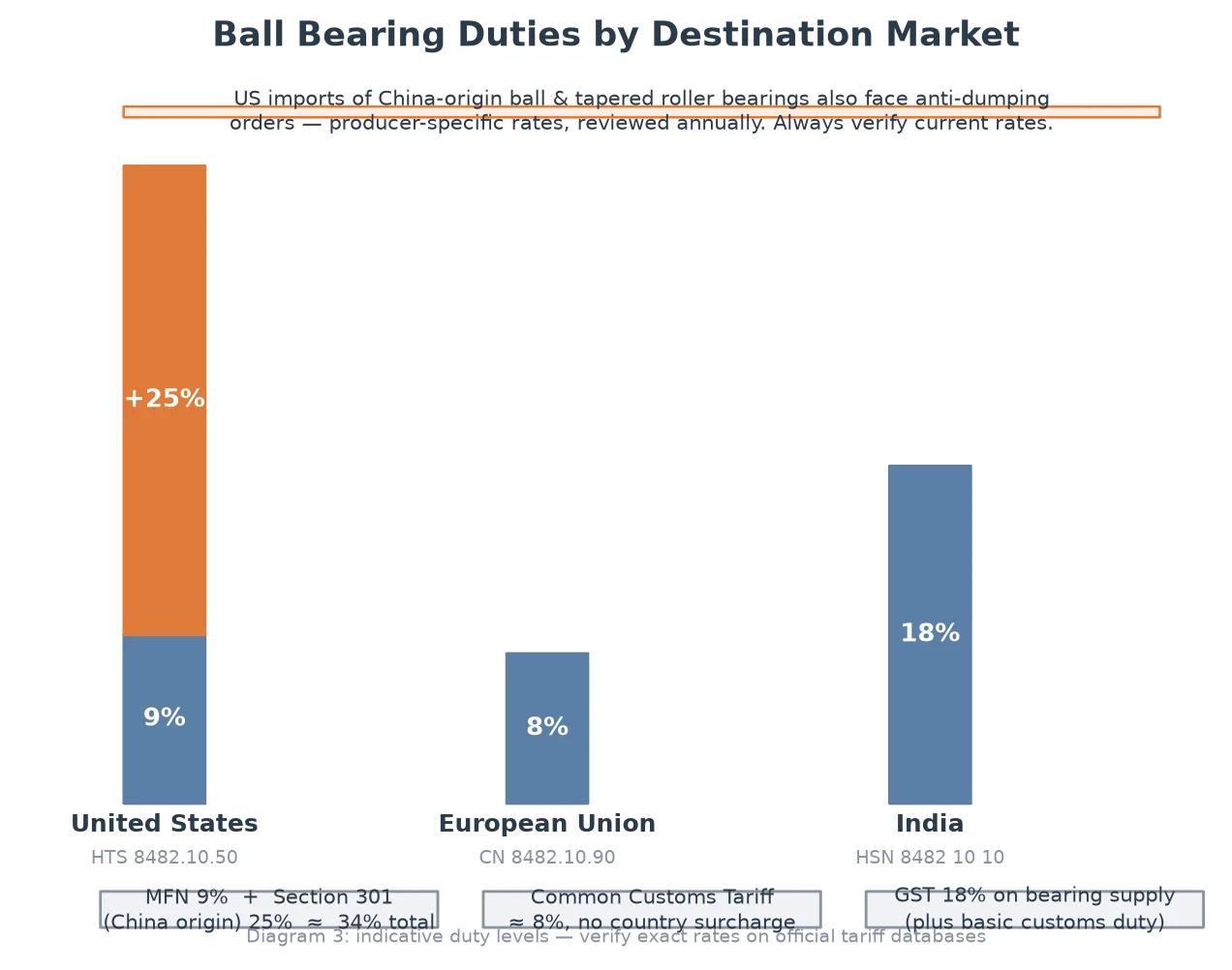
United States: MFN plus China-specific measures
Ball bearings entering the US under 8482.10.50 pay a general (MFN) duty of about 9%. If the bearings are of Chinese origin, two additional measures apply. First, a 25% Section 301 additional duty under the US-China tariff action — the USTR Section 301 program page tracks these actions and their exclusions. Second, anti-dumping duty orders cover both ball bearings and tapered roller bearings from China; rates are producer-specific and are updated in annual administrative reviews, so they must be verified per supplier rather than assumed. For a Chinese-origin shipment, the effective duty burden can therefore reach roughly 34% before freight — a number every importer should know before signing a purchase order.
European Union: a single common tariff
In the EU, ball bearings enter under CN code 8482.10.90 with a Common Customs Tariff duty of around 8%. Because the EU levies duties at union level, the rate is the same in every member state — but TARIC adds product- and origin-specific measures, including residual anti-dumping duties, so the TARIC check in Step 4 still applies.
India: GST and customs duty
India’s HSN 8482 classification carries an 18% GST rate on the supply of bearings, and imports additionally attract basic customs duty. The combined landed cost depends on the current duty schedule, so buyers should confirm the effective rate on the official CBIC portal for the specific HSN line before quoting end-user prices.
| Market | Code (extension) | Base duty | Extra for China origin |
|---|---|---|---|
| United States | 8482.10.50 (HTS) | ≈ 9% MFN | +25% Section 301; AD orders on ball & tapered roller bearings |
| European Union | 8482.10.90 (CN) | ≈ 8% CCT | Check TARIC for origin-specific measures |
| India | 8482 10 10 (HSN) | 18% GST | Plus basic customs duty |
These figures are indicative, not a legal ruling. Duty rates change with trade agreements, tariff revisions, and trade-remedy reviews — which is precisely why Step 4 (verify on the official database) is non-negotiable for every shipment.
Why Accurate Classification Matters
The ball bearing hs code on your commercial invoice is more than a formality. Customs authorities use it to screen shipments, and a wrong code can trigger three kinds of trouble.
Duty assessments and penalties
If customs reclassifies a shipment into a higher-duty line, you owe the difference — and in some jurisdictions, interest and penalties on top. Deliberate or reckless misdeclaration is treated as fraud in many countries, with criminal consequences. Even an honest error on a routine shipment can result in a fine of thousands of dollars plus storage and demurrage while the paperwork is corrected.
Delays and inspection holds
An HS code that does not match the goods is one of the most common triggers for physical inspection. Each inspection adds days to your lead time and costs money in warehousing and container charges — the opposite of hassle-free clearance.
Trade-remedy exposure
For Chinese-origin bearings, the combination of Section 301 and anti-dumping orders makes correct classification commercially critical. Misdeclaring origin or using an incorrect code to avoid these duties is precisely what customs audit teams look for, and the penalties are severe. Legitimate importers protect themselves with accurate, verifiable documentation — which is also the fastest route through the gate.
Working with a full-service manufacturer removes most of this risk at the source. When you buy from a supplier like Talos Bearing, the export team prepares the shipping documents with the correct classification information, origin documentation, and packaging that meets international transport standards — so the classification burden does not land entirely on you at the border. Our bearing supplier guide explains what to check in a supplier’s logistics and documentation capability before you commit to an order.
Common Ball Bearing Classification Mistakes
Mistake 1: Using the wrong ball bearing hs code from a third-party list
Freely circulating HS code lists are frequently outdated or simplified to six digits. The six-digit code is only the starting point — the national extension decides the duty. Always confirm against the official tariff database of the destination country.
Mistake 2: Assuming one code fits all markets
Chinese exporters sometimes put a single code on the invoice for every destination. But the US wants 10-digit HTS lines, the EU wants CN codes, and India uses HSN — and the underlying 6-digit subheading can even differ for the same product if the national nomenclatures split it differently. Prepare the documentation per destination, not per product.
Mistake 3: Confusing 8482 with 8483 and 8484
Bearing housings (8483), seals and gaskets (8484), and loose steel balls (7326) sit outside heading 8482. Batching them onto one line item — or, worse, describing a housing as a “bearing” — invites reclassification and delay.
Mistake 4: Forgetting that sealed bearings are still ball bearings
Adding shields or seals (ZZ, 2RS, etc.) changes the bearing’s suffix, not its HS code. A 6201 ZZ and an open 6201 classify identically under 8482.10 — the mistake is inventing a “sealed bearing” code that does not exist in the nomenclature.
Customs Documentation for Hassle-Free Clearance
A correct ball bearing hs code only does its job when the rest of the shipment file is consistent. Build every export shipment around this checklist:
- Commercial invoice — full 8/10-digit HS code per line, unit values, and a plain-language description that matches the code (e.g. “deep groove ball bearing, 6201, 12 x 32 x 10 mm”).
- Packing list — quantities, weights, dimensions, and marks matching the invoice line by line.
- Bill of lading / airway bill — destination, consignee, and declared value consistent with the invoice.
- Certificate of origin — required for preferential duty claims and for origin verification where trade remedies apply.
- Importer of record details — the buyer’s EORI (EU) or importer number (US); the importer of record is legally responsible for the classification, so share your code with the supplier and confirm it together before shipment.
Keep every document consistent: customs systems flag discrepancies between the invoice description, the HS code, and the packing list far more reliably than they spot any single error. One coherent file is the practical definition of hassle-free clearance.
Frequently Asked Questions
What is the HS code for ball bearings?
The international ball bearing hs code is 8482.10 (heading 8482, subheading 8482.10 — ball bearings). Depending on the destination, the code is extended for national tariff purposes, for example 8482.10.50 in the US HTS, 8482.10.90 in the EU CN, and 8482 10 10 in India’s HSN.
What is the difference between an HS code and an HTS code?
The HS code is the six-digit international classification set by the World Customs Organization. The HTS code is the US national extension to 8 or 10 digits, and it is the HTS line that carries the US duty rate. Other countries use their own extensions: CN/TARIC in the EU, HSN in India.
Do sealed or shielded bearings need a different HS code?
No. Seals and shields change the bearing’s suffix designation (ZZ, 2RS, etc.) but not its classification. An open, shielded, or sealed deep groove ball bearing all fall under 8482.10 — there is no separate “sealed bearing” code in the nomenclature.
How much duty do I pay importing ball bearings into the US?
For the US ball bearing hs code 8482.10.50, the general (MFN) rate is about 9% duty. Chinese-origin bearings additionally face a 25% Section 301 duty, and anti-dumping orders cover ball and tapered roller bearings from China with producer-specific rates. Verify the current total for your supplier and origin on hts.usitc.gov before shipping.
Can I use the same HS code for bearings and bearing parts?
Not usually. Complete bearings classify in 8482.10 through 8482.80, while unmounted rolling elements classify in 8482.91 and other parts in 8482.99. Parts and assemblies can carry different duty rates, so each line item needs its own correct code.
Do Chinese bearing suppliers like Talos provide HS codes on export documents?
Professional exporters do. Talos Bearing, for example, prepares commercial invoices with the correct classification information for each destination and provides the origin and packaging documentation needed for smooth clearance. Confirm with any supplier that their invoice states a full national extension, not just the six-digit code, and that the description matches the code line for line.
Conclusion
Getting the ball bearing hs code right is the single cheapest way to make international shipping predictable. Learn the structure: chapter 84, heading 8482, subheading 8482.10, extended to the destination’s national line. Identify the rolling element, match the subheading, add the national extension, and verify on the official tariff database. Then build an invoice, packing list, and origin file that all tell the same story. Duties for bearings are modest in most markets, but for Chinese-origin shipments to the US the Section 301 and anti-dumping layers make accurate classification commercially significant — and for every destination, one consistent document set is what turns a potential customs headache into a routine delivery.
Planning your next bearing import? Browse our deep groove ball bearings and roller bearings, or contact the Talos team for a quotation that includes export-ready documentation — the correct ball bearing hs code on every document, origin paperwork, and packaging built for international transit.