Bearing selection is where most premature bearing failures are decided — long before the bearing ever spins. Pick the wrong type, the wrong size, the wrong clearance, or the wrong cage, and no amount of good lubrication or careful mounting will save the component. This guide walks through the six costliest bearing selection mistakes, what they do to your machine, and exactly how to correct each one. It is written for engineers and maintenance teams who want to stop fixing symptoms and start fixing decisions.
Why Bearing Selection Errors Cost So Much
A correctly selected bearing delivers its rated L10 life with routine maintenance. An incorrectly selected one fails early, and the bill is never just the bearing itself. The shaft may be scored, the housing damaged, the motor rewound, and the production line stopped — often at the worst possible moment.
The good news is that bearing selection is a systematic process, not a guessing game. Our complete bearing selection guide covers the six-step selection workflow in detail. This article takes the opposite angle: the six specific oversights that cause the most downtime, with the correction for each. Read both and you will have the full picture.
The 6 Costly Bearing Selection Oversights
The six errors below account for the vast majority of selection-related failures. They are listed in the order they usually appear in the selection process, starting with the most fundamental.
Mistake 1 — Choosing the Wrong Bearing Type
The most common bearing selection mistake is reaching for a deep groove ball bearing for every application. Deep groove ball bearings are versatile, but they are only optimal for radial loads with light axial components. When a bearing is forced to carry a load it was not designed for, the contact stress climbs and the calculated life collapses.
Correct it by matching the bearing type to the load direction:
- Heavy radial load — a cylindrical roller bearing uses line contact and carries the highest radial load of any common type.
- Combined radial and axial load — an angular contact ball bearing or a tapered roller bearing handles both directions at once.
- Pure axial load — use a thrust bearing, not a radial bearing pressed sideways.
- General moderate duty — a deep groove ball bearing remains the right default.
The load rating tables in any manufacturer’s catalog show exactly why: a cylindrical roller bearing of the same bore size typically carries 1.5–2 times the radial load of a ball bearing. Choosing the type by load direction is the foundation of every other selection step.
Mistake 2 — Specifying the Wrong Bearing Size
Two different errors hide under “wrong size.” The first is a measurement error: a shaft is measured once, hastily, or the bore code is misread — 6205 means a 25 mm bore (05 × 5), and 6206 means 30 mm. The second is selecting a bearing that fits the shaft but cannot carry the load, because only the dimensions were compared and never the ratings.
Correct it with three checks:
- Measure the shaft with a micrometer at two positions, not a caliper eyeball check.
- Read the designation correctly — our 6201 ZZ bearing guide explains the full ISO designation system, including bore codes, seals, clearance, and cage suffixes.
- Verify the load rating against ISO 281:2007: the rating life is L10 = (C/P)p, where C is the dynamic load rating, P the equivalent load, and p is 3 for ball bearings and 10/3 for roller bearings. If your calculated life comes up short, step up to the next bore size or the next width series instead of hoping the margin is enough.
An undersized bearing fails by fatigue spalling in weeks or months instead of years. When shock or vibration is likely, apply a 1.2–1.5× safety factor to the calculated load before comparing it with C.
Mistake 3 — Ignoring Internal Clearance
Internal clearance is the play between the rolling elements and the raceways before mounting. Many buyers order the default CN (normal) clearance without thinking about what happens after installation — and the result is insufficient clearance after the fit and operating temperature consume it, which may cause overheating, vibration, or even seizure.
Two effects eat the initial clearance:
- Interference fit — pressing the inner ring onto the shaft expands it and consumes roughly 60–80% of the interference. A k6 fit on a 25 mm shaft averages about 8 μm of interference, so expect 5–7 μm of clearance to disappear.
- Thermal growth — when the shaft runs hotter than the housing, it grows more, removing roughly 0.0117 × ΔT × dm more clearance. A 40 K temperature rise on a 6205 removes another 4–6 μm.
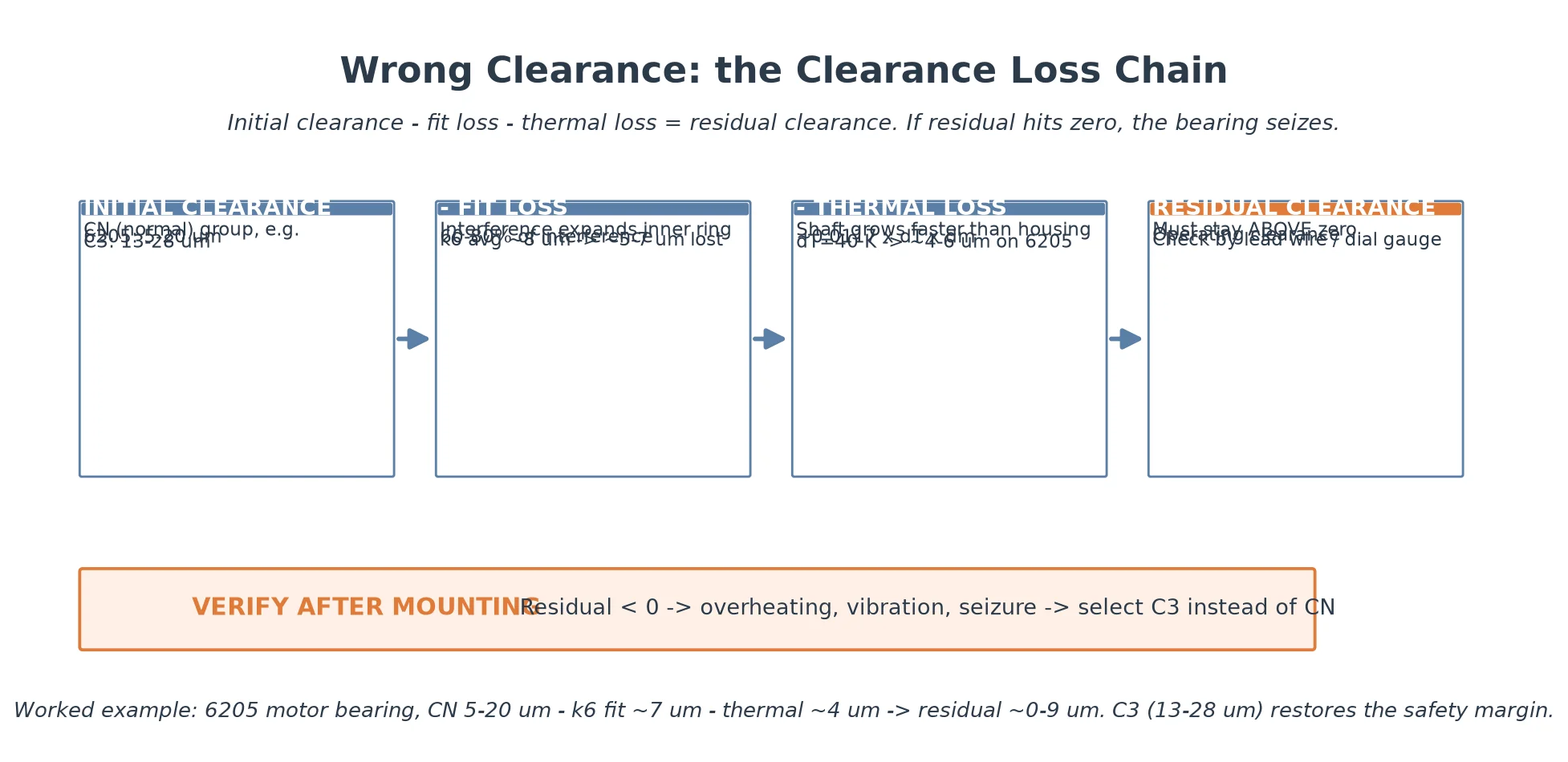
Work through the arithmetic and a 6205 motor bearing with CN clearance (5–20 μm) installed with a k6 fit can land at a residual clearance of 0–9 μm — dangerously close to zero. The correction is to specify C3 (13–28 μm for the same bearing), which restores the safety margin. Our bearing clearance guide covers the full C2/CN/C3/C4 selection logic, and after mounting you can verify the residual clearance with lead wire or a dial gauge.
Mistake 4 — Picking the Wrong Cage
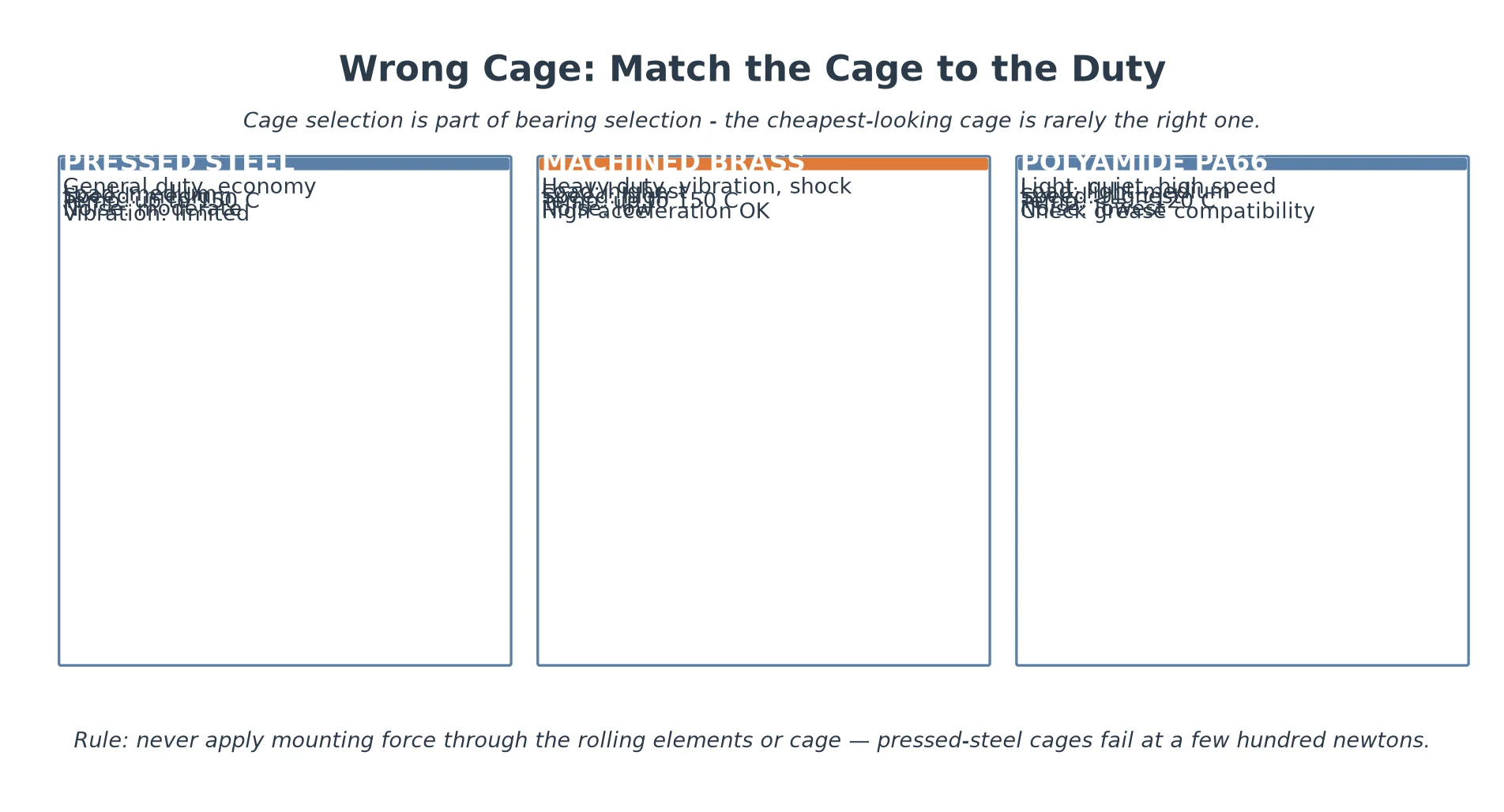
The cage holds the rolling elements apart, and it is the part most often ignored during bearing selection — right up until it fails. A pressed steel cage is the economical default, but it is the wrong choice for heavy vibration, high acceleration, or applications where shock loads slam the rolling elements sideways.
Match the cage to the duty:
- Pressed steel — general duty, economical, adequate for most moderate applications.
- Machined brass — the heavy-duty choice: highest strength, handles vibration, shock, high acceleration, and temperatures up to about 150 °C.
- Polyamide (PA66) — lightest and quietest, excellent at high speed, but limited to roughly 120 °C and sensitive to some greases; always check grease compatibility.
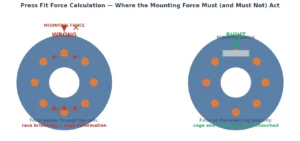
There is also a mounting mistake that is often blamed on the cage: applying the press force through the rolling elements. A pressed steel cage fails at only a few hundred newtons, while a press fit legitimately needs tons. The force must always act on the face of the ring with the interference fit — our bearing press fit force calculation shows exactly how much tonnage is safe and where to apply it.
Mistake 5 — Choosing the Wrong Lubrication
Lubrication is part of bearing selection, not an afterthought. The two classic errors are greasing a bearing that should run on oil, and over-filling a grease-lubricated bearing. A bearing packed 100% full of grease has no room for the grease to churn, temperature climbs, and the grease degrades in months instead of years.
Correct it with three rules:
- High speed or high temperature → oil. Grease lubrication typically caps the speed at 60–80% of the oil-lubricated limit because of churning losses.
- Grease fill = 1/3 to 1/2 of the free space, never a full pack.
- Never mix thickener families. Lithium and polyurea greases are not reliably compatible — mixing them can harden or soften the grease catastrophically. Our grease compatibility guide has the full compatibility matrix, and the oil vs grease lubrication comparison explains how to decide between the two.
Mistake 6 — Getting the Shaft and Housing Fits Wrong
Fits are where bearing selection meets the machine design. The governing rule is simple: whichever ring carries the rotating load gets the interference fit. When the shaft rotates (the most common case), the inner ring must be a press fit on the shaft; when the outer ring rotates, the housing gets the interference fit.
The second fit error is picking the tolerance class by habit instead of by load. The correct class depends on the load ratio P/C: light loads take j6 or k6 for ball bearings and k6 for rollers, moderate loads take k6/m6, and heavy or shock loads take m6/n6 or even p6. A bearing shaft fit tolerance mismatch produces ring creep, fretting wear, and eventually a scored shaft.
Finally, remember that surface finish eats interference: peaks on a rough shaft flatten under the press and quietly remove up to 60% of the effective interference. Keep the shaft journal at Ra ≤ 0.8 μm. And follow proper bearing mounting techniques — heat the ring for m6 and tighter, and never drive the bearing on through the rolling elements.
Quick Correction Reference Table
When a bearing is failing or a new selection feels uncertain, run down this table:
| Oversight | Typical Symptom | Correction |
|---|---|---|
| Wrong type | Early spalling, overload marks | Match type to load direction (roller for heavy radial, angular contact for combined) |
| Wrong size | Fatigue in weeks, tight assembly | Verify bore code, check C and C0, confirm L10 life |
| Wrong clearance | Overheating, vibration, seizure | Specify C3 for interference fits and thermal growth |
| Wrong cage | Noise, broken cage segments | Brass for heavy/vibration duty, PA66 for quiet high speed |
| Wrong lubrication | Temperature rise, degraded grease | Oil for high speed/temperature, grease fill 1/3–1/2 |
| Wrong fit | Creep, fretting, scored shaft | Interference on the rotating ring, Ra ≤ 0.8 μm |
Notably, a reliable aftermarket source removes much of the risk: Talos bearings are manufactured to the same ISO standards and are dimensionally interchangeable with the equivalent SKF, NSK, or FAG designations, with C3 clearance and machined brass or PA66 cages available on request.
A 4-Step Pre-Purchase Checklist
Before you place the order, spend ten minutes on these four checks — the same sequence manufacturers recommend in their own selection processes:
- Measure the shaft and housing bore with a micrometer, twice.
- Classify the load — direction, magnitude, and the P/C ratio that determines both the fit class and whether you need a roller type.
- Set the operating conditions — speed, temperature, and environment decide the clearance group, cage, seals, and lubricant.
- Verify the life — run the L10 calculation, then confirm the specification with your supplier before ordering.
This mirrors the bearing selection process used by the major manufacturers, which starts with operating conditions and load and only then moves to dimensions, tolerances, and internal design. Walking through it in order catches almost every one of the six oversights above.
Frequently Asked Questions
What is the most common bearing selection mistake?
Choosing the bearing type by habit rather than by load direction — typically a deep groove ball bearing selected for an application that needs a cylindrical roller, angular contact, or tapered roller bearing. The second most common is comparing only dimensions and ignoring the load ratings.
How do I know which clearance group I need?
Start from CN and add clearance when the bearing will be pressed on with an interference fit, when the shaft runs hotter than the housing, or when both apply. C3 is the safe default for motor and gearbox applications; C4 is reserved for high-temperature or heavy-interference cases. Our bearing clearance guide has the full selection table.
What is the difference between C3 and normal clearance?
Normal (CN) clearance is the standard group for general applications at ambient temperature. C3 is the increased clearance group — roughly 10–15 μm more radial play on typical deep groove ball bearings — designed to keep enough operating clearance after interference fits and thermal growth. Specifying C3 where CN would seize is the classic insufficient-clearance correction.
Is a Talos bearing effectively equivalent to SKF or NSK?
Yes. Talos bearings are manufactured to ISO dimension and tolerance standards, so a Talos 6205 C3 is dimensionally and functionally interchangeable with the equivalent SKF 6205-2RS/C3 or NSK 6205DU/C3 designation — same bore, same outside diameter, same width, same load rating class. For exact ratings, compare the C and C0 values for your specific size.
What happens if the cage is damaged during mounting?
A deformed or cracked cage lets the rolling elements crowd together, which leads to rapid heat generation, jamming, and seizure of the bearing. This is why mounting force must always be applied to the ring face with the interference fit — never through the rolling elements or the cage.
Can I use grease in a high-speed spindle bearing?
Only with a speed-rated high-performance grease and even then the limiting speed is roughly 60–80% of the oil-lubricated figure. For very high speeds, oil mist or oil-air lubrication is the standard choice. If the speed is borderline, check the manufacturer’s grease and oil limiting-speed values for the exact bearing before deciding.
Conclusion
Six oversights cause most selection-related failures: wrong type, wrong size, wrong clearance, wrong cage, wrong lubrication, and wrong fits. Every one of them is correctable at the specification stage — measure twice, classify the load, match the type, add clearance for interference and heat, choose the cage for the duty, and let the rotating ring carry the interference fit. Do that, and a standard bearing from a reliable supplier will give you the service life it was rated for.
Need help verifying a bearing selection? Browse the Talos bearing catalog — deep groove ball bearings, cylindrical roller bearings, angular contact bearings, and more with C3 clearance and brass or PA66 cages on request — or send your operating conditions to our engineering team for a free specification check.